The ghost DNA of West Africa — a relative without bones
There is no skull, no tooth, no piece of a finger. There is a pattern in the genomes of living people, which a statistical model attributed, in 2020, to a human lineage that split from ours hundreds of thousands of years ago. Three years later, another model explained the same pattern without it. The question in this dossier is not who the ghost was: it is whether it existed as a separate group.
- Where
- West Africa — Yoruba, Esan, Mende and Gambian samples
- Key study
- Science Advances, February 2020
- Estimated fraction
- 2% to 19%, depending on the group and the margin
- Estimated split
- ≈ 360 thousand to 1.02 million years
- Estimated admixture
- ≈ 43 thousand years (margin of 6 thousand to 124 thousand)
- Associated fossil
- none
Neanderthals were described from bones in 1856, and only in 2010 did we learn that they left DNA in almost everyone outside Africa. Denisovans took the opposite route: first the genome, extracted from a finger bone in 2010, and then, little by little, the fossils. The case in this dossier goes one step further. There is no bone at all to sequence. What exists is a signature left in the genome of living populations, read through statistics, and an honest debate over what that signature means.
Before we begin, a note on language that applies to the whole text. In genetics, "archaic" describes a lineage that split early from the one that gave rise to present-day humans. It is not a scale of value, it does not describe anyone's appearance and it says nothing about abilities. All living humans carry some ancestry from lineages like this; what changes from one population to another is which, how much and when. And the names of the populations — Yoruba, Mende — are labels for where the volunteers who donated samples came from, not biological boundaries.
01The 2020 signal
In February 2020, Arun Durvasula and Sriram Sankararaman, of the University of California, Los Angeles, published in Science Advances a paper with a straightforward title: recovering signals of "ghost" archaic introgression in African populations. Introgression is the entry of DNA from one lineage into another through interbreeding. "Ghost" is the technical term for a population that appears in the model but of which no sample exists — no ancient genome, no identified fossil.
The data were public: genomes from four West African populations sequenced by the 1000 Genomes project — Yoruba from Ibadan and Esan, in Nigeria; Mende, in Sierra Leone; and Gambians. For comparison, the high-quality genomes of Neanderthals and of one Denisovan.
The result: the pattern of variation in these genomes fit better with a model in which, besides the human history already known, there was a contribution from a lineage that split from ours before the split between modern humans and Neanderthals. Across the four populations, the 95% margins ran from 2% to 19% ancestry from that lineage. In the Yoruba group, the central estimate was 11%. The split fell, depending on the population, between about 360 thousand and one million years ago, with a central estimate of 625 thousand years for the Yoruba. And the admixture would have happened relatively late: around 43 thousand years ago in the Yoruba model, with a margin running from 6 thousand to 124 thousand years.
The authors went beyond the percentage: with a second method, they mapped stretches of the Yoruba and Mende genomes that looked archaic in origin. Some appear at high frequency — near genes linked to tumor suppression and hormone regulation, for example — and were flagged as candidates for adaptive introgression, when an inherited stretch spreads because it helped those who carried it. Candidates: no advantage was demonstrated.
02How you find a relative without a fossil
With Neanderthals and Denisovans, the logic is to compare: you take a stretch of DNA from a living person and see whether it looks more like the sequenced archaic genome than like those of other humans. For the ghost there is no reference genome. The method has to recognize archaic DNA by what is strange about it, not by what it shares with something known.
The central tool of the 2020 study is a type of count called the conditional frequency spectrum. In plain language: among the genetic variants that the Neanderthal also has, one looks at how often they appear in the African population. If the history were only the known one, the distribution would have one shape; if there was an influx of DNA from a very old lineage, a characteristic excess of variants appears at certain frequencies. The model tests thousands of simulated scenarios and keeps those that best reproduce the observed shape.
The second method searches, stretch by stretch, for typical signs of archaic inheritance: long segments with many variants that do not appear in other humans, and high divergence from the rest of the population. It is the kind of approach that works without a reference — and that, for that very reason, depends heavily on the background model being right.
03It was not the first signal
The 2020 study is the most cited, but the idea of archaic admixture within Africa is older, and each paper used different data and populations:
- 2011 — Hammer and colleagues, in PNAS. Using 61 noncoding regions from Mandinka, Biaka and San people, they estimated about 2% of material from a lineage that split some 700 thousand years ago, entering around 35 thousand years ago. A stretch on chromosome 4 was flagged as a possible inheritance from an extinct group in central Africa.
- 2012 — Lachance and colleagues, in Cell. Using complete genomes of hunter-gatherers — Hadza, Sandawe and pygmies from western central Africa — they found highly divergent blocks consistent with archaic admixture.
- 2019 — Lorente-Galdos and colleagues, in Genome Biology. Using 21 genomes from 15 African populations, they modeled a contribution of about 4% to 6% from an extinct "basal modern" lineage — 5.8% in the Mandinka.
- 2020 — Lipson and colleagues, in Nature. The first ancient DNA from the region, from four children buried at Shum Laka, in Cameroon, about 8 thousand and 3 thousand years ago. The resulting model of African history has several deep lineages, including a "modern ghost" and a small archaic contribution to West African ancestry.
What this list shows is convergence and divergence at the same time. Several groups, with different methods, find something deep and strange in African variation. But they do not agree on what it is: an "archaic" lineage, split before the Neanderthals; a "basal modern" lineage, split afterward; one or several. The percentage changes depending on the question the model asks.
04The other explanation: a stem with several branches
In May 2023, Aaron Ragsdale, Simon Gravel, Brenna Henn and colleagues published in Nature a different model for human origins in Africa. They used genomes from populations in the south, east and west of the continent — including 44 new genomes from Nama people, in South Africa, and genomes from Mende people, in Sierra Leone — and a type of statistic that looks at how neighboring variants on the chromosome tend to be inherited together.
The model that fit best had no ghost. It had a weakly structured stem: two or more ancestral human groups, only slightly different from each other, that lived in different parts of Africa for hundreds of thousands of years, exchanging migrants all the time. The first split between present-day populations appears between 120 thousand and 135 thousand years ago. And the authors write, in so many words, that models like this explain patterns that had previously been attributed to contributions from archaic hominins in Africa.
The difference between the two explanations is not only technical; it makes a prediction about what should exist in the ground. If there was an archaic ghost, a fossil of a quite different group, contemporary with modern humans, should turn up one day. If the explanation is the structured stem, the fossils of the coexisting ancestral groups should resemble one another, genetically and anatomically — variations on a single theme, not another species.
The 2023 paper does not prove there was no archaic admixture; it shows that it is not necessary to explain the data it analyzed. And other groups kept finding deep structure by other routes. In March 2025, Trevor Cousins, Aylwyn Scally and Richard Durbin, of Cambridge, described in Nature Genetics two ancestral populations that split about 1.5 million years ago and came back together some 300 thousand years ago, in a ratio of 80 to 20 — a history that applies to all present-day humans, not to one region.
05The bones that do exist
If genetics speaks of populations that were never seen, African paleontology has the opposite problem: fossils that do not fit neatly anywhere, and almost no DNA to check them against. The tropical climate destroys ancient genetic material. The oldest DNA from West and central Africa is about 8 thousand years old — that of Shum Laka.
The case most often cited alongside the ghost signal is that of Iwo Eleru, in southwestern Nigeria. The name, in Yoruba, means "cave of ashes," because of the thick layer left by fires. In 1965, the archaeologist Thurstan Shaw excavated there, near the village of Isarun, in Ondo State, a burial associated with Later Stone Age tools. Radiocarbon dating of the context pointed to about 11 thousand years.
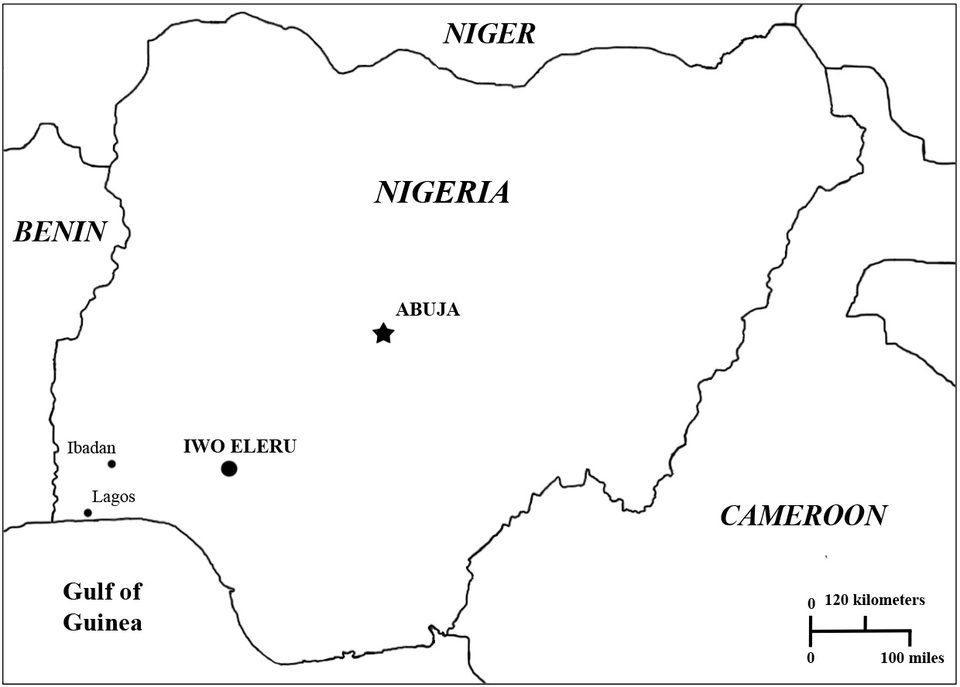
In 2011, Katerina Harvati, Chris Stringer and colleagues reexamined the skull with three-dimensional morphometrics and redated a fragment of long bone by uranium-series dating: between 11.7 thousand and 16.3 thousand years. The shape of the braincase came out closer to archaic African fossils of the Late Pleistocene than to present-day humans — intermediate, according to the authors. It is an individual from the end of the Ice Age with features that, under a simple scheme, should have disappeared much earlier.
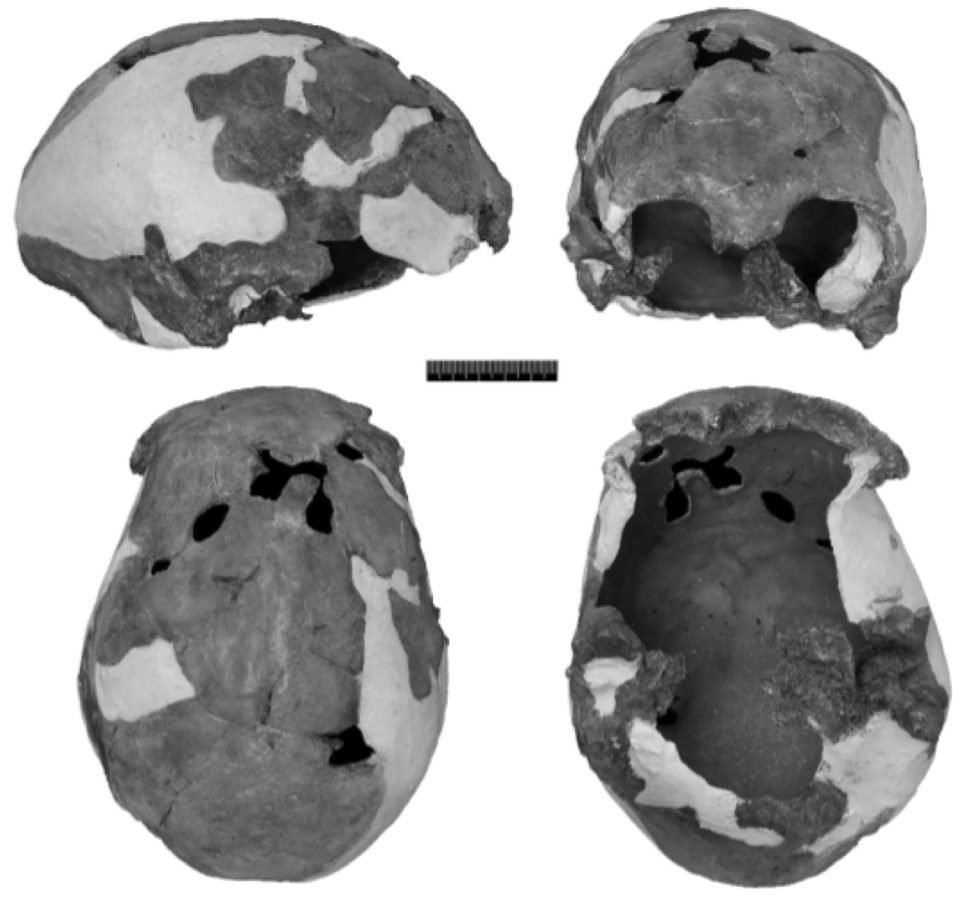
The 2011 authors read the skull as a sign of deep structure in African populations and of an origin of modern humans more complicated than a single point on the map. Note that this reading serves both genetic explanations: a survivor of an archaic lineage, or an extreme of variation within a structured stem. Iwo Eleru does not settle the dispute. It shows that the dispute has a body.
Further back in time, Africa has other signs that several human forms coexisted. The Kabwe skull, found in 1921 in a mine in present-day Zambia, was dated in 2020 to about 299 thousand years — the same period as the Jebel Irhoud fossils, in Morocco, about 315 thousand years old, which are among the oldest attributed to the Homo sapiens lineage. In South Africa, the small-brained Homo naledi lived between 335 thousand and 236 thousand years ago.
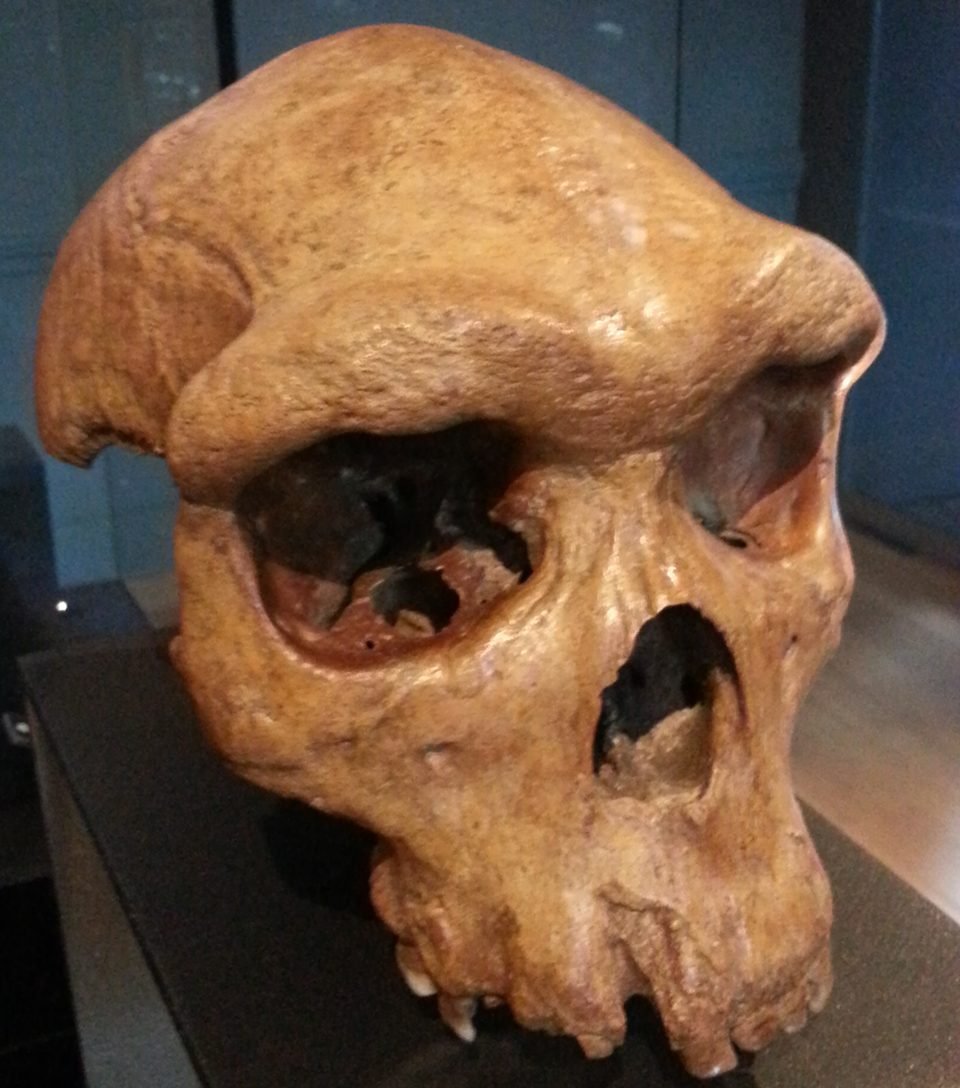
None of these fossils has DNA. That is why the link between "the group the statistics call for" and "the bone that exists" remains a matter of period and shape, not of measured kinship.
06The parallel with Denisova, and where it stops
The comparison with the Denisovans, told in dossier 007, is unavoidable and useful, as long as one sees where it stops. The Denisovans were also discovered through DNA before they had a face. But their DNA came out of a bone: a finger bone, dated, with a sequenced genome. All the Denisovan ancestry later measured in living populations is compared with that reference genome.
The West African ghost has no such anchor. Its existence as a separate group is the model's own conclusion, not a piece of data prior to it. It is the difference between recognizing a relative in a family photo and deducing that someone was missing from the photo because there is an empty chair. The empty chair is real; who would sit in it is inference.
07Discovered yesterday: the ghosts of 2026
The debate has not cooled. On the contrary: the new methods no longer depend on an archaic reference genome, and they have found signs of unknown lineages again — now on a whole-genome scale.
TRACE, in Science
At the end of July 2026, Yulin Zhang, Arjun Biddanda, Priya Moorjani and colleagues, of the University of California, Berkeley, published in Science a method called TRACE. It reconstructs the family tree of each stretch of the genome across many people at once and looks for abnormally old branches, without needing an archaic genome or an unadmixed reference population. Applied to the 1000 Genomes, the method recovered the known Neanderthal and Denisovan inheritance — a test that it works — and found two more.
The one that matters here is a ghost lineage that would have split from ours about 800 thousand years ago and interbred with modern humans in Africa before 50 thousand years ago. The estimated contribution is small, 0.5% to 1% per person, and it appears in similar amounts inside and outside Africa — which places it before the exit from the continent and makes it common to everyone. The second lineage, even older, would have passed DNA to the Denisovans, and only through them did it reach some present-day populations. The authors say the dates coincide with Middle Pleistocene groups, but that the identity of those groups is unknown.
GhostBuster, still a preprint
In April 2026, a team from Oxford, with Hrushikesh Loya as first author and Simon Myers, Leo Speidel and Pier Francesco Palamara among the authors, released as a preprint, not yet peer-reviewed, a method called GhostBuster. Between 300 thousand and one million years ago, it finds two deeply divergent ancestral lineages, with different recombination patterns, that would have mixed to form both Neanderthals and modern humans.

08What is data and what is interpretation
It is the distinction most often lost when the subject becomes a headline — and, on this topic, the headline tends to say that Africans carry DNA from an unknown species, which mixes the two things and also carries a connotation that none of the studies supports.
Data
- There is deep and unusual genetic variation in African populations, including those of West Africa. Several groups, with different data and methods, have reached this conclusion since 2011.
- Simple models with a single ancestral population do not explain this variation. On this, the proponents of archaic admixture and those of the structured stem agree.
- Africa had diverse human forms living side by side 300 thousand years ago — Kabwe, Jebel Irhoud, Homo naledi — and archaic-looking individuals as late as the end of the Ice Age, such as Iwo Eleru.
- There is no African ancient DNA older than a few thousand years that would allow any of these models to be checked directly.
Interpretation
- That the variation comes from a distinct archaic lineage, split before the Neanderthals. This is the 2020 reading; it depends on the background model.
- The exact numbers — 11%, 625 thousand years, 43 thousand years. They are estimates within a model, with wide margins, and they change when the model changes.
- That some known fossil is the ghost. No genetic study has linked Iwo Eleru, Kabwe or any other fossil to this inheritance.
- That the archaic stretches gave an advantage to those who carry them. They are statistical candidates.
09The readings, from the most sober to the most improbable
Human history in Africa had deep structure
This is the point on which the studies converge, by different routes: frequency spectra, linkage disequilibrium, genealogical trees, ancient DNA from Shum Laka, fossil morphology. Before deciding whether there was an "other" group, we already know that "our" group was not a single, homogeneous population. That in itself is a big change from the scheme of an origin in a single place and at a single moment.
There was admixture with a distinct archaic lineage
The reading of Durvasula and Sankararaman, and before them of Hammer and colleagues. In its favor are the repetition of the signal in independent studies, the tests the authors ran against technical explanations — sequencing error, variation in recombination rate, selection — and, now, methods such as TRACE, which also find lineages that split hundreds of thousands of years ago. Against it are the absence of any associated genome or fossil and the 2023 demonstration that models without archaic admixture reproduce the same pattern.
There was no ghost: it was a structured human stem
The reading of Ragsdale and colleagues: ancestral groups only slightly different from one another, connected by migration over hundreds of thousands of years, leave in the genome a pattern that, seen through a simpler model, looks like DNA from another lineage. In its favor, it explains several signals at once, including the variation in date estimates between studies. Against it is the fact that a good fit does not prove exclusivity: a model with structure and a little archaic admixture can fit equally well, and current methods still struggle to tell the two apart.
Iwo Eleru is the ghost
The idea appears in comments and popular-science pieces because the fossil is in the right place and has an archaic shape. But it has no DNA, it is some 13 thousand years old — well after the central estimate for the admixture in the Yoruba model — and the very team that redated it read it as a sign of structure within African populations, not as a member of another lineage. It is a suggestive coincidence, not a link.
The archaic DNA would say something about people today
This is the reading that circulates outside science, usually with the intent of ranking populations. None of the studies cited here says anything of the kind, and the data point the other way: all living humans carry inheritance from ancient lineages — Neanderthal, Denisovan, or the ghosts that TRACE found inside and outside Africa. A fraction of ancestry hundreds of thousands of years old is a record of demographic history, not a characteristic of the person who carries it.
10Chronology
- ≈ 1 million – 360 thousand years agoRange estimated in 2020 for the split of the ghost lineage, depending on the population analyzed. Other models place deep structure in the same range.
- ≈ 335 – 236 thousand years agoHomo naledi lives in South Africa.
- ≈ 315 – 299 thousand years agoDates of the Jebel Irhoud fossils, in Morocco, and of the Kabwe skull, in Zambia: different human forms coexisting on the continent.
- ≈ 135 – 120 thousand years agoFirst split between present-day populations, in the 2023 model.
- ≈ 124 – 6 thousand years agoMargin for the admixture with the ghost lineage in the 2020 Yoruba model; central estimate around 43 thousand years.
- ≈ 16.3 – 11.7 thousand years agoThe Iwo Eleru burial, in what is now southwestern Nigeria.
- ≈ 8 thousand years agoChildren buried at Shum Laka, in Cameroon: the oldest ancient DNA from the region.
- 1921The Kabwe skull is found in a mine in present-day Zambia.
- 1965Thurstan Shaw excavates the Iwo Eleru burial.
- 2010Neanderthal and Denisovan genomes: the first references for measuring archaic inheritance in living people.
- September 2011Hammer and colleagues publish in PNAS evidence of archaic admixture in African populations. Harvati and colleagues redate Iwo Eleru to 11.7 to 16.3 thousand years.
- 2012Lachance and colleagues find divergent blocks in the genomes of African hunter-gatherers.
- April 2019Lorente-Galdos and colleagues model an extinct "basal modern" lineage in sub-Saharan populations.
- January 2020Lipson and colleagues publish the Shum Laka DNA and a model with several deep lineages in Africa.
- February 2020Durvasula and Sankararaman estimate 2% to 19% ghost archaic ancestry in four West African populations.
- May 2023Ragsdale and colleagues propose the weakly structured stem, which explains the signal without archaic admixture.
- March 2025Cousins, Scally and Durbin describe two ancestral populations separated for more than a million years and reunited some 300 thousand years ago, at the origin of all present-day humans.
- April 2026The GhostBuster preprint, from Oxford: two deep lineages in the formation of Neanderthals and modern humans.
- July – August 2026TRACE, in Science: a ghost lineage split some 800 thousand years ago, with a 0.5% to 1% contribution in all present-day humans.
11What remains open
Whether the ghost was a separate group. The main doubt is not who it was, but whether the word "it" applies. A distinct archaic lineage and a subdivided human stem leave similar marks, and today's methods still cannot separate one from the other well.
How much, and when. Estimates range from less than 1% to nearly 20%, and from tens to hundreds of thousands of years, depending on the method and the question. Part of this variation, as the 2023 paper showed, comes from using the wrong model — and no one is sure which is the right one.
Whether there will be a bone. The archaic hypothesis predicts, somewhere, fossils of a quite different group living alongside modern humans; the structured-stem hypothesis predicts varied fossils, but on the same theme. West Africa is one of the regions of the continent with the fewest human fossils, and every new find counts.
Whether there will be DNA. Ancient proteins, which last longer than DNA, have already helped identify Denisovan fossils. A similar route, applied to African bones, may be what finally puts a face — or none — on the ghost.
12Frequently asked questions
What is ghost DNA?
In genetics, “ghost” is the technical term for a population that appears in the model but of which no sample exists — no ancient genome, no identified fossil. In the case of this dossier, it is a pattern in the genomes of living people in West Africa that a 2020 study attributed to a lineage that split from ours hundreds of thousands of years ago. See the 2020 signal.
How do scientists find a relative without a fossil?
Through statistics. Without a reference genome, the method recognizes archaic DNA by what is strange about it: a characteristic excess of variants at certain frequencies, or long stretches that diverge strongly from the rest of the population. The weak point is that everything depends on the background model being right. See the method.
Did the ghost lineage really exist?
It is disputed. In 2023, a model of a weakly structured human stem explained the same pattern without archaic admixture; in 2026, the TRACE method found a ghost lineage with a 0.5% to 1% contribution in all present-day humans, but it measures something else, with another model. Nothing prevents the answer from being both. See the readings.
Is there any fossil of the ghost lineage?
None. The Iwo Eleru skull, in southwestern Nigeria, has an archaic shape and lies near where the Yoruba samples come from, but it has never yielded DNA, and no genetic study has linked it to the signal. See the bones that do exist.
13Sources consulted
This dossier is original writing. The sources below were consulted to verify dates, figures and attributions; none was reproduced.
- Durvasula, A.; Sankararaman, S. — Recovering signals of ghost archaic introgression in African populations. Science Advances, vol. 6, no. 7, eaax5097, February 12, 2020.
- Hammer, M. F.; Woerner, A. E.; Mendez, F. L.; Watkins, J. C.; Wall, J. D. — Genetic evidence for archaic admixture in Africa. PNAS, September 2011.
- Lachance, J. et al. — Evolutionary history and adaptation from high-coverage whole-genome sequences of diverse African hunter-gatherers. Cell, 2012.
- Lorente-Galdos, B. et al. — Whole-genome sequence analysis of a Pan African set of samples reveals archaic gene flow from an extinct basal population of modern humans into sub-Saharan populations. Genome Biology, April 2019.
- Lipson, M. et al. — Ancient West African foragers in the context of African population history. Nature, January 2020.
- Ragsdale, A. P.; Weaver, T. D.; Atkinson, E. G.; Hoal, E. G.; Möller, M.; Henn, B. M.; Gravel, S. — A weakly structured stem for human origins in Africa. Nature, vol. 617, May 17, 2023.
- Cousins, T.; Scally, A.; Durbin, R. — A structured coalescent model reveals deep ancestral structure shared by all modern humans. Nature Genetics, March 18, 2025.
- Zhang, Y.; Biddanda, A.; Johnson, S. A.; O'Dushlaine, C.; Moorjani, P. — Recovering signatures of archaic hominin introgression using ancestral recombination graphs. Science, 2026 (online in July, issue of August 27); press release from the University of California, Berkeley, July 30, 2026.
- Loya, H.; Gupta Hinch, A.; Palamara, P. F.; Speidel, L.; Myers, S. R. — Genome-wide genealogies reveal deep admixtures forming modern humans. Preprint, bioRxiv, April 17, 2026.
- Harvati, K.; Stringer, C.; Grün, R.; Aubert, M.; Allsworth-Jones, P.; Folorunso, C. A. — The Later Stone Age calvaria from Iwo Eleru, Nigeria: morphology and chronology. PLoS ONE, September 15, 2011.
- Consolidated encyclopedia entries on Iwo Eleru, the Kabwe skull, Jebel Irhoud, Homo naledi and ghost populations in genetics.