The Dyatlov Pass incident — nine dead and a closed case
On the night of February 1 to 2, 1959, nine experienced students left their tent in the dark, on the slope of a mountain in the Urals, almost all of them without boots. None came back. The inquiry lasted three months and ended in a single phrase: an elemental force they were unable to overcome. In 2026, that phrase is still not enough for everyone.
- Where
- Kholat Syakhl, northern Urals (USSR)
- When
- night of Feb. 1 to 2, 1959
- Dead
- 9 of the 10 who set out
- Bodies found
- Feb. 27, Mar. 5 and May 4, 1959
- Inquiry closed
- May 28, 1959
- Official version since 2020
- avalanche — disputed by the families
On January 23, 1959, ten students and graduates of the Ural Polytechnic Institute left Sverdlovsk — today Yekaterinburg — for a ski trek through the northern Urals. The goal was Mount Otorten, and the route was rated category III, the most demanding in Soviet sports tourism at the time. The leader was Igor Dyatlov, a 23-year-old radio engineering student. All of them had winter experience; the trip would count toward the title of master of sport.
On January 28, at an abandoned logging settlement on the banks of the Lozva River, one of them turned back. Yuri Yudin, 21, was suffering from joint pain and would not be able to keep up. He said goodbye to his companions and took the road home. He would be the only survivor, and he spent the rest of his life — he died in 2013 — saying that if he could ask God one question, it would be what happened to his friends that night.
01The group and the last tent
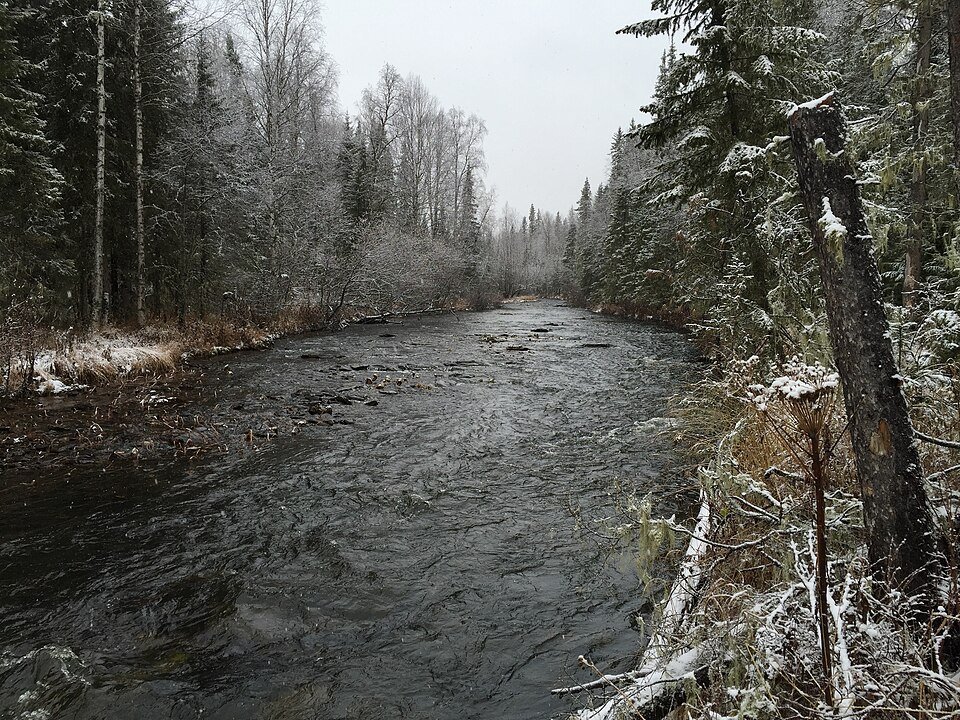
The nine who went on were Igor Dyatlov, Zinaida Kolmogorova, Lyudmila Dubinina, Alexander Kolevatov, Rustem Slobodin, Georgy Krivonischenko, Yuri Doroshenko, Nikolai Thibeaux-Brignolles and Semyon Zolotaryov. Eight were between 20 and 24 years old. Zolotaryov, the oldest, close to 38, a veteran of the Second World War and a tourism instructor, joined the group shortly before departure. The diaries and photographs recovered later show an ordinary trip: cold, hard work, jokes, music. At the camp on February 1 they even wrote a one-page humorous newsletter.
On the afternoon of February 1, after a day of strong wind, the group pitched the tent — a single one, sewn together from two, for all nine — on the eastern slope of Kholat Syakhl, about a kilometer and a half from the nearest woods. To do so, they dug a ledge into the snow on the slope. Dyatlov had arranged to send a telegram from Vizhai, on the way back, by February 12. The telegram did not arrive, and the families began to press the institute.
02The tent cut from the inside
The search began on February 20, with volunteers from the institute, soldiers, Mansi hunters and aircraft. On February 26, two students from the search team found the tent. It was half buried in snow, with the canvas torn. The forensic examination carried out later concluded that the cuts had been made from the inside, with a knife. Inside were the boots, the coats, the food, the documents, the money.
From the tent ran a trail of footprints — of eight or nine people, according to the accounts — some in socks, some barefoot, one with a single felt boot. The tracks went down the slope, in single file, for about half a kilometer, until they disappeared under the snow. Those who read the tracks wrote that the group walked, not ran.
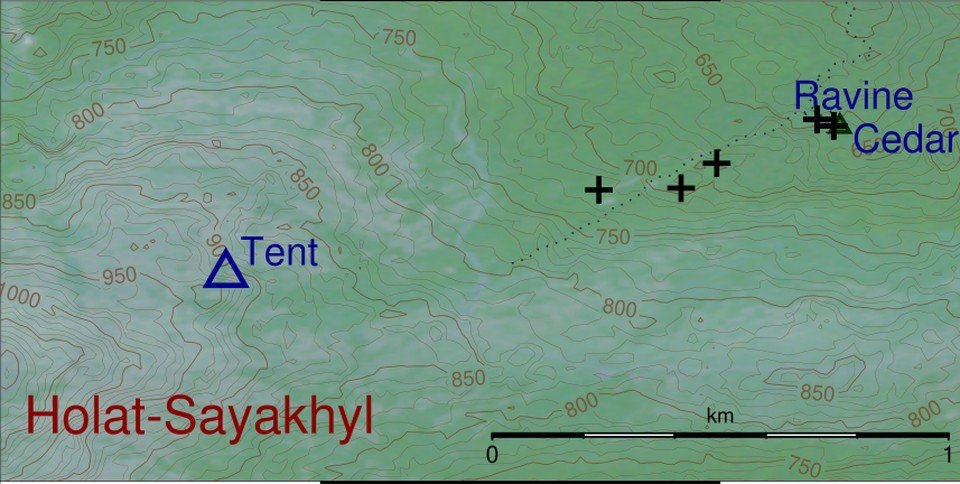
The next day, February 27, the search reached the edge of the woods, about a kilometer and a half from the tent. Under a large Siberian pine were the remains of a fire and the bodies of Krivonischenko and Doroshenko, almost without clothes. Branches had been broken off the pine up to about five meters high. Between the pine and the tent, at different points on the slope, lay Dyatlov and Kolmogorova; on March 5 Slobodin was found, along the same route. The position of the three suggested people trying to get back to the tent. The five died of hypothermia. Slobodin had a fracture in his skull, which the examination did not consider fatal.
03May: the four in the ravine
Four were still missing, and the snow did not allow a proper search until the thaw. On May 4, 1959, some 75 meters from the pine, already inside the woods, the search found a floor of branches laid out at the bottom of a ravine — and, a little further on, under about four meters of snow, by a stream, Dubinina, Zolotaryov, Kolevatov and Thibeaux-Brignolles. They were more clothed than the others, partly in clothing cut from the bodies found by the fire.
This is where the case stops being only a tragedy of cold. Thibeaux-Brignolles had a severe skull fracture. Dubinina and Zolotaryov had several broken ribs — injuries that the medical examiner Boris Vozrozhdenny compared to the force of a car crash, but without corresponding external wounds. Kolevatov died of hypothermia. The bodies that had spent three months in the water of the stream had losses of soft tissue on the face, which the examination itself treated as postmortem changes, consistent with decomposition in running water and with animals — and that is what the later forensic literature also supports.
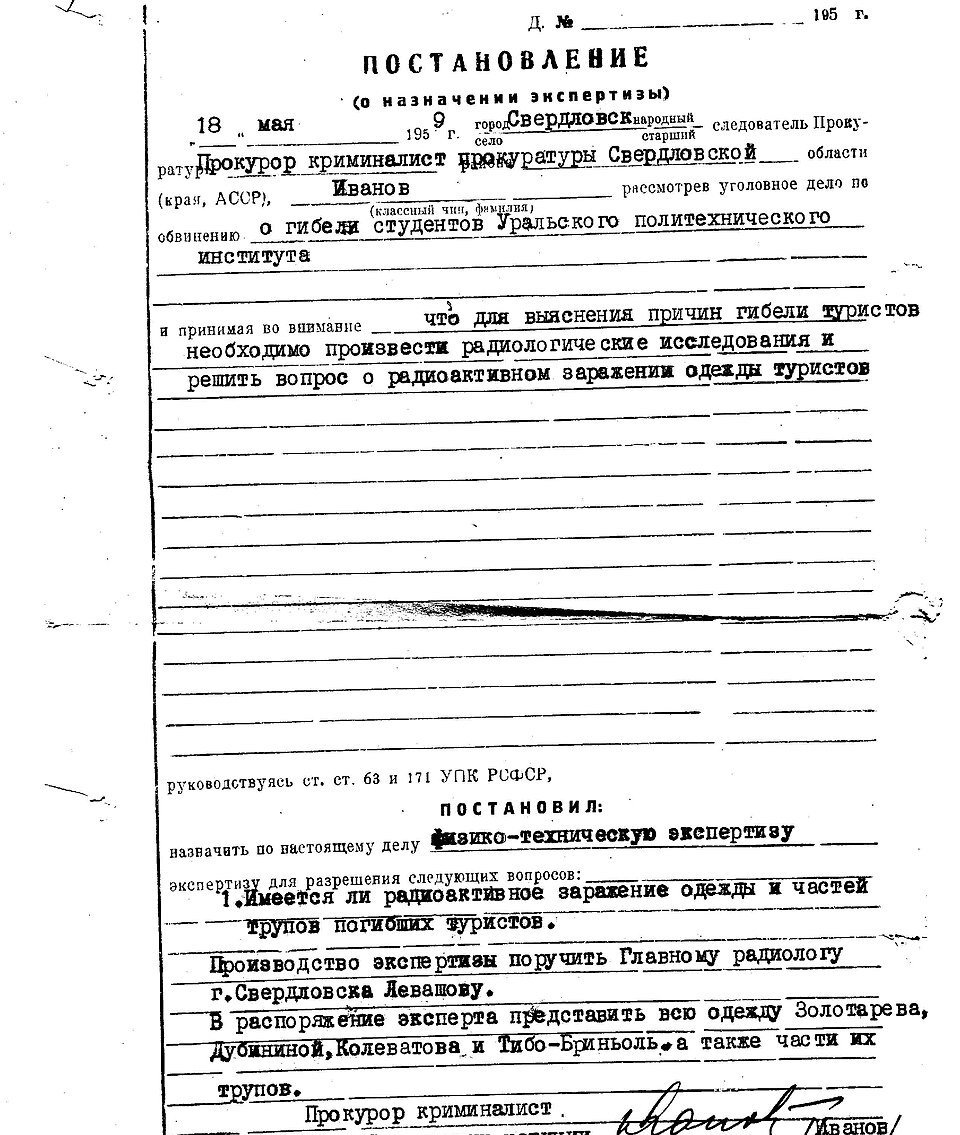
There was also an examination that fueled decades of speculation. On May 18, the prosecutor Lev Ivanov ordered the radioactivity of the four's clothing to be examined. The chief radiologist of Sverdlovsk found above-normal beta emission on some items — on a section of trousers and on the waistband of a sweater, above all — and the contamination dropped after washing. There was no alpha or gamma emission. One reading notes that Krivonischenko had worked at the Mayak nuclear complex, where a serious accident had occurred in 1957, and that clothes were lent within the group; another treats the result as a clue to something the inquiry did not want to pursue.
04The inquiry and the "elemental force"
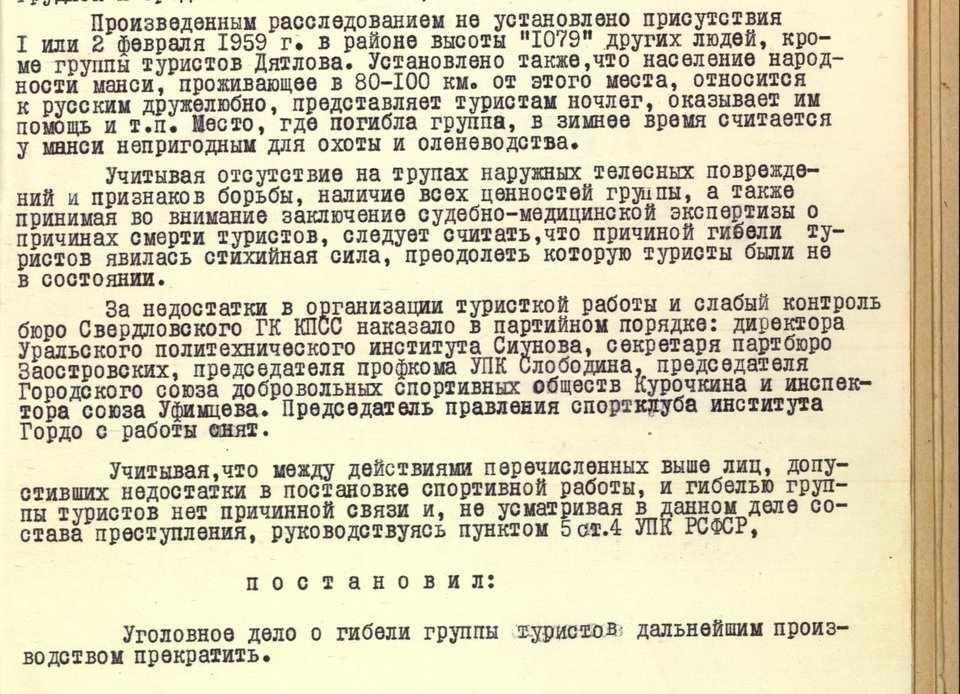
The criminal case was opened by the Ivdel Prosecutor's Office and passed to Ivanov, of the regional Prosecutor's Office. The first suspects were the Mansi, the Indigenous people of the region, and some hunters were even questioned. The hypothesis fell apart: there was no trace of other people, no sign of a struggle, and nothing of value had been taken. The final text records this expressly — and adds that the Mansi lived 80 or 100 kilometers away, received tourists hospitably and did not use that stretch in winter.
On May 28, 1959, Ivanov closed the case. The decisive paragraph says, in free translation, that given the absence of external injuries and signs of struggle, the presence of all the group's belongings and the conclusion of the medical examination, the cause of death was "an elemental force which the tourists were unable to overcome". There was no crime, and the case was closed. Officials of the institute and of local sport were disciplined by the party for organizational failures. The file went to the regional archive, with no public access.
What made the case famous was what came afterward. In 1990, near the end of the Soviet Union, Ivanov himself published an article in a Kazakh newspaper saying that the inquiry had no rational explanation, that he had seen balls of light in the sky mentioned by witnesses and that he had received orders from above not to follow that path. In the 1990s, copies of the case file began circulating among researchers and journalists, and the Dyatlov Foundation, created in Yekaterinburg in 1999 by the group's fellow students, turned the memory of the nine into a campaign for a new inquiry.
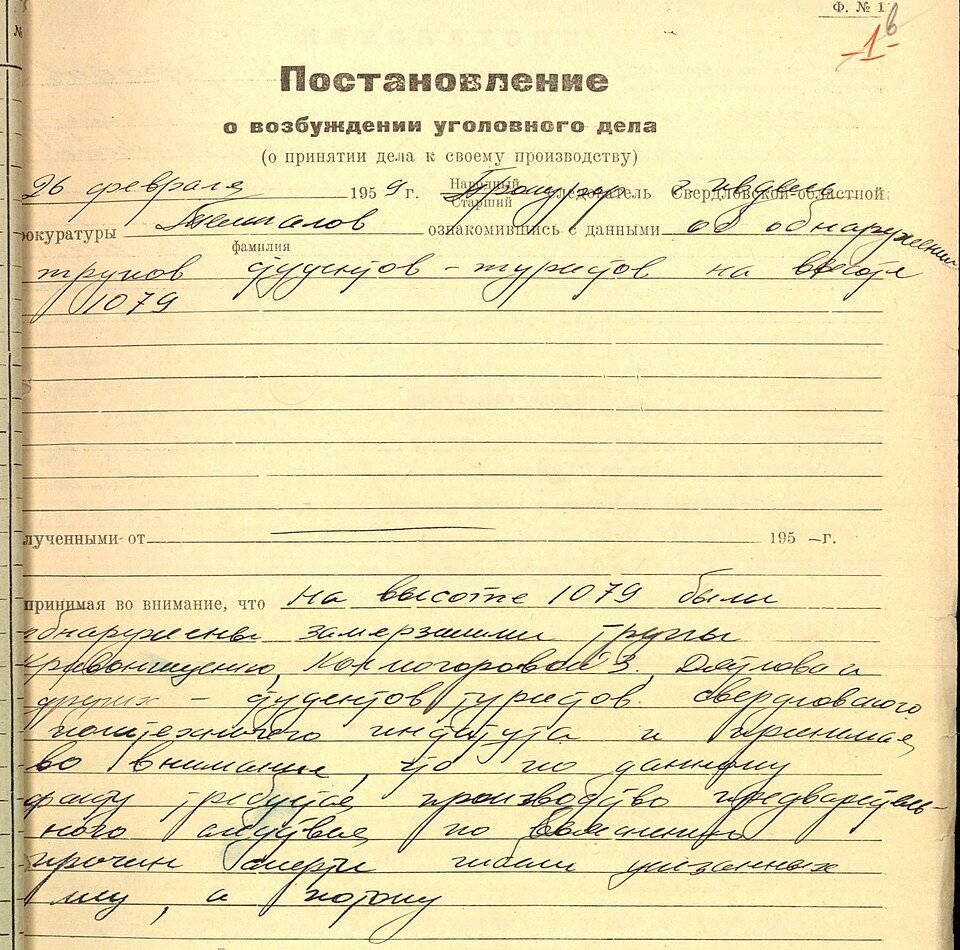
The file has its own oddities, and they weigh on every discussion. The order opening the case bears the date of February 26 — the day the tent was found — but names bodies that, according to the search accounts, were only found on the 27th. For some, it is proof that the case was opened earlier than claimed; for others, a document filled in later with the date the investigation began. And the final order speaks of "absence of external injuries" right after listing skull and rib fractures — which were, in fact, internal injuries.
052019–2020: the Prosecutor's Office returns to the mountain
In February 2019, sixty years later, the Russian Prosecutor's Office announced a new review of the case — not a new criminal case, a point the families dispute to this day. Dozens of versions were listed, and the criminal ones — a Mansi attack, escaped prisoners, the military — were ruled out from the start. Three remained, all natural: an avalanche, a snow slab and a windstorm. There was an expedition to the site, with specialists, and visibility tests.
On July 11, 2020, Andrei Kuryakov, deputy head of the Prosecutor General's directorate for the Ural Federal District, presented the conclusion in Yekaterinburg: a snow-slab avalanche struck the tent; the group left in a hurry, walked to a rock outcrop it thought was safe, lost sight of the tent with visibility of a few meters and went down to the woods, where they froze to death. Kuryakov described their conduct as a heroic struggle, without panic. The Dyatlov Foundation's lawyer responded the same day that the families did not accept the conclusion.
06The slab avalanche, on the computer
The avalanche explanation faced four old objections, repeated since 1959: the slope looks too gentle for an avalanche; the searchers saw no clear signs of a slide; the avalanche would have had to happen hours after the tent was pitched; and the injuries do not resemble those of typical avalanche victims.
On January 28, 2021, Johan Gaume, of EPFL, and Alexander Puzrin, of ETH Zurich, published in Communications Earth & Environment, a journal of the Nature group, a model that answers all four with numbers. The slope above the tent is under 30 degrees, but that is enough for a small slab if the snow is poorly bonded. The cut the group made in the slope to pitch the tent removed support from the upper layer. And a katabatic wind — the cold air that flows down the mountain at night — would have piled snow above the cut until the slab broke loose, in a simulation that places the release between seven and a half and thirteen and a half hours after the cut. A slab a few meters across, which leaves no large traces, strikes the tent where people are lying on top of their skis.
For the injuries, the authors used two unlikely materials. One was a snow simulation method derived from the one Disney studios developed for the 2013 animated film Frozen — the same kind of numerical model that makes movie snow physically plausible. The other was data from crash tests carried out by General Motors in the 1970s. The conclusion is that a block of compacted snow the size of a car could cause severe chest and skull fractures without killing on the spot — which would allow the injured to walk, helped by the others, to the woods.
The authors themselves write that the model shows the avalanche is possible, not that it happened, and that it does not explain everything — neither why the group did not return to the tent afterward, nor the radioactivity. In 2022, in a second note in the same journal, they reported on expeditions made to the site in 2021 and on independent work by Russian snow researchers: the terrain has natural steps, on a scale of meters, that the snow hides, and snow slabs do release in the area. The critics stand by their points: the tent was found still partly standing, with a flashlight on the canvas; the footprints on the slope were still visible three weeks later; an experienced leader would not camp in an avalanche path; and decades of winter expeditions to the place have recorded no avalanches near the exact spot of the tent.
072026: the families ask for a new case
On June 2, 2026, the lawyer Evgeny Chernousov, who represents relatives of the dead — among them Tatyana Perminova, Igor Dyatlov's sister — announced that the families will ask the Prosecutor General's Office to open a new criminal case and a full investigation, the first since 1959. The central argument is documentary: according to the lawyer, the chemical and histological reports that should accompany the autopsies of the nine are not in the file, which suggests they were never done. The relatives also want the federal broadcasters to stop airing programs with theories they consider false about the group's death.
Two weeks earlier, on May 16, the group's memorial foundation held in Yekaterinburg the seventh national conference on the case. As of this review, there had been no public response from the Prosecutor's Office to the request. The picture, then, is this: the Russian state has had an official version since 2020, science has had a model that makes it physically possible since 2021, and the families reject both.
08The readings, from the most sober to the most improbable
A small slab avalanche, made worse by the cold and the dark
It has been the official version since 2020 and the only one with a published, peer-reviewed physical model. It explains the hurried exit through the cut canvas, the descent to the woods without clothes, the fractures without external wounds and the fire. The objections are real — the tent still standing, the preserved footprints, the lack of clear traces — and the proposed slab is small precisely to accommodate them, which also makes it hard to prove sixty years later.
Wind: a katabatic gust or a storm
A violent wind coming down the slope may have made the tent untenable, or made the group fear it would be dragged away with them inside. It fits the weather that night, which meteorological reconstructions describe with strong wind and snow, and it was one of the three versions examined in 2019. It explains poorly the fractures of the four in the ravine, unless combined with a fall into the ravine itself under the snow.
A military test: a missile, a flare bomb, a parachute mine
This is the conviction of the Dyatlov Foundation and of some of the families, who speak of a "technogenic catastrophe." It rests on the balls of light reported in the region in February and March 1959, on the radioactivity of the clothing and on the secrecy that surrounded the case. The problem is the lack of a concrete event. The public lists of R-7 launches diverge: one records a launch on February 17, 1959, the date of one of the reported balls of light, and none records a launch on the night of February 1 to 2 or a test at that location.
Infrasound generated by wind on the mountain
Popularized by the book Dead Mountain, by the American Donnie Eichar, in 2013: wind passing over the terrain of Kholat Syakhl would create vortices capable of generating very low-frequency sound, which causes discomfort and panic. The physics of the vortex is real; that it occurred there and produced this effect on nine people has no direct evidence.
A KGB operation gone wrong
The thesis of the Russian writer Alexei Rakitin: some members of the group — he points to Zolotaryov, Kolevatov and Krivonischenko — were on an operation to hand radioactive clothing over to foreign spies, who killed them. It uses real facts (Krivonischenko's work at Mayak, the radiation on the clothing, Zolotaryov's little-known biography), but ties them all together with an operation for which there is not a single document.
An attack by the Mansi
It was the first suspicion, in 1959, and it was the Soviet inquiry itself that dismissed it: no footprints other than the group's, no sign of a struggle, nothing stolen. Repeating it today without those facts attributes a death to an Indigenous people without evidence — an error this archive does not want to reproduce.
Yeti, UFO, a secret experiment with unknown weapons
They live on documentaries and on a detail taken out of context: the humorous newsletter the group wrote at the last camp joked about the existence of "snowmen." None of these versions explains anything that the previous ones do not explain better, and none has a single piece of data in its favor.
09Chronology
- January 23, 1959Ten skiers from the Ural Polytechnic Institute leave Sverdlovsk for Mount Otorten.
- January 28Yuri Yudin turns back because of joint pain. Nine go on.
- January 31The group reaches the upper Auspiya valley and leaves a food cache.
- February 1The tent is pitched on the eastern slope of Kholat Syakhl. On the night of the 1st to the 2nd, the group abandons it.
- February 12Deadline for the telegram announcing arrival in Vizhai. It does not come.
- February 20The search begins, with students, soldiers, Mansi hunters and aircraft.
- February 26The tent is found, cut from the inside. Date of the order opening the criminal case.
- February 27Krivonischenko and Doroshenko by the pine; Dyatlov and Kolmogorova on the slope.
- March 5Slobodin's body is found on the slope.
- May 4Dubinina, Zolotaryov, Kolevatov and Thibeaux-Brignolles are found under the snow in a ravine.
- May 18Ivanov orders the radioactivity examination of the clothing.
- May 28, 1959The case is closed: "elemental force." The file goes to the archive.
- 1990Lev Ivanov publishes an article saying the inquiry had no rational explanation and that he received orders to ignore the balls of light.
- the 1990sCopies of the case file begin circulating among researchers.
- 1999The Dyatlov Foundation is created, in Yekaterinburg.
- April 27, 2013Yuri Yudin, the only survivor, dies.
- February 2019The Russian Prosecutor's Office opens a review of the case, limited to three natural versions.
- July 11, 2020Andrei Kuryakov announces the conclusion: an avalanche. The families reject it.
- January 28, 2021Gaume and Puzrin publish the slab-avalanche model in Communications Earth & Environment.
- March 2022The same authors report on the 2021 expeditions that documented terrain and snow slabs in the area.
- May 16, 2026Seventh national conference on the case, in Yekaterinburg.
- June 2, 2026Relatives of the dead announce they will ask the Prosecutor General's Office for a new criminal case.
10What remains open
What drove nine experienced people out of the tent. The slab avalanche is the official answer and the best founded, but it is an inference about an event that left no trace anyone documented in 1959. Wind is the most serious natural alternative.
The fractures of the four in the ravine. They may come from the slab, before the descent, or from a fall into the ravine under the snow, afterward. Both explanations are physical; the second does without the avalanche for these injuries, but not for the exit from the tent.
The radioactivity. The result exists in the file; it is modest and limited to a few items. Without the clothing to measure again, its origin — occupational, environmental or other — remains open.
What is missing on paper. The chemical and histological reports the families say are absent, the date of the opening order, the order Ivanov says he received. If the new case is opened, that is where it begins — and it is the first time since 1959 that paper, and not theory, can change the story.
11Frequently asked questions
What happened at Dyatlov Pass?
On the night of February 1 to 2, 1959, nine students and graduates of the Ural Polytechnic Institute abandoned their tent, cut from the inside, and went down the slope in the dark, almost all of them without boots. Six died of hypothermia; three had severe trauma. See the tent cut from the inside.
Was the Dyatlov Pass incident solved?
Officially, yes: in 2020 the Russian Prosecutor's Office concluded it was a snow-slab avalanche, and a model published in 2021 shows that it is physically possible. But the authors themselves say the model does not prove it happened, and the families reject the conclusion — in June 2026 they announced they will ask for a new criminal case. See what remains open.
Why is it called Dyatlov Pass?
After Igor Dyatlov, the leader of the group. The pass that bears his name is a neighboring saddle named after the tragedy; the tent was about a kilometer and a half from it, on the eastern slope of Kholat Syakhl. See the group and the last tent.
Why was there radiation on the clothing?
An examination in May 1959 found above-normal beta emission on some items of clothing, with no alpha or gamma emission. One reading notes that Krivonischenko had worked at the Mayak nuclear complex and that clothes were lent within the group; without the clothing to measure again, the origin remains open. See the four in the ravine.
Did a yeti kill the group?
There is not a single piece of data in favor. The idea comes from a detail taken out of context: the humorous newsletter the group wrote at the last camp joked about the existence of “snowmen.” See the readings.
12Sources consulted
This dossier is original writing. The sources below were consulted to verify dates, measurements and attributions; none was reproduced.
- Criminal case on the death of the group of tourists, Sverdlovsk regional Prosecutor's Office, 1959 — opening order (Feb. 26), order for the radiological examination (May 18) and closing order (May 28), in copies published on Wikimedia Commons.
- Consolidated encyclopedia entries on the Dyatlov Pass incident and on Mount Kholat Syakhl — makeup of the group, chronology of the search, findings.
- Documentary archive and chronology of dyatlovpass.com — transcriptions of the case file, radiological examination, meteorological estimates, accounts of balls of light.
- Kommersant — coverage of the Prosecutor General's conclusion, July 11, 2020, and of the families' reaction.
- Gaume, J.; Puzrin, A. M. — Mechanisms of slab avalanche release and impact in the Dyatlov Pass incident in 1959. Communications Earth & Environment, January 28, 2021; and press releases from EPFL and ETH Zurich.
- Puzrin, A. M.; Gaume, J. — Post-publication careers: follow-up expeditions reveal avalanches at Dyatlov Pass. Communications Earth & Environment, March 2022.
- Disney Research / Stomakhin, A. et al. — A material point method for snow simulation, 2013 (the snow method of Frozen).
- Eichar, D. — Dead Mountain: The Untold True Story of the Dyatlov Pass Incident, 2013 (the infrasound hypothesis).
- Rakitin, A. — Smert, iduschaya po sledu (the controlled-delivery hypothesis), 2010.
- Public lists of R-7 missile launches, 1957–1959 (RussianSpaceWeb, “R-7”; Wikipedia, “List of R-7 launches”) — to check the hypothesis of a launch in February 1959.
- Izvestia, Vedomosti and Fontanka — the families' request for a new criminal case, June 2, 2026.
- Dyatlov group memorial foundation — seventh national conference, Yekaterinburg, May 16, 2026.