The Voynich manuscript
The parchment is authentic. The ink is of the period. The script obeys the statistical laws of a real language, and five different hands copied it with the discipline of professional scribes. No one has ever read a single line.
- Collection
- Beinecke MS 408, Yale
- Support
- Calfskin vellum
- C-14 dating
- 1404 – 1438
- Length
- ≈ 240 pages
- Words
- ≈ 38 thousand
- Status
- Undeciphered
It is a small book. Twenty-three and a half centimeters tall by sixteen wide, five thick — it fits in one hand, though no one has held it that way in a long time. The parchment is thin and has grown soft with age; it took the hides of fourteen or fifteen calves to make it. Whoever leafs through it with gloves on sees the plants first: green and ochre foliage, red roots drawn with the care of a herbal. Then come the circular diagrams, the figures in baths, the isolated roots beside containers. And on every page, the text runs on.
The hand is steady. There are no erasures, no hesitation, none of the irregular handwriting of someone inventing as they write. The words are separated by spaces as in any European book of the fifteenth century. The paragraphs begin and end where they should. Everything on that page says that something is written there.
Except that the alphabet is no known alphabet, and in more than a hundred years of attempts — by military cryptographers, computational linguists, medievalists, obstinate amateurs and at least two men who died convinced they had succeeded — no one has produced a reading that another person can reproduce.
01The book, page by page
Before any theory, it is worth looking. These are seven of the 213 images the Beinecke published of the volume — three from the botanical section, which takes up more than half the book, and one from each of the others.
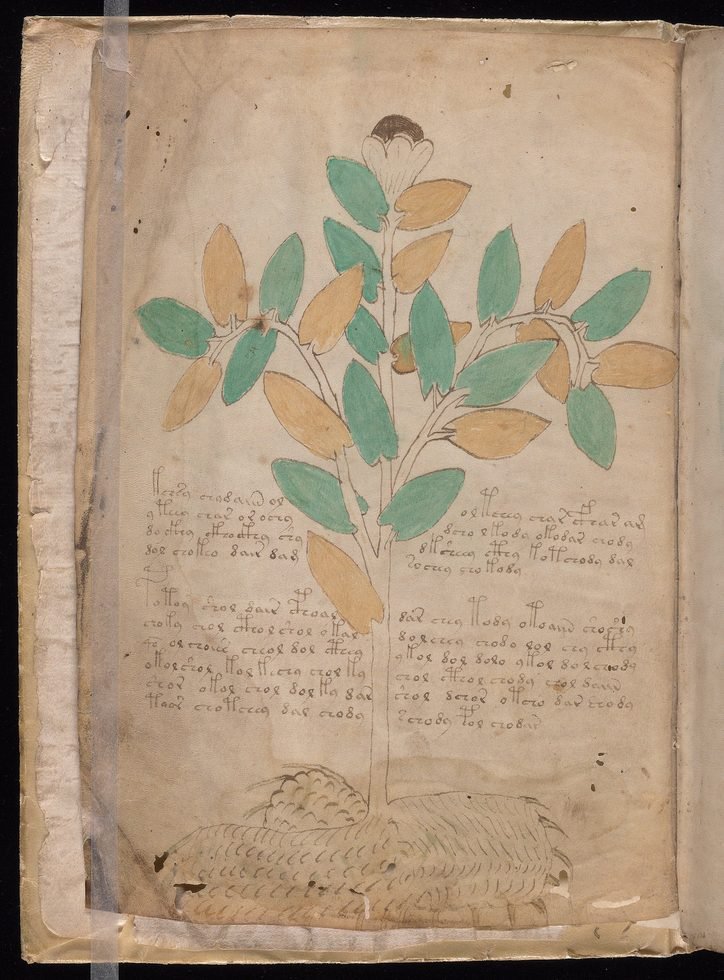
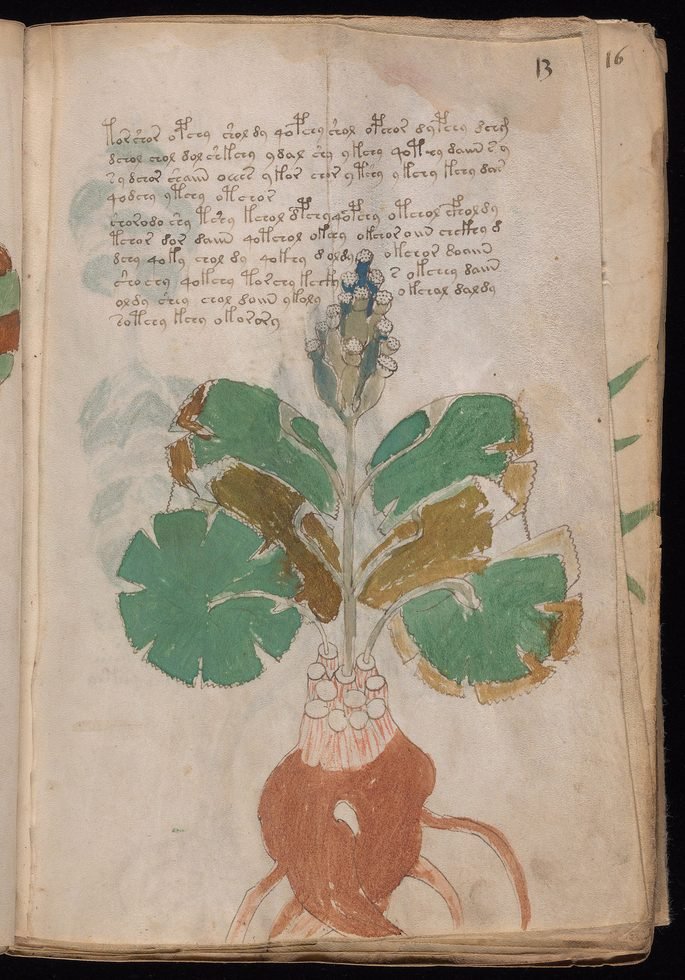
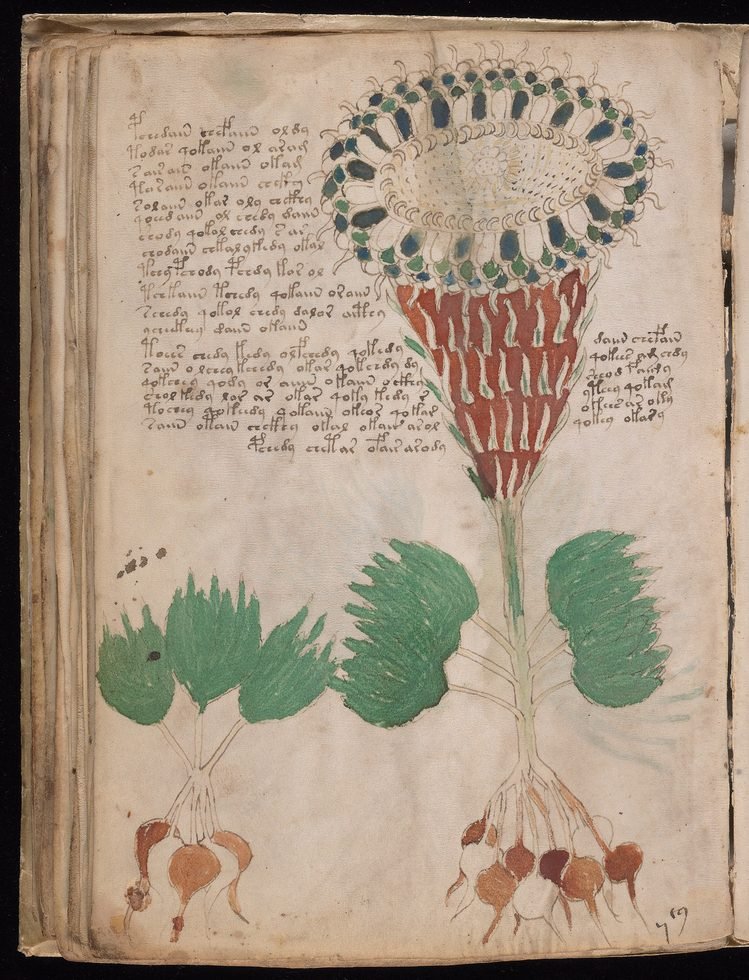
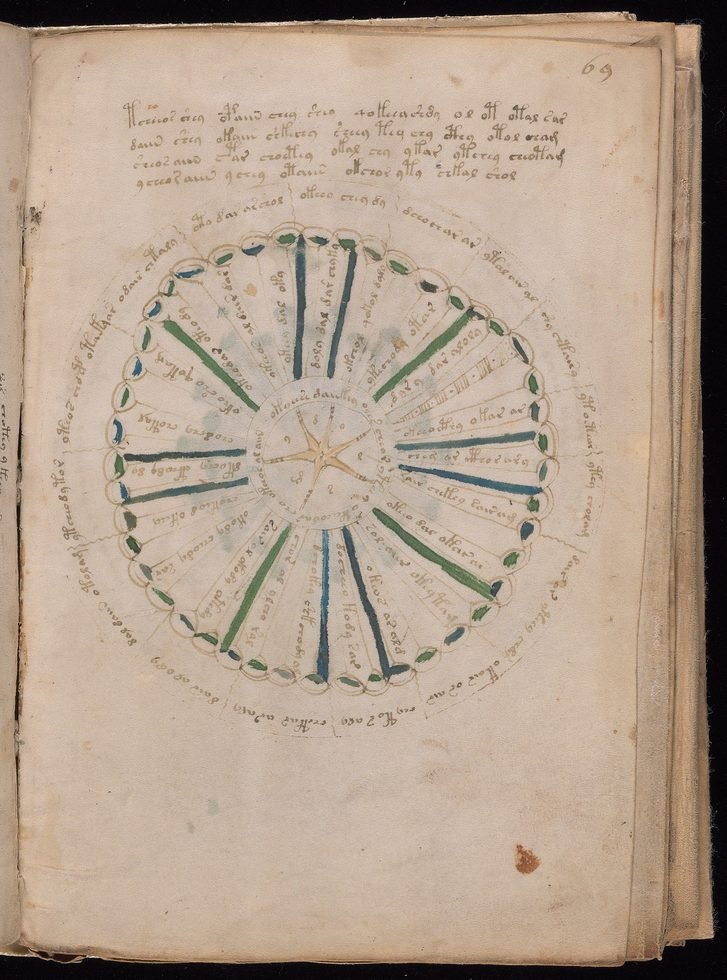
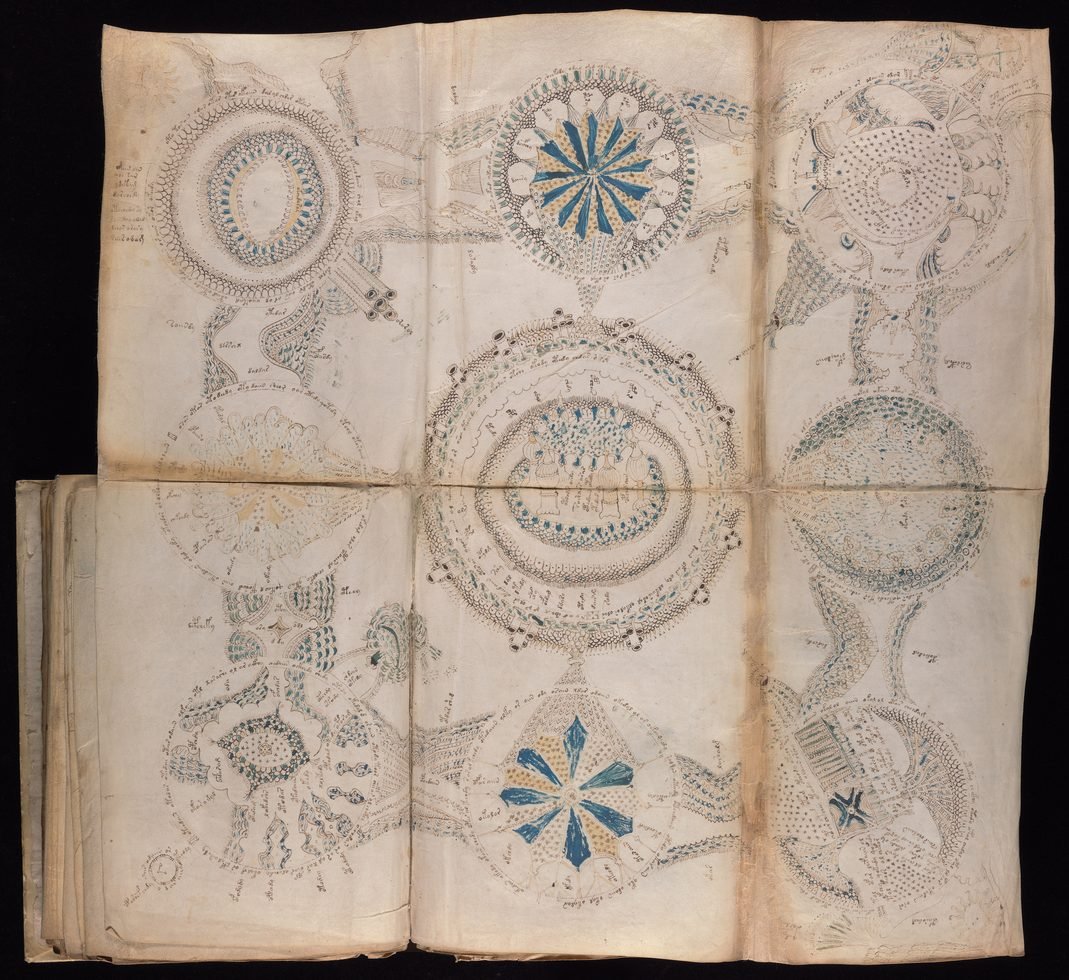
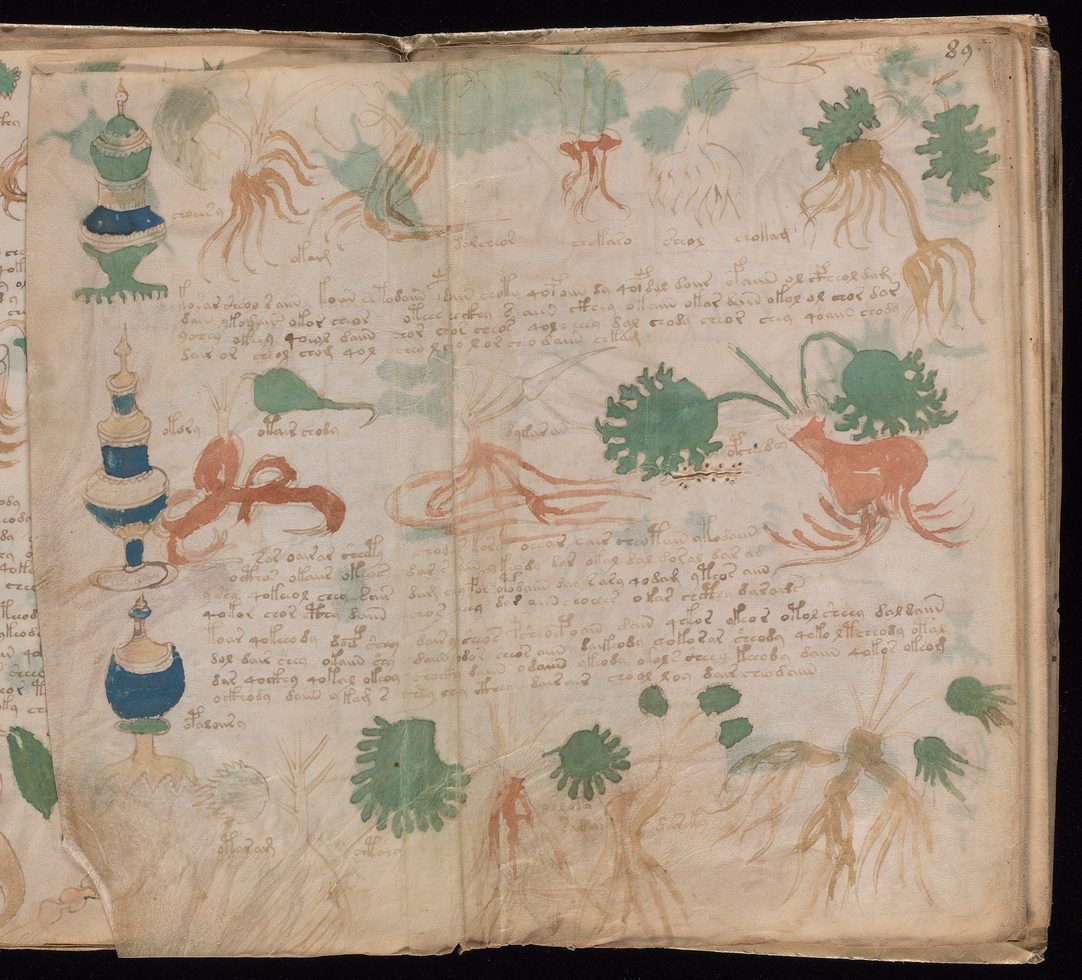
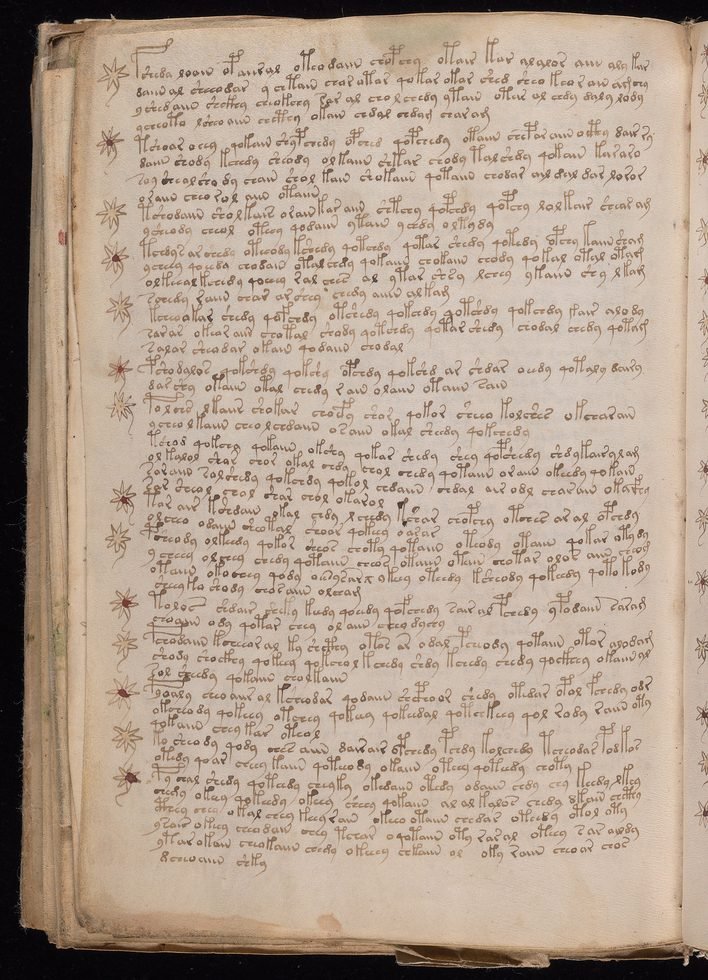
Notice what the sections have in common. The text always occupies the same proportion of the page. The illustrations never invade the column of writing. There is a graphic design at work, and it is consistent from the beginning to the end of a book that took a great deal of time and money to make.
02What the material says
This is the part of the case that is settled, and settling it eliminated the most comfortable hypothesis.
In 2009, the University of Arizona radiocarbon-dated samples of the parchment. The result was consistent across every leaf tested: between 1404 and 1438. The animal that supplied that skin died in the first half of the fifteenth century.
Dating the support, on its own, would prove nothing — blank parchment could be kept for decades, and a forger with access to an old codex would have material to spare. That is why the analysis of the inks matters so much. The examination of the pigments found iron gall ink in the text and outlines, ground azurite in the blue, red ochre with hematite in the browns, copper compounds in the greens. None of this is anachronistic: it is exactly what one would expect of a European manuscript of the period, and nothing in the samples points to modern material.
03The chain of owners
The manuscript resurfaces in the historical record in Prague, at the beginning of the seventeenth century. The first leaf bears a signature that is now almost erased, recovered under ultraviolet light: Jacobus Horcicky de Tepenec, the imperial chemist of Rudolf II. It is the oldest material evidence of ownership.
The story that Rudolf II himself bought the book for six hundred ducats — a fortune — appears in a letter written decades later and is reported as hearsay, not as something witnessed. It has circulated as fact ever since. No document identifies this book in a purchase. There is, in the court accounts, a record of a sale to Rudolf in 1599, for six hundred florins, but with no description of the volume.
The first owner proven by document is Georg Baresch, a Prague alchemist, who in 1639 wrote to the Jesuit Athanasius Kircher, in Rome, asking for help in reading the book he had at home and called a sphinx. Kircher, who was held to be the man capable of reading anything — he had published translations of Egyptian hieroglyphs that would prove entirely fanciful —, did not answer what mattered.
In 1665, Jan Marek Marci, rector of Charles University, sent the manuscript to Kircher along with the letter that is now kept with the book. From there it went to the library of the Collegio Romano, and later to one of the places where the Jesuits hid the collection on the outskirts of Rome. Which one is disputed: tradition says Villa Mondragone, in Frascati; René Zandbergen's research points to Castel Gandolfo and treats Mondragone as a guess by the antiquarian Kraus. In 1912, Wilfrid Voynich bought from the Jesuits part of a collection that, according to Zandbergen, numbered about 280 manuscripts. This one was among them, and came to bear his name.
Then came his widow Ethel, the secretary Anne Nill, the antiquarian Hans Kraus — who bought it for twenty-four thousand five hundred dollars in 1961, asked one hundred and sixty thousand and found no buyer. In 1969, Kraus donated it to Yale, where it is MS 408 and where it remains today.
04The script
Here the case becomes difficult in a specific way: the text behaves simultaneously like a language and like a non-language.
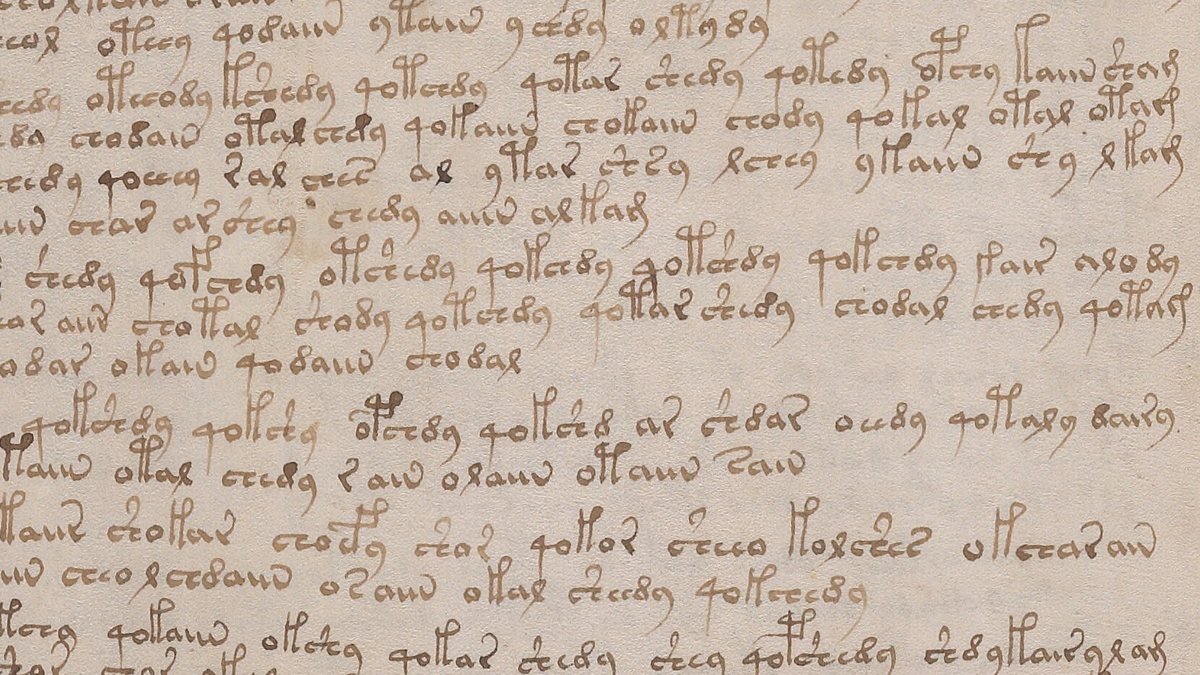
There are about 38 thousand words in all, of which roughly 9 thousand are distinct, written with an inventory of 20 to 25 main characters. The words almost always have between two and ten letters — there are practically no one-letter words and no very long words, which is already an unusual regularity.
What looks like language. The frequency distribution of the words obeys Zipf's law: the most common word appears about twice as often as the second and three times as often as the third, which is the pattern of any natural language and not that of random text. The words have a regular internal structure, with something like a prefix, root and suffix, and certain characters occur only in certain positions. There are two statistical variants distributed across different sections, identified in the 1970s and called ever since Voynich A and Voynich B — as if they were two dialects, or two hands with distinct habits.
What does not. The conditional entropy of the text is too low. In any natural language it sits around 3 to 4; here it sits near 2. This means that, knowing one letter, it is far too easy to predict the next — the text is more predictable than any known language. And words repeat in sequence with a frequency no language tolerates: there are passages where the same word appears two, three times in a row, and passages where nearly identical words follow one another, varying by a single letter.
In 2020, the medievalist Lisa Fagin Davis identified, by analyzing the hands, that the manuscript was copied by five different scribes, working with the same writing system and the same conventions. That changes the nature of the problem. It is not one person's private delusion: it is a trained team, with shared rules.
05The theories, from the most sober to the most improbable
A real language, written in cipher or in its own alphabet
The most economical hypothesis: there is a text there, in some language, and what we see is that language enciphered or transcribed in an invented alphabet. The fit to Zipf's law and the internal structure of the words point in that direction.
The obstacle is the low entropy. Simple substitution ciphers preserve the statistics of the source language, and no source language has been found — Latin, German, Hebrew, Turkic languages and Romance dialects have all been tested. More complex ciphers would explain the anomaly; in 2025, Michael Greshko showed in Cryptologia that a cipher feasible in the fifteenth century, made with cards and dice, reproduces much of the statistics of the text — without deciphering it.
A constructed language
William Friedman — the cryptographer who led the team that broke the Japanese diplomatic machine in the Second World War and who devoted years to the Voynich without result — ended up inclined toward this reading: the text would be written in an artificial language, built according to rules, and not the cipher of an existing language. It would explain the excessive regularity of the words and the low entropy.
The problem is the date. Projects for a universal philosophical language belong to the seventeenth century, two hundred years after the parchment. It is not impossible that someone got there earlier — it is merely without precedent.
A hoax from the period itself
In 2004, Gordon Rugg showed that it is possible to generate text with the properties of the Voynich using a Cardan grille — a perforated sheet slid over a table of syllables, producing plausible words without any meaning. A fifteenth-century swindler could have fabricated the book to sell it to a wealthy collector.
Three things weigh against the thesis. The Cardan grille is first described in 1550, more than a century after the parchment. The distinction between Voynich A and B is a refinement no forger would need to produce. And the cost is disproportionate: fifteen calves, months of work by five scribes and an illustrator, for a scam that any buyer would undo by asking for a reading aloud.
The announced decipherments
In 1921, William Newbold announced that he had read the manuscript: there would be a micrography hidden inside each stroke, and the author would be Roger Bacon, who would have used a microscope and a telescope centuries before they were invented. In 1931, John Manly demonstrated that the so-called micro-letters were crackling in the dried ink. Newbold had read cracks.
The pattern repeated itself. Stephen Bax proposed, in 2014, to identify proper names from the illustrations, and got to ten words before he died, without consensus. Nicholas Gibbs announced in 2017 an idiosyncratically abbreviated Latin: specialists pointed out that the result does not produce meaningful Latin. Gerard Cheshire published in 2019 a supposed proto-Romance; the University of Bristol withdrew its press release and distanced itself from the work, and the medievalist Lisa Fagin Davis summed up the result as yet another aspirational, circular, self-fulfilling piece of nonsense.
The common denominator is methodological. Every announced decipherment works in the hands of whoever proposes it and stops working in the hands of anyone else — which is the practical definition of not deciphering.
Extraterrestrial origin, time travel, lost knowledge
Nothing in the object supports this. The parchment is European calf vellum, the inks are those of a workshop of the period, the format is that of an ordinary codex and the binding is modest. The book is material and local down to the last detail.
It is worth noting what this reading does: it turns an interesting problem — a community of five European scribes writing for months in a system they had mastered and that we have lost — into a riddle without human agents. It is less, not more.
06Chronology
- 1404 – 1438Range of the radiocarbon dating of the parchment, carried out by the University of Arizona in 2009.
- early seventeenth centuryJacobus Horcicky de Tepenec, imperial chemist of Rudolf II, signs the first leaf. It is the oldest proven ownership.
- 1639Georg Baresch writes to Athanasius Kircher asking for help in reading the book. It is the first document describing the manuscript.
- 1665Jan Marek Marci sends the manuscript to Kircher with the letter that now accompanies the volume.
- 1912Wilfrid Voynich buys manuscripts from a Jesuit collection kept near Rome — Villa Mondragone, in Frascati, according to tradition; Castel Gandolfo, according to recent research. The book comes to bear his name.
- 1921William Newbold announces the decipherment and the attribution to Roger Bacon.
- 1931John Manly demonstrates that Newbold's micro-letters are crackling in the ink. The thesis collapses.
- 1944 – 46 and 1962 – 63William Friedman organizes two study groups with military cryptographers and transcribes the text onto punched cards. No result.
- 1969Hans Kraus donates the manuscript to Yale University, where it receives the shelfmark Beinecke MS 408.
- 1970sPrescott Currier identifies the two statistical variants, Voynich A and Voynich B.
- 2004Gordon Rugg publishes the Cardan grille method and proposes the hoax hypothesis.
- 2009Radiocarbon dating and pigment analysis. The modern-forgery hypothesis collapses.
- 2020Lisa Fagin Davis identifies five distinct scribal hands in the manuscript.
- 2024The multispectral analysis carried out in 2014 by the Lazarus Project is re-examined and reveals columns of letters hidden in the margin of the first leaf.
- November 2025Michael Greshko publishes in Cryptologia the Naibbe cipher, made with cards and dice, which reproduces much of the statistics of the text without deciphering it.
07What remains open
The 2024 find deciphers nothing, and for that very reason it is the best summary of the case.
In 2014, the Lazarus Project, of the University of Rochester, photographed ten pages of the manuscript in bands of the spectrum invisible to the naked eye. The images were filed away. In 2024, Lisa Fagin Davis re-examined them and found, in the right margin of the first leaf, three columns of letters erased centuries ago: two in the Latin alphabet and one in the manuscript's own characters. From the handwriting, she attributed the notes to Jan Marek Marci — the rector who had the book in his hands between 1662 and 1665 and sent it to Rome.
Marci was building a table of correspondences. Attempting, in other words, exactly what everyone attempted after him, with exactly the same result. He erased the columns and sent the book away.
Three questions remain, and none depends on better technology. Whether there is content — the statistics do not decide between language and mechanical generation of words, because a sufficiently regular system produces both signatures. What language it would be — and that may be unsolvable in principle, if it is a language with no other written record. Who the book was made for — five scribes and an illustrator working for months imply a commission, money and a recipient, and nothing is known about any of the three.
There is a possibility that is rarely said out loud and that this dossier has no way to rule out: that the manuscript is perfectly legible to whoever had the key, and the key simply no longer exists. Not every secret is kept. Some are only forgotten.
08Frequently asked questions
What is the Voynich manuscript?
An illustrated book of about 240 pages, on calfskin vellum, written in an alphabet that matches no known one: about 38 thousand words, alongside plants, circular diagrams and figures in baths. It is at Yale University's Beinecke Library, under the shelfmark MS 408.
Has the Voynich manuscript been decoded?
No. There have been announced decipherments — Newbold in 1921, Bax in 2014, Gibbs in 2017, Cheshire in 2019 —, and all of them worked in the hands of whoever proposed them and stopped working in anyone else's. See the theories.
Is the Voynich manuscript real or fake?
The object is authentic: the parchment was radiocarbon-dated to between 1404 and 1438, and the inks are those of a European manuscript of the period. That knocks down the modern-forgery hypothesis, but not that of a hoax from the period itself, which is still debated. See what the material says.
Who wrote the Voynich manuscript?
No one knows. The analysis of the hands carried out by Lisa Fagin Davis in 2020 identified five different scribes, working with the same writing system. Who the book was made for also remains open.
Where was the Voynich manuscript found?
It appears in Prague at the beginning of the seventeenth century and was sent to Kircher, in Rome, in 1665. In 1912, the rare-book dealer Wilfrid Voynich bought it from a Jesuit collection kept near Rome — at Villa Mondragone, according to tradition, or at Castel Gandolfo, according to René Zandbergen's research. Since 1969 it has been at Yale. See the chain of owners.
09Sources consulted
This dossier is original writing. The sources below were consulted to verify dates, measurements and attributions; none was reproduced.
- Beinecke Rare Book & Manuscript Library, Yale University — Beinecke MS 408, Cipher manuscript (Voynich manuscript): catalog record and full digitization.
- Clemens, R. (ed.) — The Voynich Manuscript. New Haven and London: Yale University Press, 2016, with the essays by R. Zandbergen on the early owners, by A. Hunt on Voynich as a buyer, by P. Zyats et al. on the physical analysis and by W. Sherman on the attempts at decipherment.
- Zandbergen, R. — The Voynich MS: history, voynich.nu, consulted in October 2026 (chain of owners).
- Hodgins, G. — Dating Results for Voynich Manuscript Parchment Leaves 8, 26, 47 and 68. Report to Yale University Library, February 17, 2009; and University of Arizona — UA Experts Determine Age of Book ‘Nobody Can Read’, UA News, February 10, 2011.
- Barabe, J. G. (McCrone Associates) — Materials Analysis of the Voynich Manuscript. Report to the Beinecke Rare Book & Manuscript Library, April 1, 2009.
- Bowern, C. L.; Lindemann, L. — The Linguistics of the Voynich Manuscript. Annual Review of Linguistics 7, 2021. DOI 10.1146/annurev-linguistics-011619-030613
- Amancio, D. R. et al. — Probing the Statistical Properties of Unknown Texts: Application to the Voynich Manuscript. PLoS ONE 8(7), 2013. DOI 10.1371/journal.pone.0067310
- Montemurro, M. A.; Zanette, D. H. — Keywords and Co-Occurrence Patterns in the Voynich Manuscript: An Information-Theoretic Analysis. PLoS ONE 8(6), 2013. DOI 10.1371/journal.pone.0066344
- D’Imperio, M. E. (ed.) — New Research on the Voynich Manuscript: Proceedings of a Seminar, November 30, 1976, with P. Currier's papers on the A and B “languages”.
- Davis, L. F. — How Many Glyphs and How Many Scribes? Digital Paleography and the Voynich Manuscript. Manuscript Studies 5(1), 2020.
- Davis, L. F. — Multispectral Imaging and the Voynich Manuscript. Manuscript Road Trip, September 8, 2024.
- Shaw, G. — Voynich Manuscript scans reveal early decoding attempt. The Art Newspaper, September 25, 2024.
- Rugg, G. — An Elegant Hoax? A Possible Solution to the Voynich Manuscript. Cryptologia 28(1), January 2004 (released in December 2003). DOI 10.1080/0161-110491892755
- Greshko, M. A. — The Naibbe cipher: a substitution cipher that encrypts Latin and Italian as Voynich Manuscript-like ciphertext. Cryptologia, published online November 26, 2025. DOI 10.1080/01611194.2025.2566408
- Newbold, W. R. — The Cipher of Roger Bacon, ed. R. G. Kent. Philadelphia: University of Pennsylvania Press, 1928 (the thesis was presented in 1921); and the rebuttal by Manly, J. M. — Roger Bacon and the Voynich MS. Speculum 6(3), 1931.
- Bax, S. — A proposed partial decoding of the Voynich script, self-published, January 2014.
- Gibbs, N. — article in the Times Literary Supplement, September 2017, and the criticism by L. F. Davis published the same week.
- Cheshire, G. — The Language and Writing System of MS408 (Voynich) Explained. Romance Studies 37(1), 2019. DOI 10.1080/02639904.2019.1599566; and University of Bristol — Statement re: Voynich research paper, May 16, 2019.
- Wikipedia, article “Voynich manuscript”, in English, consulted in October 2026 (physical description and statistics of the text), alongside the sources above.