The Herculaneum papyri
The largest library of classical antiquity to have reached us also arrived in the form of charcoal. For two centuries, every attempt to read it destroyed it a little. The reading, when it finally began, did not touch a single scroll.
- Where
- Villa dei Papiri, Herculaneum
- Coordinates
- 40°48′23″N 14°20′51″E
- Buried
- AD 79
- Depth
- ≈ 20–30 m
- Scrolls inventoried
- 1,814
- Read without opening
- since 2023
In AD 79, Vesuvius did not bury Herculaneum in ash, as it did Pompeii. It buried it in a pyroclastic flow — an avalanche of gas and incandescent material at hundreds of degrees, which came down the slope faster than anyone could run. It hardened over the city in a layer twenty to thirty meters thick. It was worse for whoever was alive. It was better for whatever was organic matter.
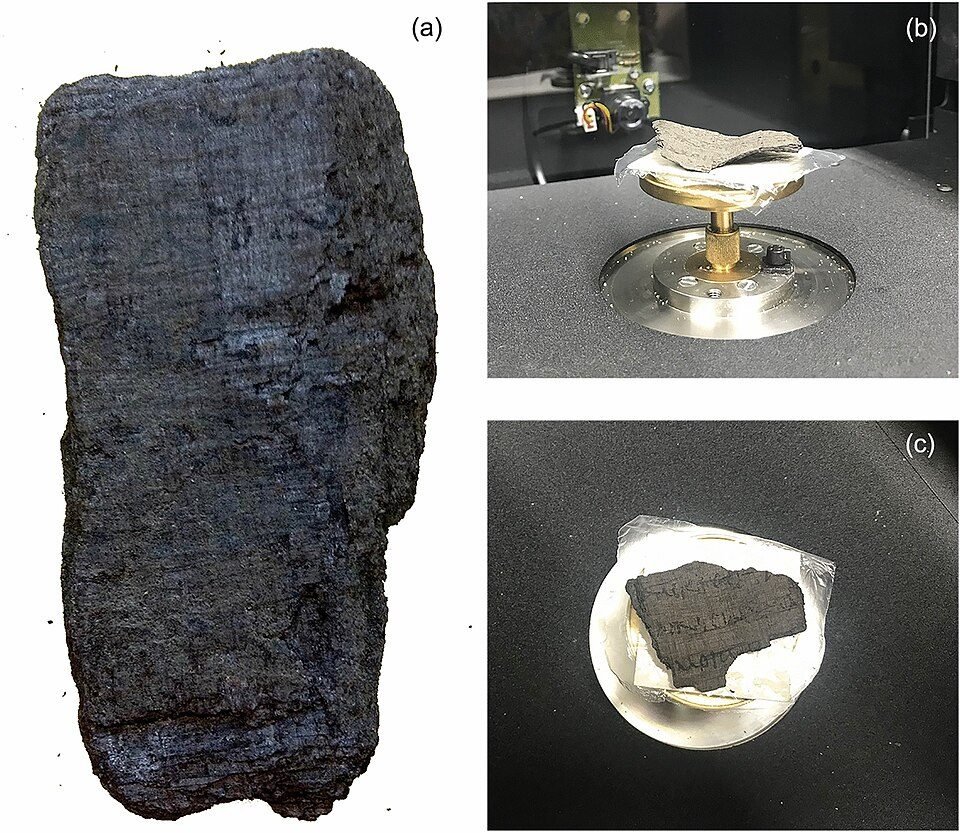
In a seaside villa there was a library. What has been recovered from it is 1,814 cataloged scrolls and fragments — many of them pieces of the same book, so the number of original works is much smaller. The heat carbonized them without burning them: there was not enough oxygen for combustion. The papyrus turned to charcoal and kept its shape. The letters were still there, written in ink that is also carbon, on top of a material that was now carbon too.
It is the only library of the ancient world that survived in quantity. And it is unreadable, because opening a scroll of charcoal is the same as breaking it.
01The library
In 1750, peasants digging a well stumbled on the villa; in the following years, workmen in the service of the Bourbon court opened tunnels through the hardened rock. They did not know what they had found: the first scrolls, removed in 1752, were thrown away as pieces of burnt wood before anyone noticed the letters.
The pace of the finds is on record. Twenty-one volumes and fragments in the autumn of 1752; eleven in the spring of 1753; two hundred and fifty in the summer of the same year; and, between the spring and summer of 1754, in the library room proper, 337 Greek papyri and 18 Latin ones. The official inventory today stands at 1,814 scrolls and fragments.
The content identified so far is philosophical and has an owner. At least 44 works are by Philodemus of Gadara, an Epicurean poet and philosopher of the first century BC. There are also texts by Epicurus and by Chrysippus. The most economical reading is that this was Philodemus's working library, and that he would have lived and written at the villa.
02Two centuries destroying what they wanted to read
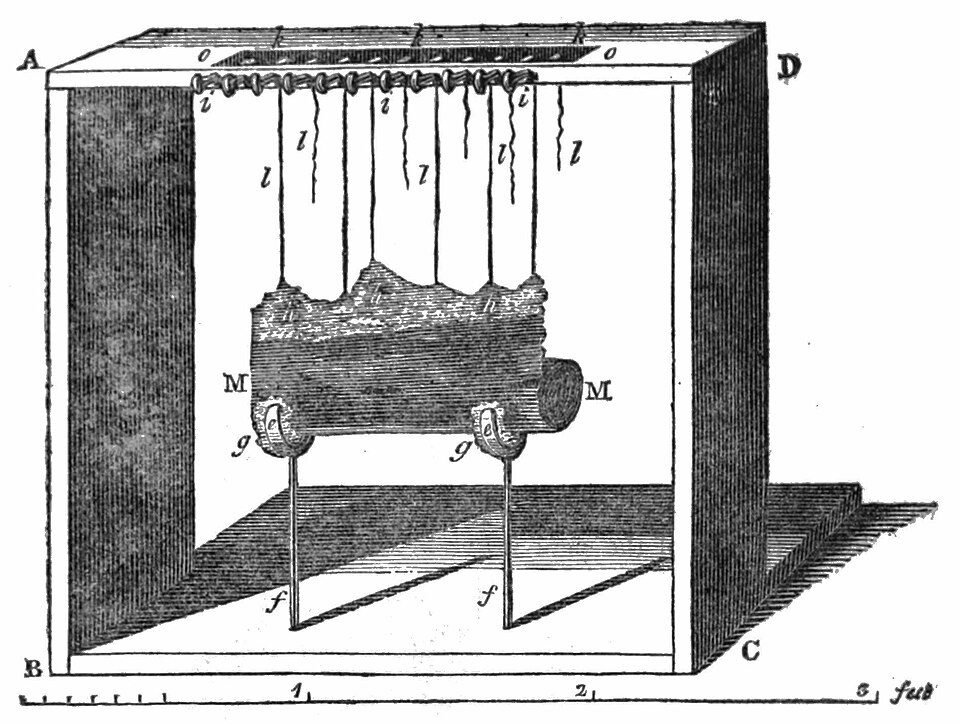
In 1756, the priest Antonio Piaggio invented a machine to unroll the papyri: a frame with silk threads glued to the surface of the scroll and weights that pulled, millimeter by millimeter. The first scroll took four years.
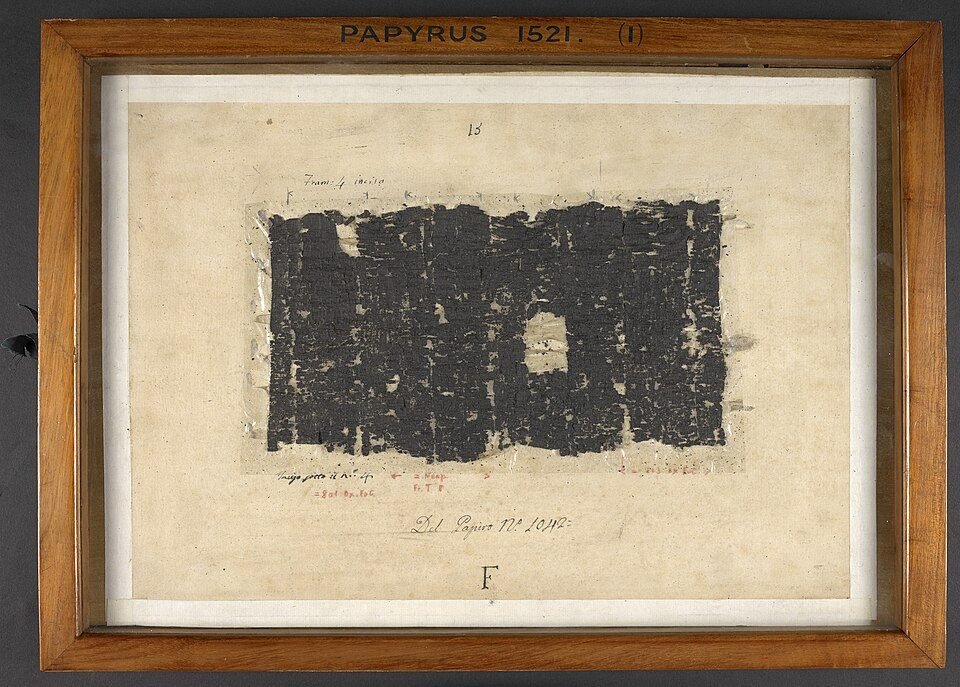
Between 1802 and 1806, the Reverend John Hayter unrolled and partially deciphered some two hundred papyri. Other methods were tried over the course of the nineteenth century, some of them chemical, nearly all of them disastrous. By the middle of the twentieth century, only 585 scrolls or fragments had been completely unrolled — and "completely unrolled" usually means "reduced to flakes that have to be pieced back together".
03The problem is the ink
The idea of using tomography instead of a knife is old and seems obvious: a scanner reads density, so it would be enough to scan the scroll and separate the layers with software. It failed for decades, and the reason is chemical.
Tomography distinguishes materials by density. In a medieval manuscript, the ink contains iron and shows up bright against the parchment. In the Herculaneum papyri, the ink is soot — carbon — applied to papyrus that the eruption turned into carbon. To the machine, the letter and the page have practically the same density. Scanning produced a uniform gray block.
What unlocked the problem was not a better scanner, but a change in what was being looked for. Instead of seeking density contrast, researchers began to seek texture: the surface where there was ink has a microscopic relief slightly different from bare papyrus. It is too subtle for the human eye to recognize in a scan, and it is exactly the kind of pattern a machine learning model learns to detect after seeing enough examples.
04Virtual unwrapping
The technique has a name — virtual unwrapping — and a principal author: Brent Seales, of the University of Kentucky. The procedure has three stages. First, an ultra-high-resolution scan by micro-CT with synchrotron X-rays, carried out at facilities such as Diamond Light Source, in the United Kingdom, and the ESRF, in France. Then, segmentation: identifying, in the three-dimensional volume, where each rolled layer lies — the work of following a sheet that folds over itself hundreds of times. Finally, flattening that surface onto a plane and detecting the ink.
The proof of concept came from another object. In 2015 and 2016, Seales applied the method to the En-Gedi scroll, a carbonized Hebrew parchment, and recovered the text — which turned out to be the beginning of Leviticus. In 2018 his team presented the digital reconstruction of P.Herc. 118, from the Bodleian Library — a scroll forced open in the nineteenth century —, combining 3D models and hyperspectral imaging of the fragments.
05The prize
In March 2023, Seales joined forces with Nat Friedman and Daniel Gross and launched the Vesuvius Challenge: the scans were released openly and a set of cash prizes was offered to anyone who could read what was there. It is open science with a competitive incentive, and it worked quickly.
In October 2023 it was announced that Luke Farritor, a 21-year-old computer science student, had detected the first word: πορφύρας — porphyras, purple. He took home forty thousand dollars.
On February 5, 2024, the grand prize of seven hundred thousand dollars was awarded to a team that recovered about 5% of a scroll — more than two thousand characters. The text, from the scroll PHerc. Paris. 4, of the Institut de France, is an unknown treatise on pleasure — probably by Philodemus, although the authorship is not established — that discusses whether what is scarce gives more pleasure than what is abundant, with music and food among the examples.
06From stray words to whole works
The leap began in 2025 and was completed in 2026, and it is what changes the nature of the case. It is no longer about recovering a word or a paragraph.
In May 2025, PHerc. 172, held at the Bodleian Library, had its title and author recovered without being opened: On Vices, by Philodemus — a treatise on greed, arrogance and other traits of character. It was the first time this had happened with a closed scroll, and it earned Marcel Roth and Micha Nowak a prize of sixty thousand dollars. In June 2026, more than seventy columns of text came out of the same scroll.
From PHerc. 1667, in Naples, came about one meter forty of text in 22 columns, according to the team's scientific paper (the press releases rounded it to a meter and a half and twenty columns). The copy is dated to the second century BC, perhaps to the end of the third — among the oldest in the collection —, and the content is a treatise on ethics. Author and title remain unknown, because the top of the scroll, where the title would be, has been lost; but the text cites Aristocreon, nephew of the Stoic Chrysippus, which opens the hypothesis that it is a lost Stoic work.
And from PHerc. 139 came On the Gods, book 8, by Philodemus — which shows, on its own, that the work had at least eight books, something no one knew.
The library was not excavated again, nor opened, nor restored. It was simply read — with X-rays, mathematics and a model trained to see what the eye does not see.
07The readings, from the most sober to the most improbable
The rest of the library is more Epicurean philosophy
The most likely prediction, and the least glamorous. Of the works already identified, at least 44 are by Philodemus, and the collection has the look of the working library of one specific philosopher, built around his interests. Epicurus and Chrysippus complete the picture.
This is no disappointment. Much of Hellenistic philosophy has reached us only through quotation by third parties; having primary texts, in contemporary copies, is a considerable gain even without any surprise.
There is a second, Latin library still buried
The villa was never fully excavated — much of it still lies under dozens of meters of rock and under the modern town of Ercolano. A Roman residence of that size would normally have held a collection in Greek and in Latin, and the 18 Latin papyri already recovered suggest that the section exists.
What prevents confirmation is not scientific, it is practical: excavating would require large-scale works beneath an inhabited town, at high cost and risk. The hypothesis is reasonable and remains untested.
Lost works of classical literature will turn up
The recurring hope: plays by Sophocles, lost books of Livy, poetry by Sappho. It is not impossible — any private library held literature besides philosophy, and PHerc. 1667 shows that unexpected material does appear.
But the distribution of what has already been read points firmly to philosophy. The expectation of a literary treasure says more about what we would like to have than about what that owner collected.
There are texts that would rewrite the history of religions
The idea circulates that the library would hold lost gospels or documents capable of shaking Christianity. The chronology settles this without argument: Philodemus died around 40 to 35 BC, and the collection reflects his interests. The villa was buried in AD 79, when Christianity was a marginal movement in the Levant, with no presence in the library of an Epicurean on the Bay of Naples.
Epicureanism, moreover, is a philosophy that treats the gods as indifferent to human affairs. It is hard to imagine a collection less inclined to keep the scripture of any religion.
08Chronology
- AD 79Vesuvius buries Herculaneum under twenty to thirty meters of pyroclastic flow. The papyri carbonize without burning.
- 1750Peasants digging a well stumble on the villa. Excavation by tunnels, in the service of the Bourbon court, begins soon after.
- 1752 – 1754The first papyri are removed — and some thrown away as burnt wood. In 1754 the library room yields 337 Greek papyri and 18 Latin ones.
- 1756The priest Antonio Piaggio builds the unrolling machine. The first scroll takes four years.
- 1802 – 1806John Hayter unrolls and partially deciphers some two hundred papyri.
- mid-twentieth centuryOnly 585 scrolls or fragments have been completely unrolled, with severe loss of material.
- 2015 – 2016Brent Seales applies virtual unwrapping to the En-Gedi scroll and recovers the text without opening it. Proof of concept.
- 2018Digital reconstruction of P.Herc. 118, from the Bodleian Library, a scroll opened in the nineteenth century.
- March 2023Launch of the Vesuvius Challenge, with open scans and cash prizes.
- October 2023The first word read in a closed scroll is announced, detected by Luke Farritor, 21: porphyras, purple.
- February 5, 2024The grand prize is awarded: about 5% of a scroll, more than two thousand characters, an unknown text, probably by Philodemus.
- May 2025Title and author of PHerc. 172 identified without opening — On Vices, by Philodemus. A US$60 thousand prize to Marcel Roth and Micha Nowak.
- June 2026More than 70 columns from PHerc. 172, about 1.4 m of text from PHerc. 1667 and book 8 of On the Gods in PHerc. 139.
09What remains open
Almost the entire library. Few scrolls have been read in full. The method exists, it works, and it is still expensive and slow: each scan requires synchrotron time, and segmenting each scroll is heavy work. The bottleneck is no longer scientific; it has become one of scale.
The unexcavated part of the villa. If there is a Latin section, and if there are more rooms with shelves, the collection may be several times larger than what we have. This is the only question in the dossier that requires, once again, digging.
And what was in the room next door. It is worth remembering that the 1,814 scrolls are what is left of a single villa, of a single owner, in a single small town. It was not a notable library in its time. It was an ordinary private collection — and it is the most complete one antiquity has left us.
10Frequently asked questions
What are the Herculaneum scrolls?
They are the scrolls from the library of a seaside villa in Herculaneum, carbonized by the eruption of Vesuvius in AD 79. The official inventory lists 1,814 scrolls and fragments, and the content identified is mostly Epicurean philosophy. See the library.
Why can't the Herculaneum scrolls be opened?
Because opening a scroll of charcoal is the same as breaking it. For two centuries, every attempt at unrolling consumed part of what people wanted to read. See two centuries destroying what they wanted to read.
How are the Herculaneum scrolls being read?
Through virtual unwrapping: a micro-CT scan with synchrotron X-rays, segmentation of each layer in the 3D volume, and a machine learning model that detects the texture of the ink, since ink and papyrus are both carbon. See virtual unwrapping.
What do the Herculaneum scrolls say?
What has been read so far is philosophy: at least 44 works by Philodemus of Gadara, as well as texts by Epicurus and by Chrysippus. The scrolls read without opening have yielded On Vices and On the Gods, book 8, by Philodemus, a treatise on pleasure and a treatise on ethics by an unknown author. See from stray words to whole works.
Have the Herculaneum scrolls been deciphered?
Only a small part. The method works, but it is still expensive and slow, and few scrolls have been read in full; the bottleneck is no longer scientific, it has become one of scale. See what remains open.
11Sources consulted
This dossier is original writing. The sources below were consulted to verify dates, figures and attributions; none was reproduced.
- Sider, D. — The Library of the Villa dei Papiri at Herculaneum. Los Angeles: J. Paul Getty Museum, 2005.
- Gigante, M. (ed.) — Catalogo dei Papiri Ercolanesi. Naples: Bibliopolis, 1979; with the supplements by Capasso (1989) and the multimedia catalog Chartes, ed. G. Del Mastro, Naples, 2005.
- Seales, W. B.; Parker, C. S.; Segal, M.; Tov, E.; Shor, P.; Porath, Y. — From damage to discovery via virtual unwrapping: Reading the scroll from En-Gedi. Science Advances 2(9), 2016. DOI 10.1126/sciadv.1601247
- Chapman, C. Y.; Parker, C. S.; Parsons, S.; Seales, W. B. et al. — The Digital Compilation and Restoration of Herculaneum Fragment P.Herc.118. Manuscript Studies 6(1), 2021.
- Parker, C. S.; Parsons, S. et al. — From invisibility to readability: Recovering the ink of Herculaneum. PLOS ONE 14(5), 2019. DOI 10.1371/journal.pone.0215775
- Bukreeva, I. et al. — Virtual unrolling and deciphering of Herculaneum papyri by X-ray phase-contrast tomography. Scientific Reports 6, 2016, with supplementary material on Piaggio's machine and the Oslo method. DOI 10.1038/srep27227
- Stabile, S.; Palermo, F.; Bukreeva, I.; Mele, D.; Cedola, A. et al. — A computational platform for the virtual unfolding of Herculaneum Papyri. Scientific Reports 11, 2021, images of the carbonized scrolls under CC BY 4.0. DOI 10.1038/s41598-020-80458-z
- Vesuvius Challenge — First word discovered in unopened Herculaneum scroll by 21yo computer science student, scrollprize.org, October 12, 2023.
- Vesuvius Challenge — Vesuvius Challenge 2023 Grand Prize awarded: we can read the scrolls!, scrollprize.org, February 5, 2024.
- Vesuvius Challenge — $60,000 First Title Prize Awarded!, Vesuvius Challenge newsletter, May 5, 2025.
- Vesuvius Challenge — An entire Herculaneum scroll has been read for the first time, scrollprize.org, June 25, 2026.
- Angelotti, G.; Parsons, S.; Nicolardi, F.; Nader, Y. et al. — Complete virtual unwrapping and reading of a rolled Herculaneum papyrus. arXiv:2606.29085, June 27, 2026.
- Diamond Light Source — press release New secrets revealed from Herculaneum scrolls, June 2026, on the works recovered from PHerc. 172, 1667 and 139; and University of Kentucky — The day the Herculaneum scrolls began speaking again, June 25, 2026.
- Wikipedia, articles “Herculaneum papyri” and “Villa of the Papyri”, in English, consulted in October 2026 — pace of the 1752–1754 finds and the inventory, alongside Sider (2005) and the Catalogo.