The empty corridors of the Great Pyramid
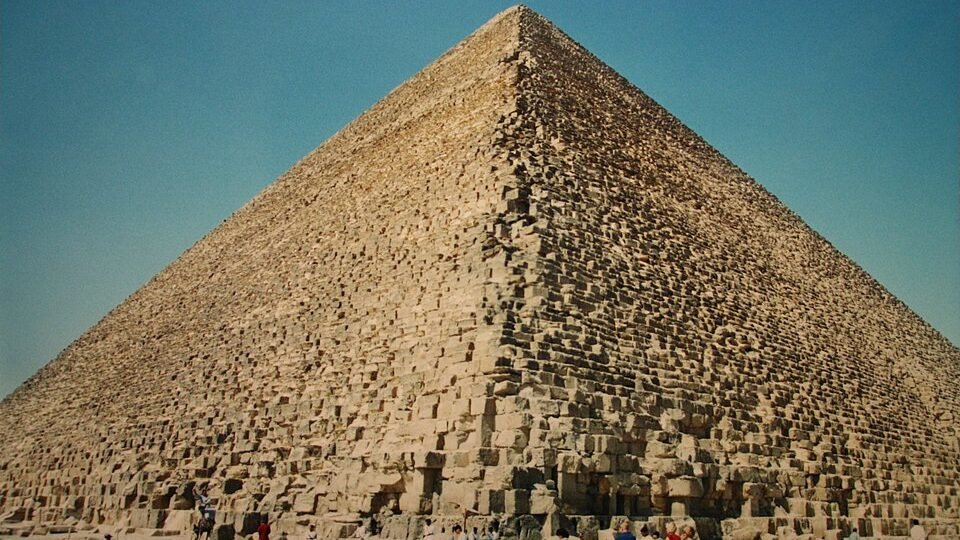
It is the most measured monument in history. It has been climbed, mapped, probed, drilled and debated for two centuries. And in 2017 it was discovered that there was a space inside it the size of an airplane, about which not a single line had ever been written.
- Where
- Giza plateau, Egypt
- Coordinates
- 29°58′45″N 31°08′03″E
- Built
- c. 2560 BC, Fourth Dynasty
- Original height
- 146.6 m
- Void detected
- ≥ 30 m long
- Method
- Cosmic muons
At this very moment, particles generated in the upper atmosphere by the impact of cosmic rays are passing through the Great Pyramid from top to bottom. They are called muons, they weigh two hundred times more than an electron, they last two millionths of a second, and they reach the ground at about ten thousand per square meter per minute. They pass through stone the way light passes through frosted glass: they get through, but part of the flux is lost along the way. The more material, the fewer muons on the other side.
That is the whole idea. If you place a detector inside the pyramid and count, for days on end, how many muons arrive from each direction, the map that forms is an X-ray. Where more muons arrive than the density of the limestone predicts, there is less stone in the way. There is a void.
No one has to open anything. The stone is read from within, without being touched.
01Before ScanPyramids
Until the twentieth century, the inventory of the interior was short and closed: a descending passage, an ascending one, the Queen's Chamber, the Grand Gallery and the King's Chamber — all of them already emptied in antiquity. The last large space added to that list was opened in 1837, and by force. The British colonel Richard Howard Vyse suspected there were more compartments above the King's Chamber, because one of them had been known since 1765, when Nathaniel Davison reached it. Vyse blasted his way upward with gunpowder and found four more. These are the relieving chambers: five low, stacked, undecorated compartments that distribute the weight of a mountain of some six million tons of stone and keep the ceiling of the King's Chamber from giving way. Inside them, the workers left builders' marks painted in red — and one of them bears the cartouche of Khufu.
After 1837, for one hundred and eighty years, no new chamber. The honest exception is tiny: in 2002 a robot drilled a 1.9 cm hole in the slab that closes one of the shafts of the Queen's Chamber, passed a camera through it and saw, behind it, a gap of a few hand-spans and a second slab — it is the same structure as in section 08, and it has nothing to do with the big void.
The first attempt to read a pyramid without opening it came from a physicist. In the mid-1960s, Luis Alvarez — who would win the Nobel Prize in Physics in 1968 — proposed using muons on the pyramid of Khafre, the second at Giza. The Six-Day War, in 1967, interrupted the installation; in 1968 the detectors, set up in Belzoni's chamber, began recording, and the count went on until 1969. The result came out in Science in February 1970: about 19% of the volume examined, and no chamber. The method worked — there was just nothing to find there. Almost half a century later, the same idea would be aimed at Khufu.
02ScanPyramids
The project began in October 2015, run by Cairo University together with the French institute HIP — Heritage Innovation Preservation —, under the direction of Mehdi Tayoubi and Hany Helal. The proposal was explicit and conservative: to examine the pyramids of the Old Kingdom exclusively by methods that did not touch them. Infrared thermography to find temperature differences on the surface, photogrammetry for the three-dimensional model, and muography for the interior.
The first clue appeared in November 2015: infrared thermography recorded, behind the chevrons — the large V-shaped stones that relieve the weight above the original entrance, on the north face —, a thermal behavior that did not match the rest of the face. It was enough for the team to install nuclear emulsion films in the Descending Corridor, aimed at that area. On October 15, 2016, after sixty-seven days of exposure, came the announcement: there was an excess of muons there with a significance of five sigma — the same degree of certainty required to announce the Higgs boson —, that is, an elongated void at least five meters long.
03The big void
On November 2, 2017, Nature published the result that took the subject out of academic circles. Above the Grand Gallery — the ascending passage with a very high ceiling that leads to the King's Chamber — there was a cavity at least thirty meters long, with a cross-section comparable to that of the Gallery itself.
What gives the finding its weight is the design of the experiment. Three teams worked in parallel with different, independent detection technologies: Nagoya University with nuclear emulsion films, the KEK laboratory with scintillators, and the French CEA with gas detectors. Three distinct instruments, three teams that did not share raw data, and the same void in the same place. It is not the reading of a faulty device.
The harshest reaction came from inside. On that same November 2, Zahi Hawass — former Minister of Antiquities and, at the time, head of the scientific committee overseeing ScanPyramids itself — told the New York Times that the team had found nothing and that the article offered nothing to Egyptology. The argument was that the pyramid is full of construction gaps, that this has been known for decades, and that a gap is not a discovery.
The Ministry of Tourism and Antiquities issued a statement the next day saying that the existence of several voids inside the pyramid was nothing new. Two days later, the acting minister said the opposite: that the finding was new and larger than the known cavities. The same government, two answers, in forty-eight hours.
04The north face corridor
The 2016 finding took longer to measure, and ended better. In March 2023, Nature Communications published the precise characterization of the structure behind the chevrons: a horizontal corridor nine meters long with a cross-section of about two by two meters, its floor roughly twenty meters above the base — some seven meters above the original entrance — and less than a meter from the outer face of the chevron.
And this time it was possible to look. An endoscopic camera six millimeters in diameter was inserted through an existing joint between blocks — with no new drilling at all — and sent back images of the interior. The corridor exists, it has a gabled ceiling formed by inclined slabs leaning against each other, and it is empty.
Empty is, in fact, the word that sums up the result. There was no treasure, there was no inscription, there was no sarcophagus. What there was, was architecture: a structure built on purpose, carefully, and then sealed for four thousand five hundred years without anyone writing a line about it.
What came afterward
The corridor did not remain the finding of a single method. In 2025 Scientific Reports published two independent confirmations of the muography: one by fusing three non-destructive techniques — ground-penetrating radar, ultrasound and electrical resistivity tomography — and another devoted to resistivity alone. All of them point to the same structure, in the same place.
And on June 18, 2026 the same team published something different: shear-wave ultrasound on the granite blocks of the King's Chamber. Forty-five blocks were measured, one by one, from the two lower courses of the four walls. The bulk of the result is engineering — the thickness of each block, where the back face ends, the geometry of the joints — and from it came the first three-dimensional model of the inside of that lining.
But in one block of the north wall, identified as NW9, a reflector appeared behind the back face, about two meters deep and running through the entire height of the block. The authors classify it as “a plausible but not uniquely constrained indication of an internal boundary or cavity” — and say the data do not allow them to pin down which of the two.
05Who built it, and how we know
Before the theories, it is worth establishing what is documented — because this is a case in which the answer exists, and exists in writing.
In 2013, a French mission led by Pierre Tallet, of the Sorbonne, with Gregory Marouard, was excavating at Wadi al-Jarf, an ancient port on Egypt's Red Sea coast. In front of caves used to store dismantled boats, they found papyrus rolls. They are the oldest inscribed papyri known, and they date from the twenty-sixth and twenty-seventh years of Khufu's reign — that is, from the period when the pyramid was being built.
One of them is a logbook. It belonged to an inspector named Merer, who led about forty boatmen. The text records, day by day, the crew's routine: loading blocks of white limestone at the quarries of Tura, on the east bank of the Nile, sailing to Akhet-Khufu — the building site of the Great Pyramid —, unloading and going back. A full cycle took four days. Based on the records, the estimate is something around two hundred blocks a month, of two to three tons each.
The question "how did they build it" has a bureaucratic answer, written by hand, by a mid-ranking official who was there. What the Diary of Merer adds to the case
The diary does not explain everything — it covers the transport of the casing, not the raising of the core blocks, and it is the record of one crew among many. But it destroys an entire premise. There was administration, shifts, accounting, a chain of command and a vizier overseeing the port of Giza, a nobleman named Ankhhaf, half-brother of the pharaoh himself.
The other pillar of the evidence lies on the ground of the plateau: the workers' village, with bakeries, breweries, storehouses and lodgings, and the builders' tombs dug beside the monument. Those buried there received graves with inscriptions, offerings and titles. That is not how enslaved labor is buried.
06The theories, from the most sober to the most improbable
The voids are a structural solution
The most economical reading, and the one the north face corridor seems to confirm. The pyramid already has five relieving chambers stacked above the King's Chamber, whose function is to distribute the weight of the mass above and keep the ceiling from giving way. The chevrons at the entrance do the same job. An empty corridor set against the north face, with a gabled ceiling, has exactly the geometry of something that relieves load.
Applied to the big void above the Gallery, the hypothesis is plausible by the same reasoning — but there the scale is different, and thirty meters is a lot of load relief.
They are remnants of the construction process
The internal ramp hypothesis, championed mainly by the architect Jean-Pierre Houdin, proposes that the blocks went up by a spiral ramp built inside the mass itself, and that stretches of it remained as voids at the end of the work. The big void would be one of those stretches, or a maneuvering space.
The idea is ingenious and explains well the logistical problem of raising blocks above one hundred meters. What is missing is confirmation: muography has not traced any spiral, and the position of the only large void located so far — on the central axis, above the Gallery — is not the one a spiral ramp would require, even though Houdin maintains the opposite.
There is an intact chamber with contents
It is the hypothesis that fires the imagination and the one that holds up least so far. The only cavity ever seen from the inside was empty. The known chambers of the pyramid were all emptied in antiquity. And the sarcophagus in the King's Chamber was already without its lid and without contents when the first modern records describe it.
It is not impossible — the big void has never been observed. But the expectation of treasure says more about those who expect it than about the pyramid.
Lost technology, hidden energy, non-human builders
This is the thesis that the Diary of Merer settles on its own. There is a contemporary record, written by an official at the building site, describing the transport routine. There is the village of those who worked, with its bread ovens. There are the builders' tombs with their names. There are the work-gang marks painted on blocks inside the relieving chambers, with the name of the crew and the year of the reign.
What this reading does is take the credit away from a people who left their own accounting in writing and hand it to imaginary agents. The real feat — organizing and feeding thousands of people for two decades, with a working bureaucracy — is more impressive than any mystical substitute, and it is documented.
A network of tunnels seen by satellite radar
In October 2022, Filippo Biondi and Corrado Malanga published in Remote Sensing a method that promised to reconstruct the interior of the pyramid from space: measuring micro-movements caused by background seismic vibration, picked up by satellite synthetic-aperture radar, and from them drawing what lies inside the stone. What they claimed to have found was a three-dimensional network of ramps, rooms and tunnels far more extensive than anything known.
It was this line of work that fed, in 2025, the wave of videos about a gigantic city hidden beneath the Giza plateau.
On August 10, 2026 the journal retracted the article, citing serious methodological flaws and statistical errors that invalidated the conclusions. A retraction is not a correction: it is the formal invalidation of the article, which remains accessible, but stamped as retracted. The central objection, made by the specialist in radar applied to archaeology Lawrence Conyers, of the University of Denver, is simple — the signal from that satellite has no way of penetrating the pyramid, reflecting off internal structures and returning to the sensor, and the vibrations the method claimed to measure are far below what is detectable from orbit.
The retraction does not erase the voids. The big void of 2017 and the corridor of 2023 still stand, measured by other methods, by other teams, and later confirmed by three independent techniques. What fell was the underground city.
07Chronology
- c. 2560 BCConstruction of the pyramid for the pharaoh Khufu, in the Fourth Dynasty. Original height of 146.6 meters.
- years 26 and 27 of the reignPeriod covered by the diary of the inspector Merer: about four months, from July to November, recording the transport of limestone from Tura to the building site.
- ninth – nineteenth centuriesSuccessive openings, excavations and probes. The known chambers had already been emptied.
- 1765Nathaniel Davison reaches the first relieving chamber, just above the King's Chamber.
- 1837Richard Howard Vyse blasts his way through with gunpowder and finds the other four relieving chambers, with builders' marks in red and the cartouche of Khufu. It is the last large space opened in the interior.
- 1967 – 1970Luis Alvarez applies muons to the pyramid of Khafre: the Six-Day War interrupts the installation, the data come from 1968 and 1969, and Science publishes in February 1970 — about 19% examined, no chamber.
- 1990sExcavation of the workers' village and the builders' tombs on the Giza plateau.
- 1993The robot Upuaut, built by Rudolf Gantenbrink, finds a slab with two copper handles closing the southern shaft of the Queen's Chamber.
- 2002 and 2011A robot sees, through a 1.9 cm hole, a second slab behind the first; the robot Djedi films marks in red ochre in the gap between the two.
- 2013The mission of Pierre Tallet and Gregory Marouard finds the Wadi al-Jarf papyri, the oldest ever found bearing text.
- October 2015ScanPyramids begins, with the commitment not to touch the monuments.
- November 2015Infrared thermography records a thermal anomaly behind the chevrons, on the north face.
- October 15, 2016Muography confirms a void there at least five meters long, with a significance of five sigma.
- November 2, 2017Nature publishes the big void above the Grand Gallery, confirmed by three teams with independent technologies.
- March 2023Nature Communications characterizes the north face corridor. An endoscope goes in through an existing joint and confirms the structure, empty.
- 2025Two publications in Scientific Reports confirm the corridor by ground-penetrating radar, ultrasound and electrical resistivity.
- November 2025Zahi Hawass announces, at an international book fair, that a discovery inside the pyramid will be revealed in 2026 and that it will rewrite a chapter of the history of the pharaohs.
- June 18, 2026Scientific Reports publishes the ultrasound of the forty-five granite blocks of the King's Chamber, with a reflector behind block NW9 of the north wall.
- August 10, 2026Remote Sensing retracts the 2022 article on satellite radar, for methodological flaws and statistical errors.
- September 2026As of September 2026, no report and no announcement. The big void has still never been observed.
08What remains open
The big void of 2017 has never been observed. It is known to be there, its approximate location and minimum size are known, and what it is is not known. It sits in the middle of the mass, far from any accessible joint, and reaching it would require opening the stone.
This is where the case is decided. The pyramid is not a site that can be excavated and redone: every intervention is permanent. The choice of ScanPyramids was not to touch, and the 2023 corridor showed that the choice works — it was possible to see a space sealed for four millennia through a crack that already existed.
Three questions remain unanswered. What the big void is — a room, a gap, a collapsed gallery or several spaces that muography reads as one. How many others exist — the method's resolution improves with each generation of detector, and small cavities may lie below what the 2017 instruments could distinguish. Whether there is a plan behind them — whether the voids form a coherent load-relieving system, or whether they are building-site accidents accumulated over twenty years of work.
It is worth separating what is publication from what is statement. No peer-reviewed article describes a door at the end of the big void, and no one has gotten there. A robot with a camera did in fact find a stone slab closing a narrow shaft, with two copper handles — but that was in 1993, in one of the shafts of the Queen's Chamber, by Rudolf Gantenbrink's team, and it is a different structure. In 2002 another robot drilled a 1.9 cm hole in that slab, passed a camera through it and saw, a few hand-spans away, a second slab; in 2011 the robot Djedi, from the University of Leeds, filmed marks in red ochre there. As of September 2026, no report and no announcement.
09Frequently asked questions
Where is the Great Pyramid of Giza?
On the Giza plateau, in Egypt. It was built around 2560 BC for the pharaoh Khufu, in the Fourth Dynasty.
How tall is the Great Pyramid?
Its original height was 146.6 meters.
What is inside the Great Pyramid?
The known interior is a descending passage, an ascending one, the Queen's Chamber, the Grand Gallery, the King's Chamber and the five relieving chambers above it, all emptied since antiquity. Muography added an empty corridor on the north face and a big void above the Gallery. See before ScanPyramids.
Is there a secret chamber in the Great Pyramid?
In 2017, three independent teams used muons to detect a void at least thirty meters long above the Grand Gallery. Muography measures density, not shape: no one knows whether it is a room, a gap or a collapsed gallery, and the void has never been observed. See the big void.
Who built the Great Pyramid?
Egyptian crews organized by Khufu's administration. The diary of the inspector Merer records the transport of limestone from Tura to the building site, and the workers' village and the builders' tombs, with inscriptions and offerings, are on the plateau itself. See who built it, and how we know.
10Sources consulted
This dossier is original writing. The sources below were consulted to verify dates, measurements and attributions; none was reproduced.
- Morishima, K. et al. — Discovery of a big void in Khufu's Pyramid by observation of cosmic-ray muons. Nature, November 2, 2017.
- Procureur, S. et al. — Precise characterization of a corridor-shaped structure in Khufu's Pyramid by observation of cosmic-ray muons. Nature Communications, March 2023.
- Confirmation of the ScanPyramids North Face Corridor in the Great Pyramid of Giza using multi-modal image fusion from three non-destructive testing techniques. Scientific Reports, 2025.
- Investigation of the North Face Corridor in the Great Pyramid of Giza using Electrical Resistivity Tomography. Scientific Reports, 2025.
- Investigation of the lower block rows in the King's Chamber of the Great Pyramid using ultrasonic testing with shear wave arrays. Scientific Reports, June 18, 2026.
- Vyse, R. W. H. — Operations Carried On at the Pyramids of Gizeh in 1837. London, 1840–1842. The opening of the relieving chambers and the builders' marks.
- Alvarez, L. W. et al. — Search for Hidden Chambers in the Pyramids. Science, February 1970. The negative result in the pyramid of Khafre, forty-five years before ScanPyramids.
- Biondi, F.; Malanga, C. — Remote Sensing 14(20):5231, October 2022. Retracted on August 10, 2026 for methodological flaws and statistical errors; cited here only as the subject of section 06.
- Richardson, R. et al. — The “Djedi” Robot Exploration of the Southern Shaft of the Queen's Chamber in the Great Pyramid of Giza, Egypt. Journal of Field Robotics, 2013. Includes the history of Upuaut (1993) and the Pyramid Rover (2002).
- Retraction Watch, August 31, 2026 — the retraction of the 2022 article and the objections of Lawrence Conyers.
- Coverage of Zahi Hawass's statement at the International Book Fair, November 2025 — Egypt Independent and Jerusalem Post.
- Zahi Hawass's reaction to the Nature publication, November 2 and 3, 2017 — New York Times, Phys.org and Ahram Online.
- Public documentation of the ScanPyramids project — Cairo University and the HIP institute, from October 2015 onward.
- Tallet, P.; Marouard, G. — the Wadi al-Jarf papyri and the diary of the inspector Merer, from 2013 onward.
- Consolidated encyclopedia entry on the Diary of Merer — dating, content of the record and administrative context.
- Reference literature on the workers' village and the builders' tombs on the Giza plateau.