Göbekli Tepe — the temple the hill buried
Hunter-gatherers raised limestone pillars five and a half meters tall on top of a hill in southeastern Turkey. Centuries later, the enclosures disappeared under tons of debris. For decades the question was who would have buried it all on purpose. The answer coming from the excavation itself is less solemn: the hill.
- Location
- Şanlıurfa, Turkey
- Coordinates
- 37°13′25″N 38°55′18″E
- Period
- c. 9600 – 8200 BC
- Excavated
- ≈ 10% of the site
- Heritage
- UNESCO, 2018
- Status
- Active excavation
In summer, the wind rising from the Harran plain reaches the hill dry and carries ground limestone. From a distance the rise is unimpressive: fifteen meters high on an already elevated plateau, the rounded shape that gave the place its Turkish name — göbekli tepe, the hill with a belly. There is no river nearby, no shade, nothing to recommend the hilltop to anyone who has to live off the land. The springs of the Balikh, a tributary of the Euphrates, lie below. Whoever climbed up there, eleven thousand six hundred years ago, climbed for another reason.
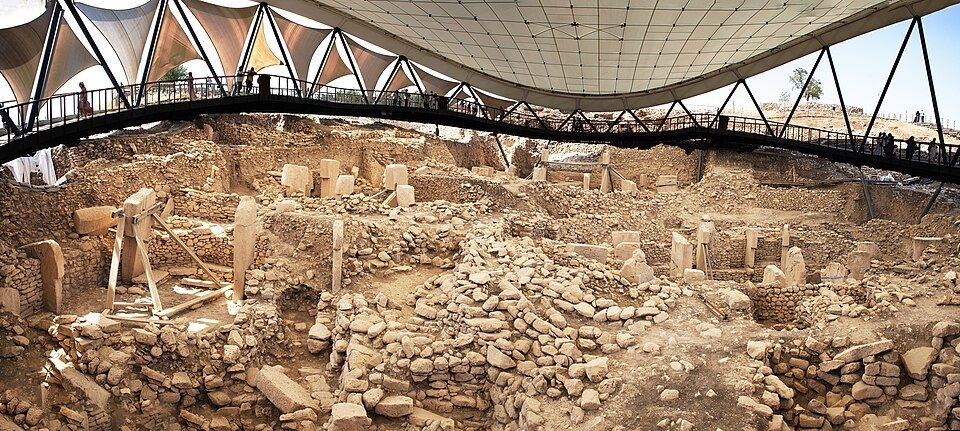
What that someone found at the top were rings of stone. Circular and oval enclosures, between ten and thirty meters across, bounded by low walls and stone benches. Set into those walls, limestone pillars in the shape of a T. At the center of each enclosure, a larger pair, taller than any man, the two facing each other. On the faces of the pillars, in low relief: foxes baring their teeth, boars, bulls, scorpions, snakes descending in a row, long-necked birds. Some pillars have arms carved on their sides, hands meeting over the belly, a belt, a loincloth. They are bodies. Headless bodies, of stone, standing, in a circle, on top of a hill without water.
None of this should exist. Not at that date.
01The hill that passed for a cemetery
Göbekli Tepe was first recorded in 1963, in a survey led by Halet Çambel, of Istanbul University, and Robert Braidwood, of the University of Chicago. The teams noted broken limestone slabs scattered across the surface and moved on. The reading was reasonable for what could be seen: they looked like gravestones. According to Schmidt's account, the hill went into the notebooks as a medieval cemetery of little interest and stayed that way for three decades.
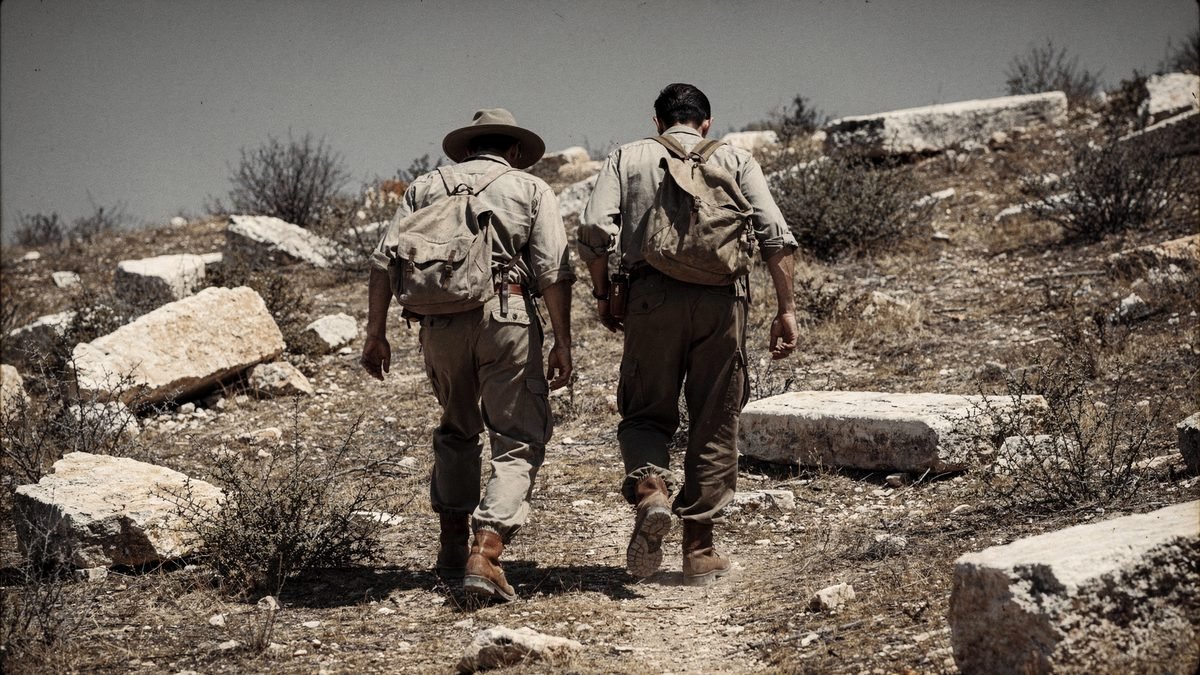
In 1994, the German archaeologist Klaus Schmidt, of the German Archaeological Institute, reread those notes while looking for a site to excavate in the region. The description of the slabs did not fit a cemetery: the volume of worked limestone was too large, and the stone bore tool marks. Schmidt went to the site. On the surface he recognized the tops of pillars that were still buried. The following year he began to dig, and he would remain there until his death, in 2014.

The first radiocarbon dating dismantled the chronology the textbooks carried. The oldest layers of the site belong to the Pre-Pottery Neolithic A, around 9500 BC. The UNESCO inscription, in 2018, places the occupation between approximately 9600 and 8200 BC. That puts the pillars about seven thousand years before the pyramids of Giza and about six thousand five hundred before Stonehenge, and — this is the point that unsettled the archaeology of the Near East — before agriculture, before pottery, before the wheel, before writing and before any city.
First came the temple, then the city. Summary attributed to Klaus Schmidt of the inversion the site proposes
The phrase sums up the inversion. The classic model said agriculture comes first: settled people, a food surplus, a concentrated population, hierarchy and, at the end of that chain, religious monuments. Göbekli Tepe presents the opposite order. The bones found at the site are from hunted animals — gazelles, aurochs, boars, deer, wild birds. No herds. The cereals processed there were wild. The people who raised those pillars did not yet farm. And yet they moved and raised stones weighing several tons.

02What is actually in the ground
It is worth separating what has been excavated from what has been inferred, because much of what circulates about Göbekli Tepe confuses the two.
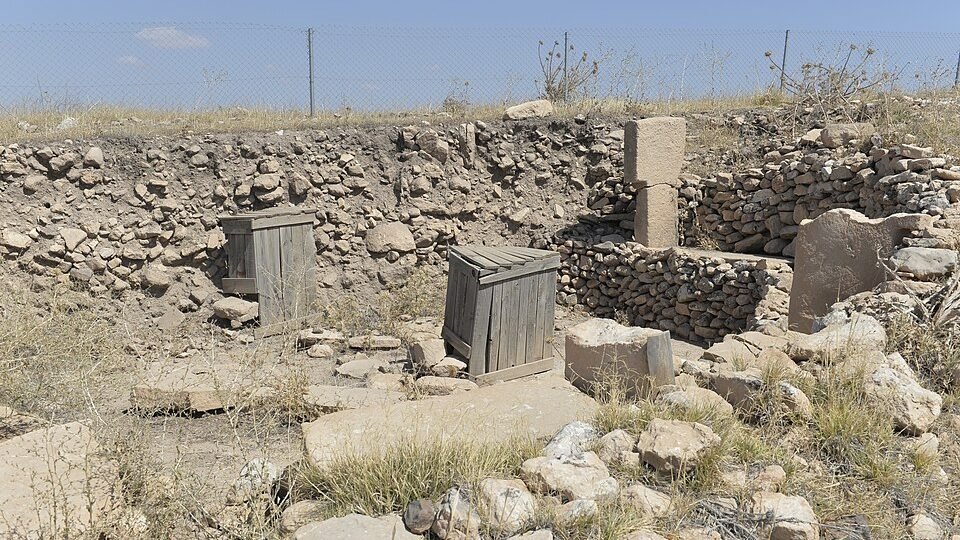
Four monumental enclosures — A, B, C and D — have been largely excavated in the main area; others, among them E, F, G and H, have been only partly opened. Geophysical surveys — ground-penetrating radar and magnetometry — indicate at least twenty other buildings across the mound, still buried. In the enclosures already opened, the circle has ten to twelve pillars, plus the central pair. Estimates published in 2021 indicated that about 10% of the site had been opened. The other 90% are, for now, an instrument reading.
The carved repertoire
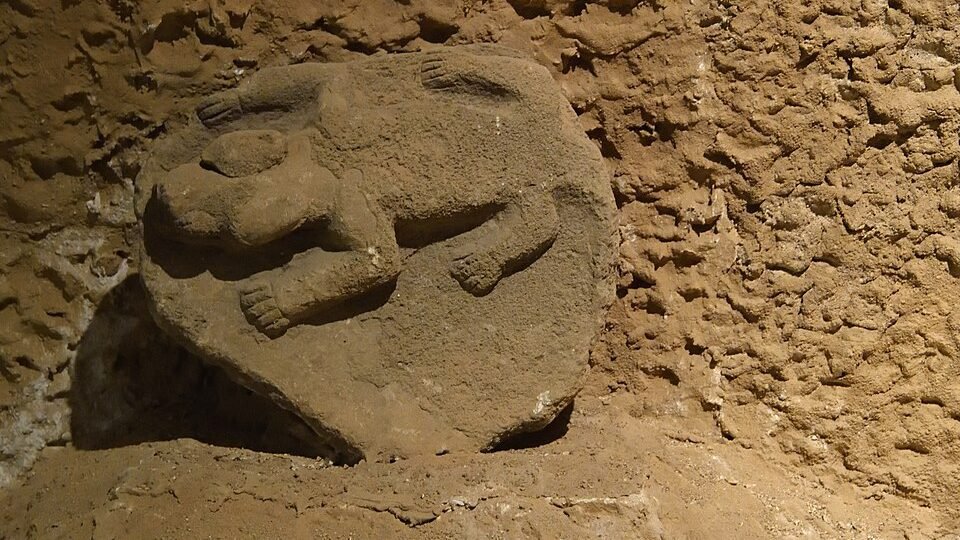
The reliefs are not decorative in the modern sense. They repeat a closed and unbalanced repertoire: predators and dangerous animals appear far more often than prey. Lions, boars, scorpions, spiders, snakes and vultures dominate the faces. Abstract symbols — the H sign, crescents, discs — reappear on different pillars and at different sites in the same region, which suggests a shared system of conventions, even if it is illegible to us.
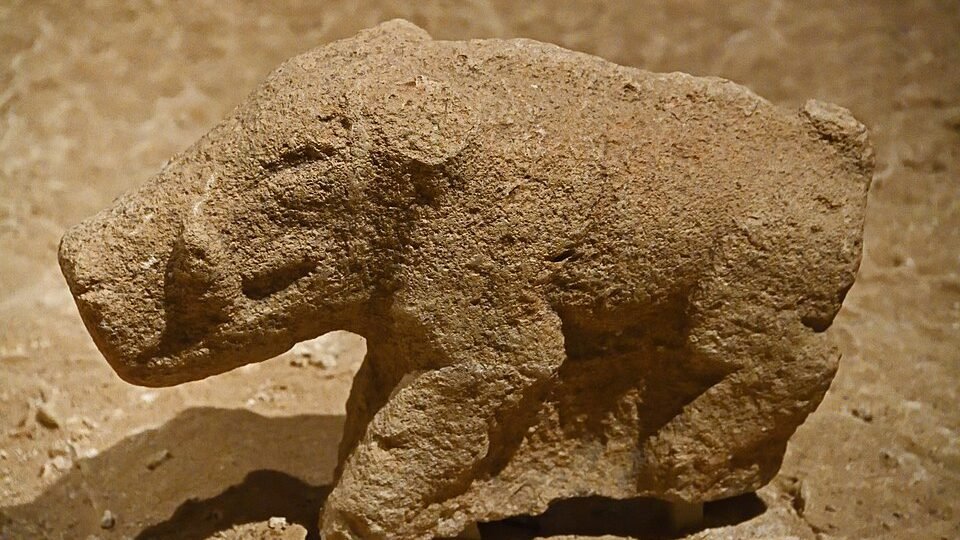
In 2023, the excavation recovered in Enclosure D a life-size limestone sculpture of a boar, with residues of red, white and black pigment still adhering to the stone. The Turkish Ministry of Culture announced it as the first painted Neolithic statue on record; the German Archaeological Institute, more cautious, speaks of the first unequivocal pigmentation on a sculpture from Göbekli Tepe. The piece was resting on a bench decorated with an H symbol, a crescent, two snakes and three human faces or masks. It is information with consequences: it means that what we see today as grey stone was originally colored.
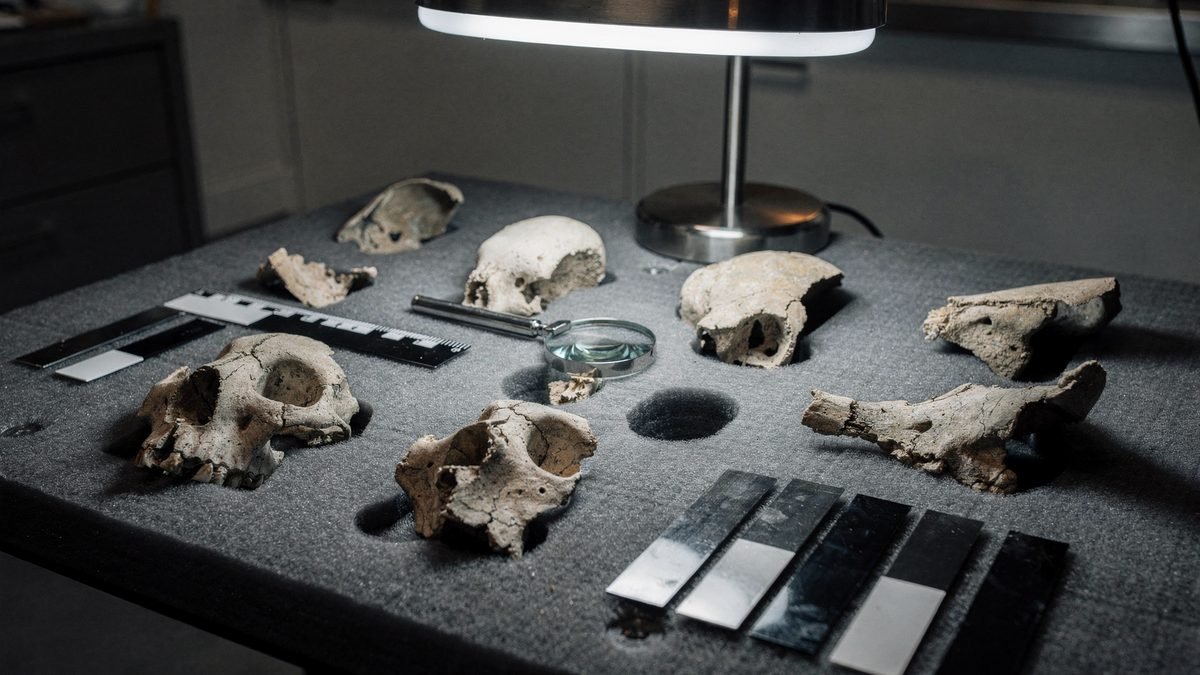
There are also human bones. In 2017, skull fragments with deliberate incisions were published and interpreted as evidence of a skull cult — a practice documented at other Neolithic sites in the Levant, such as Jericho and Tell Aswad, and later at Çatalhöyük. In the large enclosures there is no formal burial. The site's first burials were only published in September 2026, by Julia Gresky and Lee Clare, and they lie outside them: under the floor of a later rectangular building and to the west of Enclosure A.
03The burial — and the revision
Here is the crux of this dossier. The enclosures of Göbekli Tepe did not collapse: they were found full. Up to the tops of the pillars, filled with a mass of sediment, limestone chips, animal bones, worked flint and broken stone vessels. It was this cover that preserved the reliefs for eleven millennia — and it is what raises the hardest question about the site.
Schmidt interpreted this fill as intentional. The argument is one of composition and rhythm: the material is not homogeneous soil, as a deposit formed by slow accumulation would be, but a heterogeneous mix of refuse and stone that the stratigraphy suggests was laid down in concentrated episodes. The reading that dominated for two decades was that of ritual decommissioning — each enclosure would have been closed, buried and replaced by another at the end of a cycle of use. It was this reading that gave the site its fame as a temple buried on purpose.
The very team that excavates the site has abandoned this reading. Since 2020, the German Archaeological Institute — with Lee Clare leading the revision — has attributed the filling of the main enclosures to successive landslides: archaeological material from the higher parts of the mound that slid downslope and filled the buildings. The study of the construction shows signs of repairs and reinforcements made while the buildings were still in use, as a response to an unstable slope. The hill is sloped, the surroundings are friable limestone, and eleven thousand years is enough time to move a great deal. The ritual hypothesis has not vanished from the region: at Karahan Tepe, a neighboring site in the same program, Necmi Karul describes buildings filled on purpose. But at Göbekli Tepe it is now part of the history of research, attributed to Schmidt.
04The theories, from the most sober to the most improbable
A ceremonial center of hunter-gatherers
Schmidt's original reading: a hilltop sanctuary, built and frequented by groups who lived elsewhere and gathered there periodically to build, celebrate and feast. It rests on the monumental scale, the iconography, the large-volume limestone vessels and the bone deposits consistent with collective feasts.
A settlement with communal architecture — not just a temple
The revision that gained strength after 2014. The archaeologist Ted Banning had questioned, as early as 2011, whether the modern categories of “sacred” and “profane” make sense for Neolithic societies, proposing that the enclosures might be richly decorated houses. Later excavations reinforced this direction: domestic structures, more than seven thousand grinding stones, intensive processing of wild cereals, water-catchment cisterns. Today the dominant formulation is one of coexistence — ritual and everyday functions in the same space, without the boundary we project onto it.
The work required a hierarchical society
Schmidt held that moving and raising those pillars demanded hundreds of coordinated workers — and therefore some form of authority capable of coordinating them. The study of the construction disputes the scale: Moritz Kinzel and Lee Clare estimated, in 2020, that between twelve and twenty-four people could raise the walls of all the exposed Pre-Pottery Neolithic B structures — the smaller and later ones, not the great enclosures — in less than four months, which would fit an extended family or a small community.
The dispute is not about the stone, it is about the society: how much political structure it takes to produce a monument.
The solar calendar of Pillar 43
In July 2024, Martin Sweatman, of the University of Edinburgh, published in the journal Time and Mind a reading of Pillar 43 in Enclosure D — the so-called Vulture Stone — according to which each V-shaped mark carved on the piece would represent a day, adding up to 365: twelve lunar months plus eleven days. It would be the oldest calendar record ever identified. Sweatman links the set to the impact of comet fragments around 10,850 BC, an event that would lie at the origin of the Younger Dryas.
The interpretation travels well outside archaeology and poorly within it. Two problems are structural: the site's repertoire of symbols is recurrent and appears in contexts where the calendrical reading does not apply, which weakens the assignment of numerical value to the marks; and there is a gap of approximately one thousand two hundred years between the date proposed for the event and the construction of the enclosure, which would require precise oral transmission over dozens of generations. Neither objection is fatal — but neither has been answered.
Lost civilization, outside visitors, forgotten technology
The thesis that Göbekli Tepe would be the legacy of an earlier advanced civilization — or of something non-human — rests entirely on an argument from incredulity: the assumption that hunter-gatherers would not be capable of it. The site answers that objection on its own. The quarries are a hundred meters away. An unfinished pillar still lies in the bedrock, with the percussion marks visible. The stone tools used for the carving have been recovered. There is not a single metal artifact, no trace of mechanized cutting, no material anomaly.
What the site actually overturns is not human capability — it is our estimate of it. That is the discovery, and it is more interesting than any substitute.
05Chronology
- c. 9600 BC Start of the recorded occupation. The first enclosures with T-shaped pillars are raised, in the Pre-Pottery Neolithic A.
- c. 8700 – 8200 BC Early Pre-Pottery Neolithic B. The special buildings remain in use until the middle of the millennium, alongside smaller rectangular structures, which come to dominate.
- c. 8200 BC Abandonment of the site. The enclosures are already filled — by the current reading, by landslides from the slope.
- 1963 A survey by Halet Çambel and Robert Braidwood records limestone slabs on the surface. The place is cataloged as a medieval cemetery.
- 1994 – 1995 Klaus Schmidt rereads the survey notes, visits the hill and begins systematic excavation.
- 2014 Death of Schmidt. The leadership of the project goes through a transition and the interpretation of the site begins to be revised.
- 2017 Publication of the skull fragments with deliberate incisions, the basis of the skull-cult hypothesis.
- 2018 Inscription on the UNESCO World Heritage List, under criteria (i), (ii) and (iv).
- 2020 – 2021 Lee Clare publishes the revision that attributes the filling of the enclosures to landslides. Necmi Karul, of Istanbul University, takes over in 2020 the direction of the joint project with the Şanlıurfa Museum and the German Archaeological Institute; since 2021 the work has continued within the regional Taş Tepeler program.
- 2023 A life-size boar sculpture, with red, white and black pigment preserved, is recovered in Enclosure D — the first known painted Neolithic statue.
- 2024 Publication of the Pillar 43 solar-calendar hypothesis, in Time and Mind. Wide reception outside archaeology, guarded within it.
- 2026 Publication of the first burials at Göbekli Tepe, outside the great enclosures, by Julia Gresky and Lee Clare, in PLOS ONE.
06What remains open
Göbekli Tepe is no longer an isolated case. The Taş Tepeler program — “the stone hills” — now investigates a dozen contemporary sites spread across the same region of Şanlıurfa, among them Karahan Tepe, Sefer Tepe and Taşlı Tepe, all with the same grammar of T-shaped pillars. What seemed a one-off event turned out to be a regional phenomenon. That settles one question — it was not an anomaly — and opens another: there was, in the tenth millennium before Christ, a network of communities sharing architecture, symbols and probably beliefs, on a scale we do not know how to describe.
Three questions remain unanswered, and not for lack of technology:
What the central pillars represent. The arms, the hands over the belly, the belt and the loincloth indicate anthropomorphic figures. The systematic absence of a head may be a stylistic convention, may be a representation of ancestors, may be something for which we have no concept. There is no text, no direct ethnographic analogy.
How each enclosure was covered. The landslide reading applies to the main enclosures studied; whether any building was filled on purpose, as at Karahan Tepe, only fine stratigraphy, enclosure by enclosure, will tell — and 90% of the site remains closed.
What the relationship is with the birth of agriculture. The proximity to Karacadağ is suggestive, the coincidence in time is real, and the direction of causality remains undetermined. It is not known whether the need to feed the builders drove cultivation, whether cultivation freed up time to build, or whether the two grew together without one having caused the other.
The excavation advances slowly by deliberate decision: the current leadership prefers to preserve most of the site for methods that do not yet exist, rather than open everything with today's. It is an unusual choice and, probably, the right one. It means that the answer to the question in this dossier's title is physically there, under the hill, a few meters down — and that the conscious decision is not to go and get it yet.
07Frequently asked questions
What is Göbekli Tepe?
A Pre-Pottery Neolithic archaeological site with circular and oval enclosures bounded by T-shaped limestone pillars, some with carved arms and hands. It was built by hunter-gatherers, before agriculture, pottery and writing.
Where is Göbekli Tepe?
On top of a hill in Şanlıurfa province, in southeastern Turkey, on an already elevated plateau. The springs of the Balikh, a tributary of the Euphrates, lie below, and the Karacadağ massif is about ninety kilometers away, to the northeast.
What does Göbekli Tepe mean?
It is Turkish for “the hill with a belly,” after the rounded shape of the rise.
When was Göbekli Tepe discovered?
It was recorded in 1963 by Halet Çambel and Robert Braidwood, who took it for a medieval cemetery. Klaus Schmidt reread the notes in 1994 and began excavating the following year. See the discovery.
Was Göbekli Tepe buried on purpose?
That was Schmidt's reading for two decades. Since 2020, the German Archaeological Institute team has attributed the filling of the main enclosures to landslides from the slope; whether any building was filled on purpose, only the stratigraphy, enclosure by enclosure, will tell. See the burial and the revision.
08Sources consulted
This dossier is original writing. The sources below were consulted to verify dates, measurements and attributions; none was reproduced.
- UNESCO World Heritage Centre — official inscription record for Göbekli Tepe (ref. 1572, 2018).
- ICOMOS — Göbekli Tepe (Turkey), No 1572, technical evaluation of the World Heritage nomination, 2018.
- Deutsches Archäologisches Institut — the pages The Site, FAQ and Research Structure and Staff of Tepe Telegrams, the official blog of the Göbekli Tepe Project, consulted in October 2026.
- Schmidt, K. — Göbekli Tepe – the Stone Age Sanctuaries. New results of ongoing excavations with a special focus on sculptures and high reliefs. Documenta Praehistorica 37, 2010. DOI 10.4312/dp.37.21
- Gresky, J.; Clare, L. — First burials give insights into mortuary rites at Göbeklitepe, Early Neolithic Türkiye. PLOS ONE 21(9), September 2026. DOI 10.1371/journal.pone.0358979
- Clare, L. — Göbekli Tepe, Turkey. A brief summary of research at a new World Heritage Site (2015–2019). e-Forschungsberichte des DAI 2020-2, 2020. DOI 10.34780/efb.v0i2.1012
- Curry, A. — Gobekli Tepe: The World’s First Temple? Smithsonian Magazine, November 2008.
- Curry, A. — Last Stand of the Hunter-Gatherers? Archaeology, May/June 2021.
- Heun, M.; Schäfer-Pregl, R.; Klawan, D. et al. — Site of Einkorn Wheat Domestication Identified by DNA Fingerprinting. Science 278(5341), 1997. DOI 10.1126/science.278.5341.1312
- Lang, C.; Peters, J.; Pöllath, N.; Schmidt, K.; Grupe, G. — Gazelle behaviour and human presence at early Neolithic Göbekli Tepe, south-east Anatolia. World Archaeology 45(3), 2013. DOI 10.1080/00438243.2013.820648
- Dietrich, L.; Meister, J.; Dietrich, O.; Notroff, J. et al. — Cereal processing at Early Neolithic Göbekli Tepe, southeastern Turkey. PLOS ONE 14(5), 2019. DOI 10.1371/journal.pone.0215214
- Gresky, J.; Haelm, J.; Clare, L. — Modified human crania from Göbekli Tepe provide evidence for a new form of Neolithic skull cult. Science Advances 3(6), 2017. DOI 10.1126/sciadv.1700564
- Deutsches Archäologisches Institut — press release Life-size statue of a wild boar found in Special Building D of Göbekli Tepe, 8 October 2023; and Anadolu Agency — New statues unearthed in Türkiye’s ancient Gobeklitepe, Karahantepe sites, 1 October 2023.
- Banning, E. B. — So Fair a House: Göbekli Tepe and the Identification of Temples in the Pre-Pottery Neolithic of the Near East. Current Anthropology 52(5), 2011. DOI 10.1086/661207
- Kinzel, M.; Clare, L. — Monumental – compared to what? A perspective from Göbekli Tepe. In: Gebauer, A. et al. (eds.), Monumentalising Life in the Neolithic. Oxbow Books, 2020.
- Sweatman, M. B. — article on the calendrical interpretation of Pillar 43, Time and Mind, July 2024 (DOI 10.1080/1751696X.2024.2373876).
- Karul, N. — Buried Buildings at Pre-Pottery Neolithic Karahantepe. Türk Arkeoloji ve Etnografya Dergisi 82, 2021.
- Deutsches Archäologisches Institut — Taş Tepeler – The discovery of a Neolithic cultural landscape, 12 February 2026; and the Ministry of Culture and Tourism of Turkey — page of the Taş Tepeler program, consulted in October 2026.
- Wikipedia, article “Göbekli Tepe”, in English, consulted in October 2026, alongside the sources above.