Puma Punku — the H-shaped stones of Tiwanaku
In a field nearly four thousand meters above sea level, blocks of volcanic stone cut with right angles lie scattered like the pieces of an overturned game. None of them is where it was placed. The temple was never finished, was dismantled over five centuries and became, on the internet, the favorite proof that someone from outside built it. The stones tell another story.
- Where
- Tiwanaku, Bolivian altiplano, 3,850 m
- Construction
- ≈ AD 580 – 710
- Platform
- T-shaped, ≈ 167 × 116 m
- Stone
- red sandstone and andesite
- Andesite blocks
- ≈ 150, all out of place
- Largest slab
- estimates diverge: 83 to 131 t
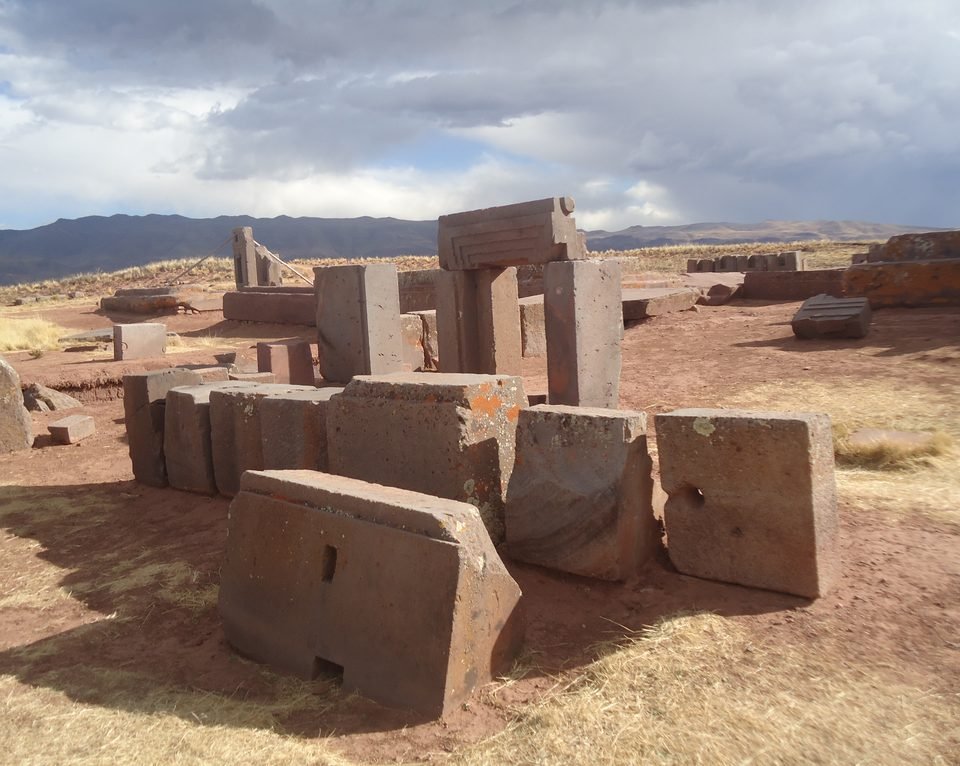
The first Europeans to describe Puma Punku arrived in the middle of the sixteenth century, and the tone of the descriptions is always the same: astonishment. The chronicler Pedro Cieza de León passed through around 1549 and could not imagine how those stones had been brought there and cut. The accounts that followed speak of doorways and windows carved from a single block, of enormous polished slabs — and of a work that seemed to have been interrupted halfway.
By around 1600, according to the chroniclers, a single doorway and a "window" were still standing. In the centuries that followed, not even that. What the visitor sees today is the result of five hundred years of treasure hunting, quarrying and botched restoration, on a building that had already been abandoned before it was finished. That is why Puma Punku is, at the same time, the most refined work of ancient Andean stonemasonry and one of the hardest to understand.
01A temple inside a city
Puma Punku — "gate of the puma," in Aymara — is not an isolated site. It is one of the monumental buildings of Tiwanaku, the city that was, between the seventh and tenth centuries, the largest political and religious center of the Lake Titicaca basin. The city's main core, with the Akapana pyramid, the Kalasasaya platform and the Semi-Subterranean Temple, lies east of the present-day village; Puma Punku lies to the southwest. The complex has been a UNESCO World Heritage Site since 2000.
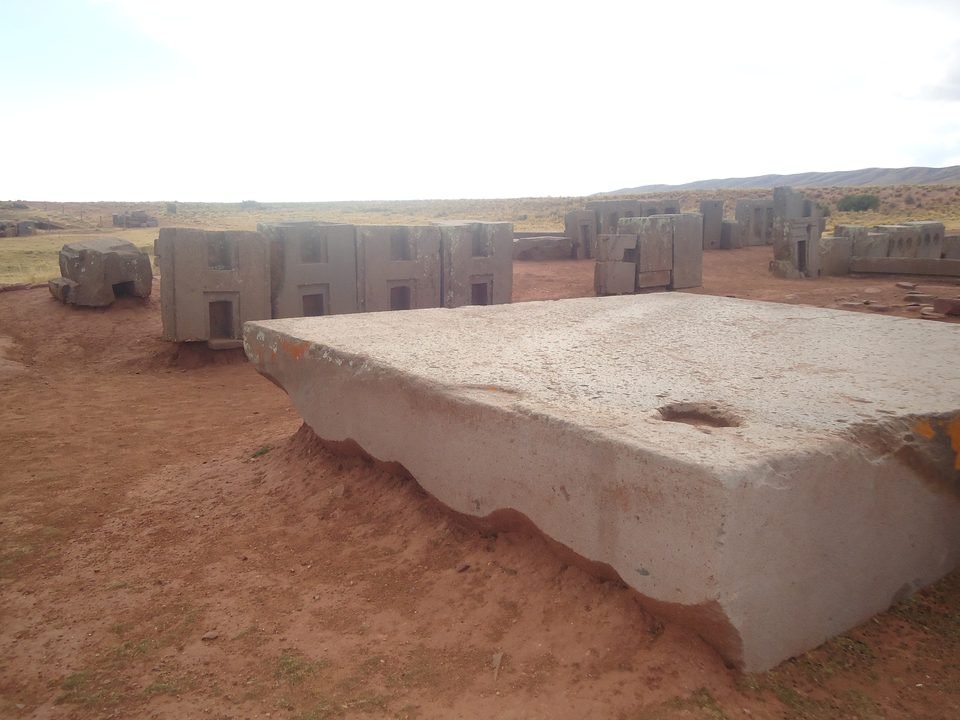
The design is that of a stepped earthen platform, faced with stone, with a T-shaped plan: about 167 meters on the west side and 116 on the north and south sides, according to excavation measurements. A wide sandstone staircase, worn by use, rose on the west. At the top, on the east side, is what is left of the heart of the temple: seventeen sandstone slabs forming a flat surface of almost 39 by 7 meters, with geometric recesses carved where the andesite walls and doorways were meant to sit.
The detail that changes the reading is that the work was unfinished. The chroniclers already said so, and architectural studies have confirmed it: there are slabs with incomplete finishing and andesite blocks with faces still being dressed. Part of the "mystery" of Puma Punku is, in truth, the look of a construction site that stopped more than a thousand years ago.
02The date: from seventeen thousand years to one or two generations
No aspect of Puma Punku has been as distorted as its age. The version that circulates in videos and mystery books — that the site is between eleven and seventeen thousand years old — has an author and a date. It comes from the Austrian-Bolivian engineer Arthur Posnansky, who between 1910 and 1945 defended that antiquity on the basis of geological comparisons and astronomical alignments at the Kalasasaya. The method was abandoned; the figure survived.
Twentieth-century archaeology brought the date much closer. A long chronology by Carlos Ponce Sanginés, from the 1970s, pushed the founding of Tiwanaku back to the second millennium before Christ, and it too was revised. In 1999, Alexei Vranich published a radiocarbon date from the deepest layer of the Puma Punku fill: between 536 and 600 after Christ. Other dates, gathered by Jason Yaeger and Vranich in 2013, built a sequence for the complex.
The finest-grained work is from 2023. Erik Marsh and colleagues brought together 102 radiocarbon dates from Tiwanaku in a Bayesian statistical model, published in PLOS ONE, and refined the chronology of Puma Punku:
- ≈ AD 580 — start of construction, from the model's starting boundary.
- ≈ AD 630 — last use of stone quarried and carved for the work. After that, at both Puma Punku and the Akapana, the masonry switches to reused stones, little modified.
- ≈ AD 710 — end of construction.
- ≈ AD 740 – 770 — offerings deposited along the outer walls.
- ≈ AD 1020 — a looter's pit is already disturbing the old offerings.
The consequence is the study's strongest sentence: perhaps only one or two generations of stonemasons made most of Tiwanaku's famous ashlar masonry, with its smooth planes, geometric corners and tight joints. It is not a centuries-long tradition that was lost; it is a short burst of production, after which the city began to recycle its own stones. The same model places the founding of Tiwanaku at the end of the second century and the end of permanent residence around 1010.
03Two stones, two journeys
Puma Punku was made with two materials, and the difference between them is the key to understanding the work. The foundation slabs and the larger blocks are of red sandstone, a relatively soft sedimentary stone. The fine pieces — doorways, friezes, the H-blocks — are of andesite, a grey, hard, fine-grained volcanic rock that takes a sharp edge and a smooth surface.
The sandstone came from nearby. The petrographic studies of Ponce Sanginés and Mogrovejo, in 1970, pointed to quarries in the Kimsachata range, about ten kilometers to the south. The andesite came from far away, and here the sources diverge. The classic identification is the Copacabana peninsula, on the other side of the lake, some ninety kilometers away. In 2013, John Janusek, Patrick Ryan Williams and colleagues analyzed the Tiwanaku andesite by X-ray fluorescence and concluded that most of it came from Mount Ccapia, an extinct volcano on the south shore of the lake — without ruling out Copacabana. In both readings, the stone crossed or skirted Titicaca, and there is a roughly dressed andesite block abandoned near the shore, at the ancient port of Iwawe, which suggests the route by water.
The weight of the largest slabs is another point where the numbers do not add up. The most repeated figure, about 131 tons for a slab measuring 7.8 by 5.2 meters, comes from Ponce Sanginés's measurements. Vranich, in 2018, describes the largest sandstone slab as 8.12 by 3.86 by 1.2 meters and estimates 83 tons. Part of the difference is which slab is measured and what density is assumed for the stone; this dossier records both without choosing. Either way, it is a load for ramps, levers, ropes and a great many people — not for mystery.
04The H-blocks and serial production
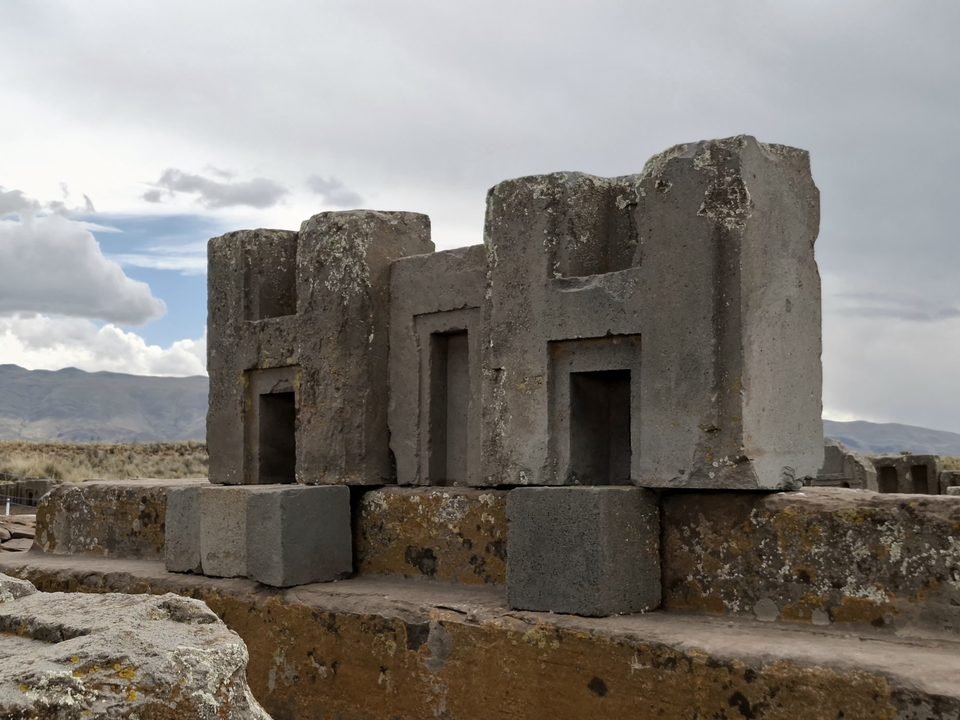
The H-blocks are the image of Puma Punku. Seen from the front, each one has the profile of a letter H, with niches, steps and right-angled inner corners. What impresses is not a single block, but the repetition: there are pieces practically identical to one another, and mirrored versions, right-handed and left-handed, of the same shape. For the architect Jean-Pierre Protzen and the architectural historian Stella Nair, who studied Tiwanaku's stonemasonry from the 1990s on, this indicates standardization — interchangeable forms, produced according to rules of proportion.
They also noticed a peculiarity of method. At Tiwanaku, each andesite block was finished before being set, including the decorative friezes that ran across several pieces. In many traditions, relief is carved after the wall is assembled; not here. The blocks have recesses carved for lifting, which allowed them to be lowered slowly without breaking the edges. And a famous block, the so-called "Escritorio del Inca" (the Inca's desk), turned out to be a scale model: a reduced version, at a fixed ratio, of a full-size architectural composition. There were stone models to guide the work.
With what tools? It is one of the questions that remain open, and Protzen and Nair say so plainly: the tools of Tiwanaku's stonemasons are essentially unknown. The sharp right-angled inner corners do not come from percussion: the tip of the hammerstone cannot reach the bottom of the corner. In Nair's experiments, tools of harder stone — flint, agate, jasper, obsidian, hematite — worked; bronze, hardly at all. The working interpretation is a combination of pecking, abrasion with sand and templates, with a great deal of time and organized labor.
05The metal cramps
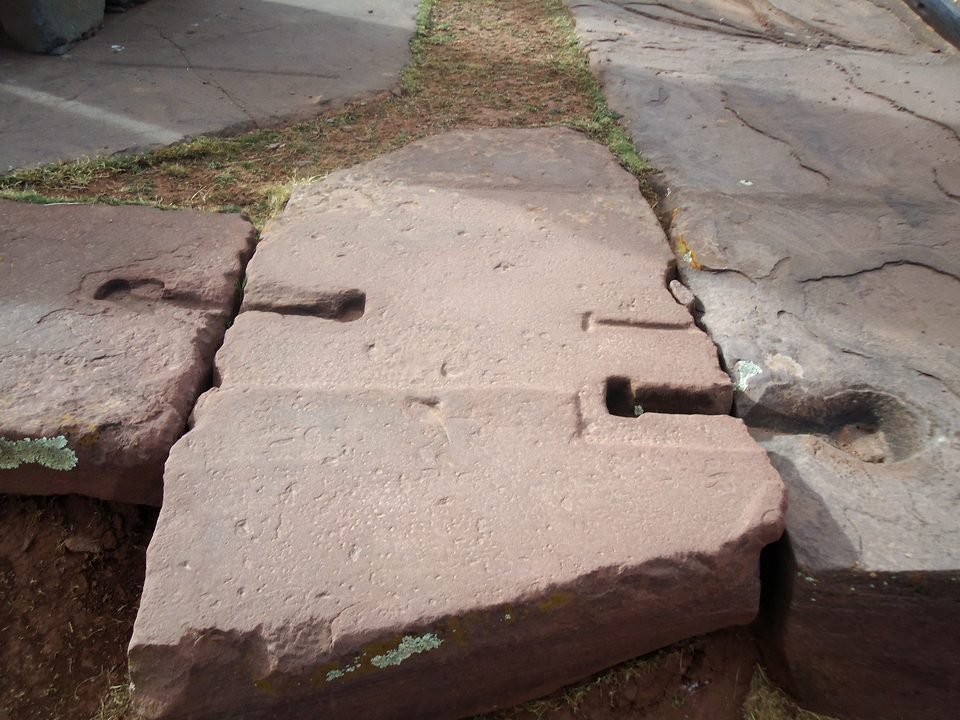
In several of Puma Punku's slabs and blocks there are shallow I- or T-shaped sockets, carved on both sides of a joint. They held metal cramps that tied one stone to its neighbor and kept them from sliding — a device also known in ancient Egypt and in Greece. Today almost all the sockets are empty.
The cramps that survived were analyzed by the archaeometallurgist Heather Lechtman, of MIT, in work published in 1997 and 1998. The metal is an unusual alloy, a copper-arsenic-nickel bronze. And the method of manufacture varied: in the cramps of a channel on the south side of Puma Punku, the metal was cast in place — poured as a liquid into the already carved sockets, where it took the shape of the cavity. At the Akapana, the cramps of a channel were made another way, by cold-hammering ingots of the same alloy.
Casting on site, at 3,850 meters, requires a crucible and a furnace capable of melting bronze — which fits with what is known of Andean metallurgy of the period. Lechtman placed alloys of this type in a zone between Tiwanaku and San Pedro de Atacama, in northern Chile, between the years 600 and 900. It is regional technology, dated and consistent with the chronology of the work.
06Five centuries of dismantling
Puma Punku did not fall on its own. The destruction has layers, and each one left its mark:
- Colonial looting. The Spanish believed there was gold in the ruins and turned them over; the treasure hunting went on for centuries. Vranich himself sums it up: over the last five hundred years, treasure hunters dismantled the building to the point that none of the roughly 150 pieces of the standing architecture is in place.
- A ready-made quarry. Cut stone is cheap building material. Blocks from Tiwanaku were taken for houses, bridges and the colonial church of the neighboring village, built in the early seventeenth century, and also to La Paz.
- The railway. The line between La Paz and the port of Guaqui, on the lake, opened at the beginning of the twentieth century, runs through the archaeological zone, and stones from the ruins were broken up and used as ballast and fill for the track.
- Gunfire and weathering. There are records of the ruins being used as targets by soldiers, and the altiplano climate — frost, rain, strong sun — works on whatever was left exposed.
- Botched restoration. In the mid-twentieth century, a nationalist-inspired excavation and reconstruction program reassembled entire stretches of Tiwanaku to give the site a more monumental look. In 2006, on the orders of an interim president, the Puma Punku slabs were leveled and several blocks were repositioned — in the wrong place and arrangement, according to Vranich, contrary to available publications.
What remained for research, besides the overturned stones, were the records of those who came before: the plan and drawings of the French diplomat Léonce Angrand, from 1848, and the photographs and notes of the German archaeologist Max Uhle, from 1893. In 2001, the Indigenous communities of the region took over management of the ruins; today the administration is carried out in collaboration with national and international bodies.
07Assembling the temple in the palm of your hand
In December 2018, Alexei Vranich, then affiliated with the University of California, Berkeley, published in the journal Heritage Science a way out of the puzzle. Instead of scanning the stones — laser scanning and photogrammetry had proved expensive, fragile in the altiplano climate and too heavy for those who manage the site —, the team went back to the field notebooks. Most of the blocks were modeled from the measurements taken by Protzen in the 1990s; pieces lost in the last century came from the notes of Angrand and Uhle.
The measurements were entered into a simple modeling program, and each piece was printed in plaster on a 3D printer, at 4% of actual size — and not at one tenth, as is sometimes repeated. In all, 140 andesite pieces and 17 sandstone slabs; the slabs were milled into a single fiberboard sheet, which became the worktable. With the miniatures in hand, the researchers spent months testing fits. The decisive moment came when they realized that the model of the "Escritorio del Inca" and a miniature doorway met at a right angle: the facade that had been imagined as straight was, in fact, the corner of a building.
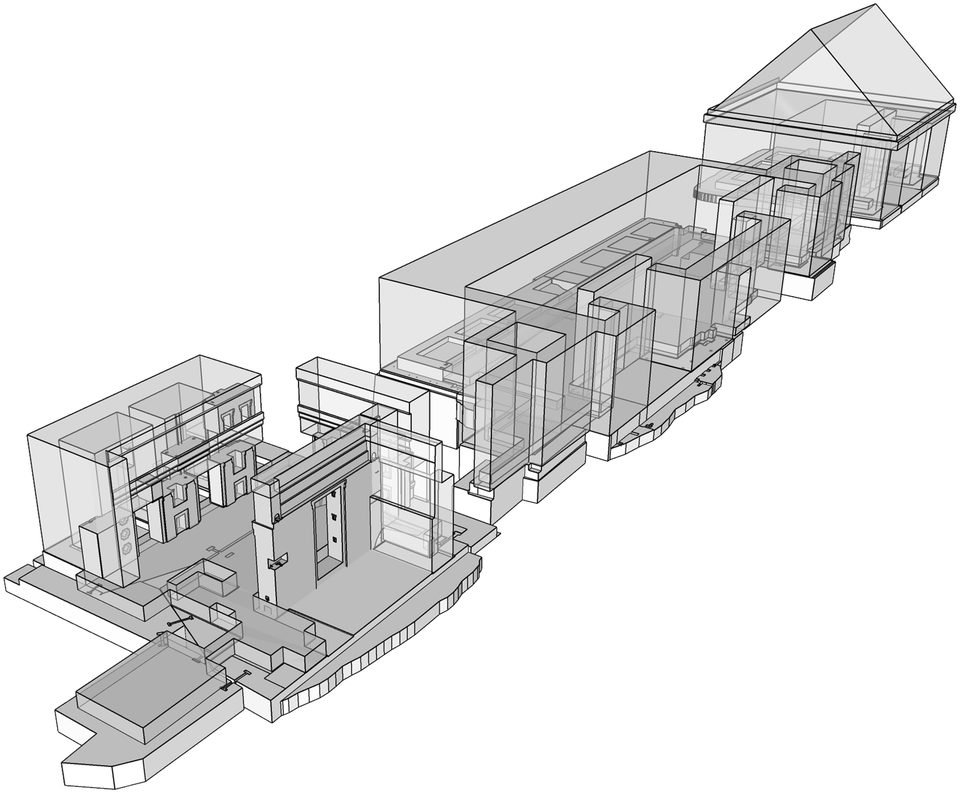
The form that emerged was recognized at once by specialists: it is the design of older buildings in the Titicaca basin itself, such as those of Chiripa and Pucara, centuries earlier than Tiwanaku. Vranich noted, with some irony, that this finally provided solid proof against the idea, repeated by alien enthusiasts, that Puma Punku had no local precedents. A complete set of the printed pieces was handed over to the site's Indigenous administrators.
The caveat that Vranich's own colleagues make is worth noting. The 2023 Bayesian study warns against idealized reconstructions, based on right angles, symmetry and perfect proportions, which tend to ignore the details that do not fit. The 2018 reconstruction is the best available proposal for the shape of the building — and it is a proposal.
08Discovered yesterday: stone chosen for its place
In mid-2026, a team led by Luis Flores-Blanco and Patrick Ryan Williams, of Arizona State University, published in the Journal of Archaeological Science: Reports the chemical analysis of eight Tiwanaku chachapumas — volcanic stone sculptures of beings half human, half feline, which flanked the doorways of the temples. Using portable X-ray fluorescence and statistics, checked in the laboratory, they concluded that the stone of the statues came from sources more than forty kilometers away, even though suitable stone was available closer by.
The authors' interpretation is that the choice followed the meaning of the places the stone came from, and not just convenience. It is in the same line as the 2013 study on the andesite, in which Williams also took part: at Tiwanaku, bringing stone from far away — from a volcano, from a sacred peninsula on the lake — was part of the meaning of the work. The study did not analyze the Puma Punku blocks, and eight statues are a small sample; the team plans to extend the analysis to the whole Titicaca basin. But it helps answer the question that most feeds the mystery — why haul andesite for dozens of kilometers — without needing any mystery at all.
09The readings, from the most sober to the most improbable
A Tiwanaku work, built between the sixth and eighth centuries, and left unfinished
It is the reading that brings together every line of evidence. Radiocarbon places the construction between the late sixth century and the early eighth. The sandstone and andesite quarries have been identified in the region itself. The cramps are of a regional alloy of the same period. The form of the building, as reconstructed, repeats older models from the Titicaca basin. And the work shows what one expects of interrupted human labor: unfinished faces, guiding scale models, variation between pieces.
What remains open within this reading — the exact tools, the method of transport, the final form — is a question for archaeology, not a gap that calls for another explanation.
Where the andesite came from, and by what route
Copacabana, ninety kilometers away, according to the classic identification; Mount Ccapia, on the south shore of the lake, according to the 2013 chemical analysis. By water, in reed boats, as the block abandoned at Iwawe suggests, or overland, skirting the lake. The sources do not agree, and there may have been more than one quarry.
The Gate of the Sun belonged to Puma Punku
Tiwanaku's most famous monolithic doorway now stands in the Kalasasaya, where it was re-erected. Many specialists think it was made for Puma Punku, judging by the stone, the style and the fragments of other similar doorways found there. It is a well-founded hypothesis, with no proof of its original position.
The blocks are artificial stone, molded like concrete
In 2019, Joseph Davidovits, Luis Huaman and Ralph Davidovits published in the journal Materials Letters the thesis that the sandstone and andesite of Puma Punku are "geopolymers" — grains of stone bound by a man-made paste and molded in place. The proposal appeared in a materials-science journal, from a group that argues the same idea for the pyramids of Egypt, and has not been confirmed by independent analysis. It runs up against the identified quarries and the dressing marks on the unfinished blocks.
Seventeen thousand years old
Posnansky's chronology depended on astronomical alignments and geological assumptions, without physical dating. All the dated organic material from the Puma Punku fill falls in the first millennium after Christ.
Aliens, or a lost technology
Puma Punku has been a fixture of the "ancient astronauts" literature since the books of Erich von Däniken and became an entire episode of the TV series Ancient Aliens. The argument is always the same: too much precision, too much altitude, too much stone for the period. The pieces answer one by one. The stone is local and the quarries are known. The metal is regional bronze. The date is measured. The form has precedents in the region. And the work is full of signs of the human hand: unfinished blocks, scale models, "identical" pieces that are not identical.
There is also a cost to this thesis that is rarely mentioned. Taking the authorship of Puma Punku away from the peoples of the altiplano — whose Aymara descendants still live around the ruins and today take part in managing the site — erases the ability of those who actually raised it. What Puma Punku shows is not that someone from outside came to build it; it is that one or two generations of Andean stonemasons, fourteen centuries ago, produced some of the most refined stonework of the ancient world.
10Chronology
- ≈ 550 BC – AD 300Chiripa and Pucara, in the Titicaca basin, build sunken courts and rectangular enclosures — the model that reappears at Puma Punku.
- late second centuryFounding of Tiwanaku, according to the 2023 Bayesian model.
- 536 – 600Radiocarbon date from the deepest layer of the Puma Punku fill, published by Vranich in 1999.
- ≈ 580Start of construction, according to the 2023 model.
- ≈ 630Last use of stone quarried and carved for the work; from then on, Puma Punku and the Akapana reuse stones.
- 600 – 900The range in which the copper-arsenic-nickel bronze appears between Tiwanaku and San Pedro de Atacama.
- ≈ 710End of construction. The temple is left unfinished.
- ≈ 1010End of permanent residence at Tiwanaku. A looter's pit at Puma Punku is dated to around 1020.
- ≈ 1549Pedro Cieza de León describes the ruins, among the first Europeans to do so.
- ≈ 1600A doorway and a "window" are still standing. The use of the ruins as a quarry begins, including for the village church.
- 1848Léonce Angrand draws the first known plan of the temple.
- 1893Max Uhle photographs and measures the blocks on the east side.
- 1910 – 1945Arthur Posnansky argues for an age of eleven to seventeen thousand years for Tiwanaku.
- early twentieth centuryThe La Paz–Guaqui railway crosses the archaeological zone; stones from the ruins become ballast.
- 1970Ponce Sanginés and Mogrovejo identify the sources of the sandstone and the andesite.
- 1990sProtzen and Nair measure the andesite blocks and study the stonemasonry technique.
- 1997 – 1998Heather Lechtman publishes the analysis of the cramps: copper-arsenic-nickel bronze, cast in place at Puma Punku.
- 2000Tiwanaku is added to the UNESCO World Heritage List.
- 2006An intervention ordered by the interim government levels the slabs and repositions blocks incorrectly.
- 2013Janusek, Williams and colleagues point to Mount Ccapia as the main source of Tiwanaku's andesite.
- December 2018Vranich publishes the 3D-printing reconstruction in Heritage Science.
- 2019The geopolymer thesis comes out in Materials Letters.
- November 2023Marsh and colleagues publish the Bayesian chronology of Tiwanaku in PLOS ONE.
- mid-2026Flores-Blanco and Williams's team shows that the stone of the chachapumas came from sources more than 40 km away.
11What remains open
With what tools. The experiments show that hard-stone tools and abrasives are enough for the result, but no toolkit of Tiwanaku's stonemasons has been found in a workshop context that settles the question.
What the building looked like. The 2018 reconstruction proposes the general form of the andesite building, but the connection between the blocks and the recesses in the slabs is certain at only one point, and an unknown number of pieces have been lost or remain buried.
From where, exactly, and by what route. Copacabana or Ccapia, or both; across the lake or overland. The chemistry of the Puma Punku stones, piece by piece, has not yet been published at the scale of the chachapumas study.
Why it stopped. The 2023 model shows that new stone stops arriving around 630 and that the city begins to recycle. Whether it was a change of power, of plan or of resources, no one knows. And most of the Tiwanaku complex remains unexcavated.
12Frequently asked questions
What is Puma Punku?
It is a Tiwanaku temple: a stepped earthen platform, faced with stone and with a T-shaped plan, on which an andesite building was meant to stand. The work was left unfinished and was dismantled over five centuries; none of the roughly 150 andesite blocks is where it was placed.
Where is Puma Punku located?
At Tiwanaku, on the Bolivian altiplano, at an altitude of 3,850 meters, in the Lake Titicaca basin. It lies southwest of the main core of the ancient city, which has been a UNESCO World Heritage Site since 2000.
Who built Puma Punku?
The stonemasons of Tiwanaku. The stone comes from quarries in the region itself, the cramps are of a regional bronze alloy from the same period, and the form of the building repeats older models from the Titicaca basin. See the readings.
How old is Puma Punku?
According to radiocarbon dating, construction began around 580 after Christ and ended around 710, according to the 2023 model. The age of eleven to seventeen thousand years that circulates online comes from Arthur Posnansky and has no physical dating behind it. See The date.
How was Puma Punku made?
The exact tools remain unknown. The working interpretation is pecking, abrasion with sand and templates, using hard-stone tools, a great deal of time and organized labor; the blocks were finished before being set, and several stones were tied to one another with metal cramps. See The H-blocks.
13Sources consulted
This dossier is original writing. The sources below were consulted to verify dates, measurements and attributions; none was reproduced.
- Consolidated encyclopedic entries on Puma Punku and Tiwanaku — location, dimensions, history of destruction, theories.
- Ponce Sanginés, C.; Mogrovejo Terrazas, G. — Acerca de la procedencia del material lítico de los monumentos de Tiwanaku. La Paz, 1970.
- Protzen, J.-P.; Nair, S. — Who Taught the Inca Stonemasons Their Skills? A Comparison of Tiahuanaco and Inca Cut-Stone Masonry. Journal of the Society of Architectural Historians, 1997.
- Protzen, J.-P.; Nair, S. — The Stones of Tiahuanaco: A Study of Architecture and Construction. Cotsen Institute of Archaeology, UCLA, 2013.
- Lechtman, H. — Architectural Cramps at Tiwanaku: Copper-Arsenic-Nickel Bronze. In Rehren, Hauptmann and Muhly (eds.), Metallurgica Antiqua, 1998; and a 1997 paper on the distribution of the alloy.
- Vranich, A. — Interpreting the Meaning of Ritual Spaces: The Temple Complex of Pumapunku, Tiwanaku, Bolivia. Dissertation, University of Pennsylvania, 1999.
- Yaeger, J.; Vranich, A. — A Radiocarbon Chronology of the Pumapunku Complex and a Reassessment of the Development of Tiwanaku, Bolivia. In Advances in Titicaca Basin Archaeology-2, Cotsen Institute, 2013.
- Janusek, J. W.; Williams, P. R.; Golitko, M.; Lémuz Aguirre, C. — Building Taypikala: Telluric Transformations in the Lithic Production of Tiwanaku. In Mining and Quarrying in the Ancient Andes, Springer, 2013.
- Vranich, A. — Reconstructing ancient architecture at Tiwanaku, Bolivia: the potential and promise of 3D printing. Heritage Science, vol. 6, art. 65, December 2018.
- Davidovits, J.; Huaman, L.; Davidovits, R. — Ancient geopolymer in south-American monument. SEM and petrographic evidence. Materials Letters, vol. 235, 2019.
- Marsh, E. J. et al. — The center cannot hold: A Bayesian chronology for the collapse of Tiwanaku. PLOS ONE, November 2023.
- Flores-Blanco, L.; Guengerich, A.; Bowen, C.; Janusek, J. W.; Williams, P. R. — Volcanic stone sculptures of were-animals at Tiwanaku: pXRF and statistical analyses suggest regional geochemical provenance of chachapuma statues. Journal of Archaeological Science: Reports, 2026 (doi 10.1016/j.jasrep.2026.105858); and Arizona State University news release, July 13, 2026.
- UNESCO — inscription of Tiwanaku: Spiritual and Political Centre of the Tiwanaku Culture on the World Heritage List, 2000.