The moai of Easter Island — the bodies beneath the slope
The heads everyone knows, on the slope of a volcano in the middle of the Pacific, are not heads. They are whole statues, with torso, arms and hands, buried up to the chest by the earth that came down from the quarry itself. The same mistake — seeing only the top part — repeats itself in the story of those who made them.
- Where
- Rapa Nui (Easter Island), Chile
- Settlement
- dates diverge: ≈ AD 800 to 1200
- Statues
- ≈ 900 to 1,000, depending on the inventory
- Made at Rano Raraku
- ≈ 95%
- Largest erected
- Paro, ≈ 10 m
- Largest unfinished
- Te Tokanga, ≈ 21 m
Rapa Nui is a triangle of volcanic land of about 164 square kilometers, some 3,500 kilometers off the coast of Chile and a little over 2,000 from the nearest inhabited island, Pitcairn. It is one of the most isolated places human beings have ever settled. Polynesian navigators reached it in double-hulled canoes, coming from the west, and brought what every Polynesian expedition brought: crop plants, chickens and — as stowaways or on purpose — the Pacific rat.
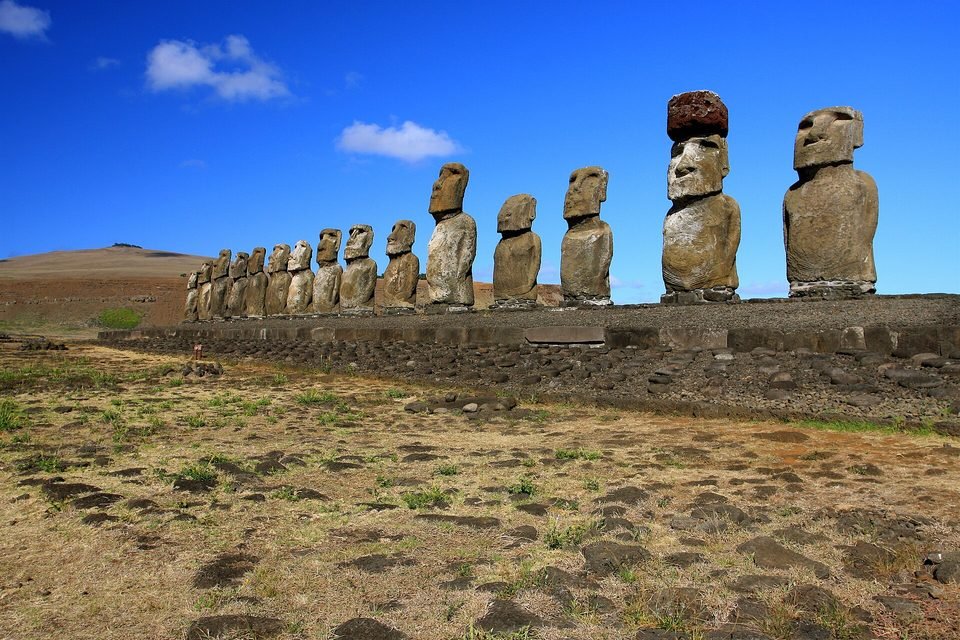
What they left is known around the world: the moai, human figures of stone, with large heads, long noses and pronounced chins, almost all carved from a single volcano. They were raised on ceremonial platforms called ahu, generally with their backs to the sea and facing the villages, and the Rapanui themselves read them as representations of ancestors. None of them is an ownerless mystery: there is a living people, with a language, an oral tradition and claims, who call them their own.
The mystery the internet repeats — "who made them, and how?" — is the least mysterious of the three. The hard questions are others: when the island was settled, how statues weighing dozens of tons crossed kilometers without the wheel or draft animals, and what actually happened to the population. The version that became a best-seller answers all three at once, with a story of self-destruction. The research of the last twenty years has separated the three, and answered each one differently.
01When they arrived: the date that shrank
For much of the twentieth century, the accepted date for the arrival of the first Polynesians lay between the fourth and eighth centuries. It came from radiocarbon dates obtained from the 1950s onward, some with error margins of two centuries either way, and from charcoal samples whose link to human occupation was not always clear.
In 2006, Terry Hunt and Carl Lipo published in Science new dates for the oldest layers at Anakena beach, the landing place of the oral tradition, and proposed a short chronology: arrival around AD 1200. Later work that applied stricter criteria to the old dates — discarding samples of uncertain context or of wood that might already have been old when it burned — arrived at a similar range, around 1150 to 1280. The short chronology is now the most cited, and it fits the late settlement of all of East Polynesia.
It is not unanimous. Researchers connected with the older excavations continue to argue that some first-millennium dates deserve revision, not dismissal. The disagreement matters for a practical reason: if the island was occupied in 800, there were four more centuries for the population to grow and for the forest to disappear slowly; if it was in 1200, everything — moai, deforestation, platforms — happened in much less time.
02The quarry: hundreds of half-finished statues
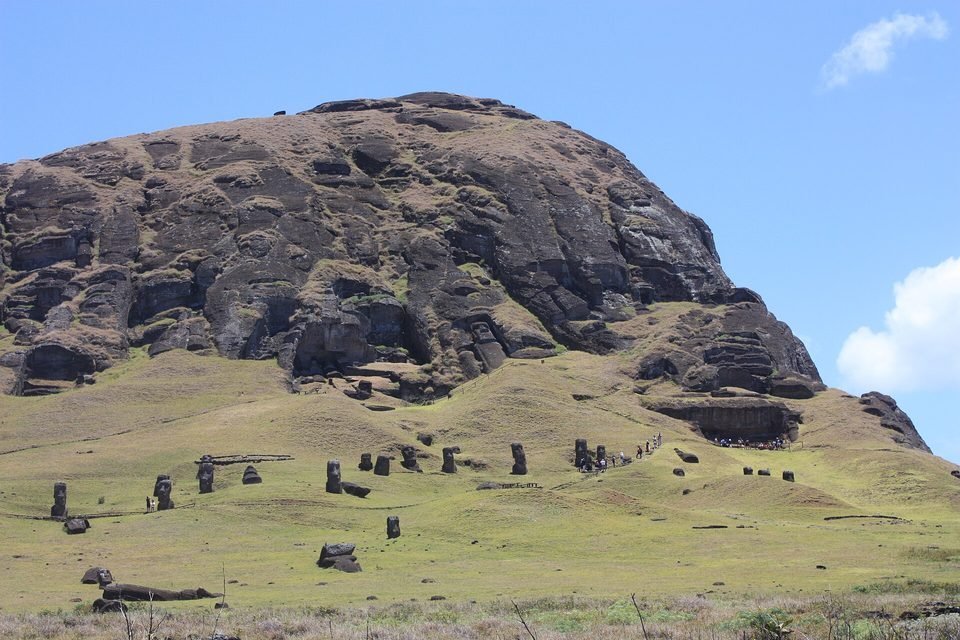
Almost all the moai — about 95% — were carved at Rano Raraku, a small volcanic cone in the east of the island. The rock is a lapilli tuff, compacted volcanic ash, soft enough to be worked with basalt tools, called toki, which are still found by the thousands on the spot. Other statues, far fewer, were made of basalt, trachyte or red scoria. The red stone of Puna Pau was used for the pukao, the cylinders some statues wear on their heads.
What makes Rano Raraku unique is that it stopped in the middle of the work. The statues were carved lying down, backs to the rock, first the front and the sides; last of all, the keel that held them to the rock face was cut, and the piece was lowered down the slope. There are moai at every stage: barely begun outlines, figures with finished faces still attached by the spine, empty niches from which a statue has already left. The largest of them, Te Tokanga, is about 21 meters long and was never freed from the rock — more than twice the size of the largest moai ever erected.
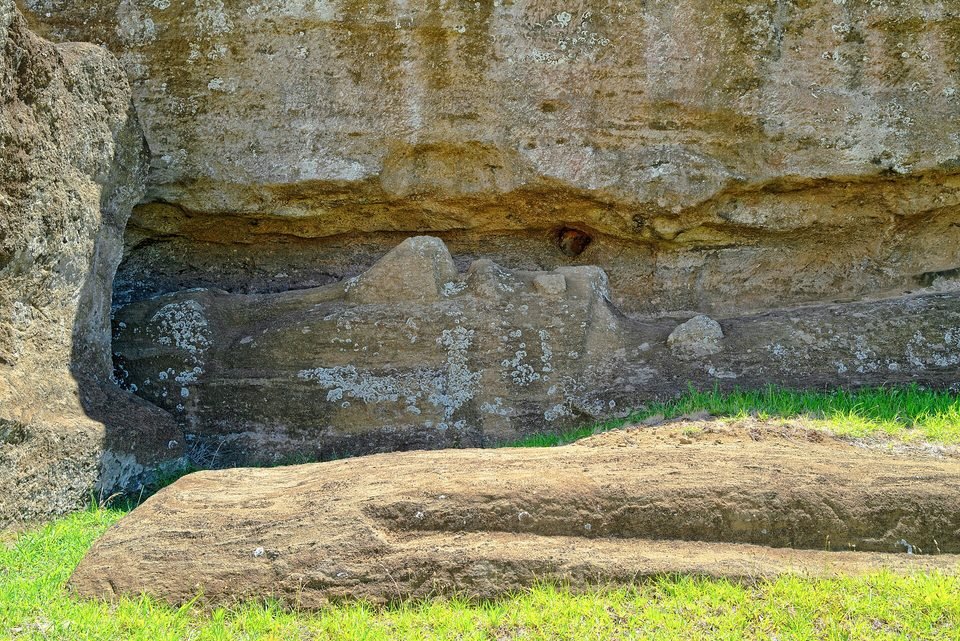
Why so many were left half-finished is one of the open questions. There are three explanations, which are not mutually exclusive. Some pieces may have been abandoned because of flaws — an inclusion of hard rock, a crack. Some reflect the end of production, when moai stopped being made. And Te Tokanga may never have been meant to leave: its size has no parallel in any transported moai.
03The bodies beneath the slope
On the slopes of Rano Raraku, inside and outside the crater, there are dozens of standing moai of which only the head and shoulders can be seen. They are the "Easter Island heads" of the photographs. The image deceives: beneath each one is a whole body, several meters tall, covered by the debris that came down from the quarry over the centuries — the rubble of the carving work itself, plus the erosion of the volcano.
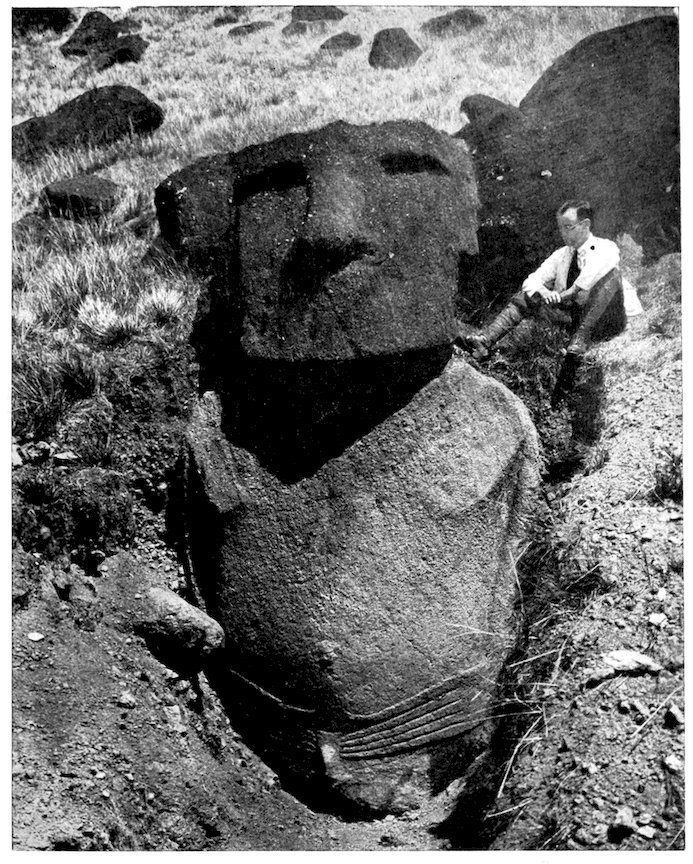
This is not a recent discovery. The British archaeologist Katherine Routledge excavated some of these statues during the Mana expedition, in 1914 and 1915, and photographed whole bodies inside the trenches. Thor Heyerdahl repeated excavations during the Norwegian expedition of 1955–1956. The news that goes viral from time to time — "the heads have bodies!" — presents as new what has been published for more than a hundred years.
What is recent is the detail. In 2010 and 2011, the Easter Island Statue Project, directed by the archaeologist Jo Anne Van Tilburg, of the University of California, Los Angeles, re-excavated two statues in the quarry, with modern recording. One of them had its back covered in petroglyphs: Polynesian canoes, a flying fish and other motifs, which the team studied in a 2021 paper. And the excavation showed how it had been raised: in a deep pit, set on a stone base and wedged with a chock stone, the same system used on the ahu.
The consequence is that these statues are not "on their way" anywhere. They were raised there on purpose. What for is debated: Van Tilburg suggests that many were stood up so that their backs could be finished before the journey; other researchers read them as statues meant for the quarry itself, which would also have served as a ceremonial place. The excavations do not decide between the two readings.
04How they were moved
The Rapanui oral tradition has a short answer: the moai walked, by the power of mana. For a long time, researchers read this as a metaphor and worked with a more intuitive idea — the statue lying on a wooden sled, pulled over rails or rollers. The hypothesis required a lot of wood and a lot of people, and so it fit neatly into the story of deforestation.
Experimental testing has a long history. In 1986, the Czech engineer Pavel Pavel, with Heyerdahl, showed that a standing moai could be moved forward by rocking it with ropes, pivoting on its base. In 1987, Charles Love tested a standing statue on a sled with rollers. In 1998, Van Tilburg tested a replica lying on a ladder-like frame. All of them worked, each with its own difficulties. An experiment that works proves that a method was possible — not that it was the one used.
What changed the debate was looking at the statues left along the way. There are about sixty fallen moai along the ancient roads leading out of Rano Raraku. Hunt and Lipo showed that they are not like those on the ahu: they have a wider, D-shaped base and a body leaning forward. That design places the center of gravity in front of the base, which is exactly what a statue needs in order to "walk" in a zigzag, rocked by ropes on both sides and pulled by a third from behind. When it reached the ahu, the statue was reworked: the base was flattened and the lean disappeared.
In 2012, the team built a 4.35-ton concrete replica with the proportions of a road moai. Eighteen people, with three ropes, moved it a hundred meters in about forty minutes. The paper came out in 2013. The roads reinforce the reading: they are about four and a half meters wide with a slightly concave profile, which helps steady a rocking statue. And the breakage pattern of the fallen statues — face down and face up, broken where a standing piece would break as it toppled — is that of a piece that fell while moving, not that of one that slid off a sled.
05The collapse that became a best-seller
The best-known version of the story of Rapa Nui was consolidated in the 1990s and popularized by Jared Diamond in his book Collapse, from 2005. It goes like this: the population grew to perhaps fifteen or twenty thousand people; the clans competed by raising ever larger moai; the forest was cut down to transport them and to clear fields; without trees there were no canoes, the land eroded, then came hunger, war and even cannibalism; and when the Europeans arrived, in 1722, they found the survivors of a society that had destroyed itself. It is a powerful ecological parable, and that is why it spread so widely.
Part of it is solid. The island did have a forest, dominated by a giant palm now extinct, and it disappeared after humans arrived — the pollen cores from the crater lakes show this. The production of moai also stopped, and the statues on the ahu were all eventually toppled in the nineteenth century. What the revision disputes is the link between these facts, and the population crash that should have accompanied them.
What recent research has added
- The rats. The Pacific rat, with no predators on the island, multiplied quickly. Palm nuts found in caves almost all bear rat tooth marks. Hunt and Lipo's thesis is that the rats kept the forest from regenerating by eating the seeds, while fire and fields opened up the land. The forest vanished, but not because of the moai.
- The rock gardens. The Rapanui grew sweet potatoes in "rock gardens" — stones spread over the soil to retain moisture and nutrients. A June 2024 study in Science Advances, by Dylan Davis, Robert DiNapoli and colleagues, mapped these gardens by satellite with machine learning and concluded that they covered much less area than had been estimated. The population they could have supported, together with fishing, would be around 3,900 people at most — close to the roughly three thousand that the first European visitors estimated, and very far from the fifteen thousand of the collapse.
- The genomes. The study published in Nature in September 2024, led by Víctor Moreno-Mayar and Anna-Sapfo Malaspinas, sequenced fifteen Rapanui who lived between 1670 and 1950. There is no sign of the seventeenth-century population bottleneck that the collapse hypothesis requires: the population grew steadily from the thirteenth century until European contact.
- The platforms. A Bayesian analysis of the construction dates of the ahu, from 2020, concluded that the Rapanui kept building, maintaining and using the monuments for at least 150 years after 1600 — that is, until after the arrival of the Europeans, in 1722.
- The drought. A November 2025 study in Communications Earth & Environment, based on leaf waxes preserved in the crater sediments, identified a prolonged drought beginning in the mid-sixteenth century, with a drop of 600 to 800 millimeters in annual rainfall. Its onset coincides with the decline in the construction of moai and ahu and with the rise of the birdman cult at Orongo. It is an explanation of adaptation to a drier climate, not of ecological suicide.
Defenders of the classic version have not disappeared, and some of the criticisms are legitimate: population estimates from satellite data depend on assumptions about agricultural productivity; and the genomes analyzed begin in 1670, so the period before that is inferred by modeling. But the weight of the evidence has changed sides. The version with the most support today is that of a small population that transformed the landscape, adapted its agriculture and religion, and was still functioning when the ships arrived.
06The collapse that actually happened
There was a population collapse on Rapa Nui. It just was not prehistoric. The Dutch navigator Jacob Roggeveen arrived on Easter Sunday of 1722 — hence the island's European name — and opened a century and a half of contacts that brought disease. In December 1862, ships of Peruvian slave traders carried off by force some 1,400 to 1,500 Rapanui, something like a third of the population, to work on plantations and in the guano deposits. Most died within a short time. Under international pressure, a few survivors were sent back; they brought smallpox, and the epidemic devastated those who had stayed.
Then came missionaries, the deportation of inhabitants to Tahiti and the transformation of the island into a sheep ranch. In 1877, 111 Rapanui remained. Along with the people went most of the memory: priests, chiefs and those who could read rongorongo, the island's script, still undeciphered today. Chile annexed Rapa Nui in 1888. It is this collapse, documented and caused from outside, that the parable of ecocide tends to erase — and that is why many Rapanui reject the version in which their ancestors destroyed their own island.
07Fire, restitution and a statue in the lagoon
The 2022 fire
On October 4, 2022, a fire swept more than a hundred hectares of Rapa Nui National Park, and the worst-hit area was Rano Raraku itself. Dozens of moai were blackened by soot, and some of them suffered damage described by the authorities as irreparable: the porous volcanic tuff cracks and flakes in the heat. UNESCO completed a detailed assessment of the damage in June 2023. Since 2017 the park has been managed by the Rapanui community, through the Ma'u Henua organization.
The statues off the island
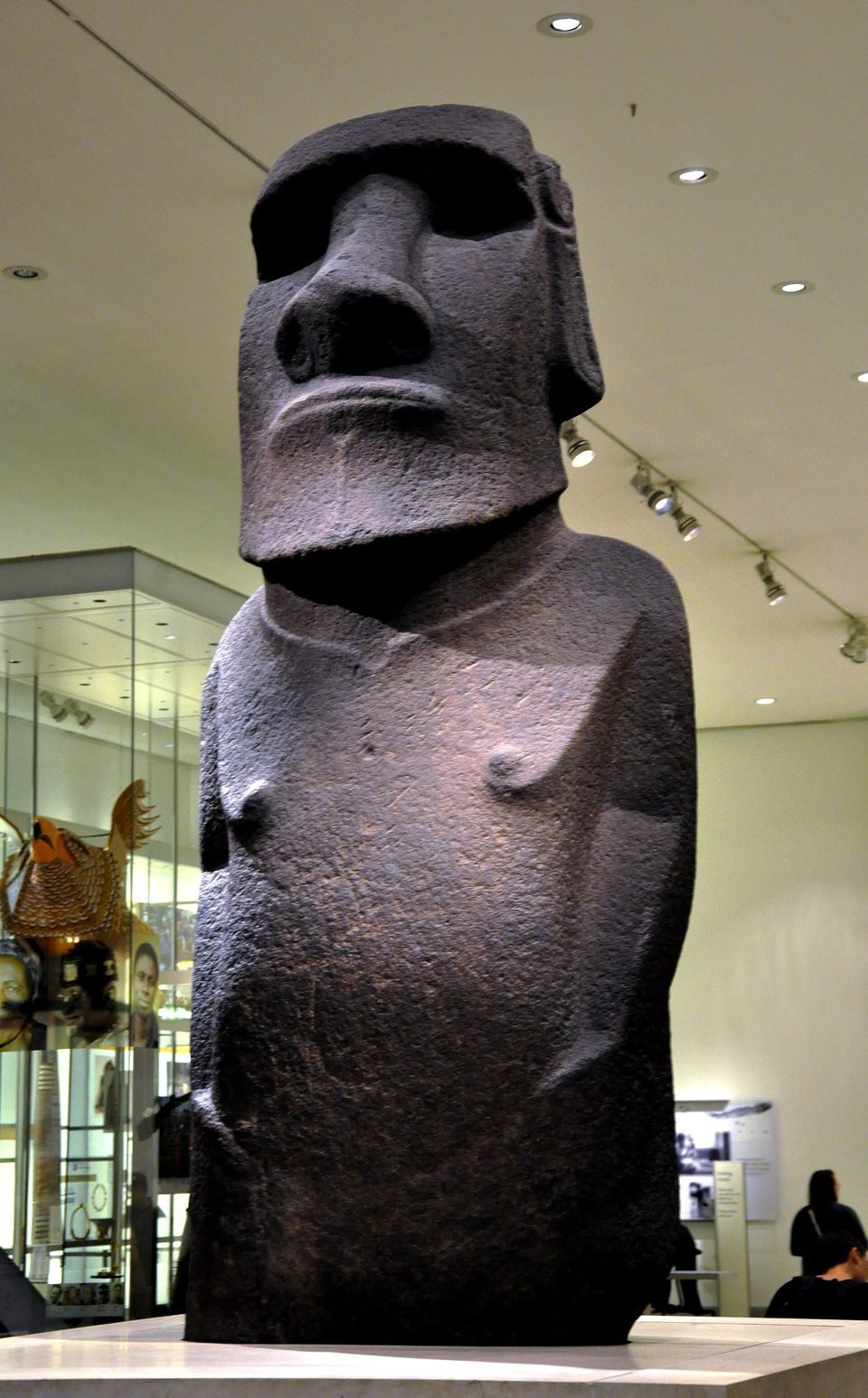
In November 1868, the crew of the British ship HMS Topaze removed from the ceremonial village of Orongo a basalt statue about 2.4 meters tall, called Hoa Hakananai'a. The Navy presented it to Queen Victoria, who gave it to the British Museum in 1869. In July 2018, Rapa Nui formally requested the return of the statue and of another piece; a delegation went to London in November of the same year, and talks continue. The museum has not agreed to return it, and cites the 1963 law that prevents it from giving up most of its collection.
On the Chilean side, there has been a return. In March 2022 the moai Tau, taken to the mainland in 1870 and displayed since 1878 at the National Museum of Natural History, in Santiago, went back to the island, as part of a program for repatriating ancestral remains and sacred objects. It went to the Father Sebastián Englert Anthropological Museum.
The moai that turned up in the lagoon
On February 21, 2023, volunteers from Chilean universities working on the restoration of the wetland in the Rano Raraku crater found a moai about 1.6 meters tall at the bottom of the inner lagoon, then almost dry. It was the first moai found inside the lagoon. The water had dropped after years of drought — which ties the find, by chance, to the same climate theme that the 2025 research brought to the center of the story.
08Discovered yesterday: what changed in 2025
The moai walked: the answer to the critics
In October 2025, Lipo and Hunt published in the Journal of Archaeological Science the full argument for the "walking" hypothesis, with a title that does not hide its tone: archaeological evidence, experimental validation and response to critics. The paper brings together measurements of almost a thousand moai, with attention to the 62 road moai, 3D models that calculate the stability of each shape, the physics of the rocking and the pattern of the roads. The authors' conclusion is that the road moai were designed to be transported upright. It is the best-supported reading today, published with peer review — and it is still a reading: there is no direct record of a statue being moved.
The whole quarry, in three dimensions
On November 26, 2025, the same team published in PLOS One the first complete three-dimensional model of Rano Raraku, assembled from more than eleven thousand drone photographs. The survey counted 426 moai in production, 341 quarrying trenches, 133 empty niches and five anchor points used to lower the statues down the slope. And it identified thirty distinct work areas, each with its own techniques.
The authors' reading is that production was not directed by a central authority, but by independent family groups, each in its own workshop, sharing knowledge — the same decentralized pattern that archaeology already saw in the rest of Rapanui society. If they are right, another piece of the collapse parable falls, since it needed chiefs competing in a race for ever larger statues.
09The readings, from the most sober to the most improbable
The work of the Rapanui, with local stone and stone tools
The quarry is there, with statues at every stage, the basalt tools on the ground and the empty niches the size of the erected statues. The oral tradition, the language and the genome are Polynesian. There is no stage of the process without material evidence.
The moai were "walked" upright to the ahu
Supported by the shape of the road moai, the profile of the roads, the breakage pattern, the 2012 experiment and the oral tradition. The main objection is that it cannot be ruled out that several methods coexisted, depending on the size of the statue and the terrain, and that the largest moai, weighing dozens of tons, have never been tested this way.
Transport lying down, on sleds or on rollers
It works in experiments and was the dominant hypothesis for decades. It does not explain the leaning, wide-based shape of the road moai, nor why they fell both face down and face up. It may have been used for part of the route or for specific pieces.
Ecocide: the society destroyed itself before the Europeans
The deforestation is real, and so is the end of moai production. But the genomes show no population decline in the seventeenth century, the estimated agricultural capacity is a few thousand people, the ahu remained in use until after 1722, and a prolonged drought explains the cultural change without requiring collective suicide. The collapse the documents record is that of the nineteenth century, brought from outside.
Aliens, or a lost civilization
It is the reading that survives only if the quarry is ignored. The entire process is in plain view at Rano Raraku, from the first mark on the rock to the statue standing on the ahu, and those who did it have living descendants who speak the builders' language. Attributing the moai to others is not just wrong: it takes authorship away from a people who are still there.
10Chronology
- ≈ AD 800 – 1200Arrival of the first Polynesians. The long chronology speaks of the first millennium; the short one, now more widely cited, of ≈ 1150 – 1280. The sources diverge.
- thirteenth – seventeenth centuriesMain period of moai carving at Rano Raraku and of ahu construction.
- thirteenth – fifteenth centuriesContact with Native Americans, according to the genetic studies of 2020 and 2024.
- mid-sixteenth centuryOnset of a prolonged drought, according to the 2025 study; the construction of moai and ahu declines and the birdman cult at Orongo grows.
- April 5, 1722Jacob Roggeveen reaches the island on Easter Sunday.
- December 1862Peruvian traffickers carry off some 1,400 to 1,500 Rapanui as slaves. Smallpox arrives with the few who return.
- November 1868HMS Topaze removes Hoa Hakananai'a from Orongo; the statue goes to the British Museum in 1869.
- 1877111 Rapanui remain on the island.
- 1888Chile annexes Rapa Nui.
- 1914 – 1915Katherine Routledge's Mana expedition excavates Rano Raraku moai and photographs the buried bodies.
- 1955 – 1956Thor Heyerdahl's Norwegian expedition; new excavations and the first radiocarbon dates.
- May 22, 1960The Chile earthquake generates the tsunami that scatters the fallen statues of Ahu Tongariki.
- 1986 – 1998Transport experiments: Pavel Pavel (upright, rocked), Charles Love (upright, on a sled), Van Tilburg (lying down, on a wooden frame).
- 1990sA Chilean team re-erects the fifteen moai of Ahu Tongariki.
- 2005 – 2006Jared Diamond publishes Collapse; Hunt and Lipo propose the short chronology in Science.
- 2010 – 2011Jo Anne Van Tilburg's Easter Island Statue Project excavates two statues in the quarry, one with petroglyphs on its back.
- 2012Eighteen people "walk" a 4.35-ton replica a hundred meters in about forty minutes.
- 2017The Rapanui community, through Ma'u Henua, takes over management of the national park.
- July and November 2018Rapa Nui asks the British Museum to return Hoa Hakananai'a; a delegation goes to London.
- March 2022The moai Tau returns to the island after more than 150 years in Santiago.
- October 4, 2022A fire sweeps more than a hundred hectares of the park, with Rano Raraku as the worst-hit area.
- February 21, 2023A moai of ≈ 1.6 m turns up at the bottom of the almost dry lagoon in the Rano Raraku crater.
- June 2024A satellite study of the rock gardens estimates a maximum population of ≈ 3,900 people.
- September 2024Ancient genomes, in Nature: no population bottleneck in the seventeenth century.
- October 2025Lipo and Hunt publish the full defense of the "walking" hypothesis in the Journal of Archaeological Science.
- November 2025A sediment study identifies the sixteenth-century drought; on November 26 the 3D model of the quarry comes out, with thirty distinct workshops.
11What remains open
When the island was settled. The short chronology is the most accepted, but the difference of centuries between the two versions changes the pace of the whole story — from population growth to the end of the forest.
How the largest ones were moved. "Walking" is well demonstrated for medium-sized road moai. For those weighing dozens of tons, like Paro, and for those that would have had to climb rough terrain, there is no test.
Why the Rano Raraku statues were left standing there. Awaiting finishing, guarding the quarry, or both — the excavations showed how they were raised, not what for.
How many people lived on the island. Current estimates converge on a few thousand, but they depend on agricultural assumptions and genetic models. The exact number before 1722 is not in any source.
What lies underground. Only a fraction of the statues in the quarry has been excavated. The lagoon moai, from 2023, is a reminder that Rano Raraku still holds pieces no one has seen.
12Frequently asked questions
What are the moai?
They are human figures of stone, with large heads, long noses and pronounced chins, raised on ceremonial platforms called ahu, generally with their backs to the sea. The Rapanui themselves read them as representations of ancestors. There are about 900 to 1,000, depending on the inventory.
Where is Easter Island, and what country owns it?
Rapa Nui, Easter Island, lies in the middle of the Pacific, some 3,500 kilometers off the coast of Chile, the country that annexed it in 1888. It is one of the most isolated places human beings have ever settled.
Who made the Easter Island statues?
The Rapanui, descendants of the Polynesian navigators who settled the island — exactly when, the sources disagree: between about 800 and 1200 after Christ. The oral tradition, the language and the genome are Polynesian, and the descendants of the builders live on the island and have managed the national park since 2017.
How were the moai made?
About 95% were carved at Rano Raraku, a volcano of soft tuff, with basalt tools, the toki. The statues were carved lying down, attached to the rock face, and freed last; hundreds were left half-finished, at every stage. See The quarry.
How were the moai moved?
The best-supported reading today is that they were “walked” upright, rocked with ropes, as the oral tradition of mana says: in 2012, eighteen people moved a 4.35-ton replica a hundred meters this way. There is no direct record of a statue being moved, and the largest ones have not been tested. See How they were moved.
13Sources consulted
This dossier is original writing. The sources below were consulted to verify dates, measurements and attributions; none was reproduced.
- Consolidated encyclopedic entries on Rapa Nui, the moai, Rano Raraku, Ahu Tongariki and Hoa Hakananai'a.
- Hunt, T. L.; Lipo, C. P. — Late colonization of Easter Island. Science, 2006.
- Lipo, C. P.; Hunt, T. L.; Rapu Haoa, S. — The 'walking' megalithic statues (moai) of Easter Island. Journal of Archaeological Science, 2013.
- DiNapoli, R. J. et al. — A model-based approach to the tempo of "collapse": the case of Rapa Nui (Easter Island). Journal of Archaeological Science, 2020.
- Van Tilburg, J. A. et al. — Rock art on excavated monolithic statues (moai), Rano Raraku statue quarry, Rapa Nui (Easter Island). Archaeology in Oceania, 2021; and the excavation reports of the Easter Island Statue Project, 2010–2011.
- Diamond, J. — Colapso: como as sociedades escolhem o fracasso ou o sucesso (Brazilian edition of Collapse), 2005.
- Cauwe, N. — Easter Island: The Great Taboo, 2011; and work on the transformation of the ahu.
- Davis, D. S.; DiNapoli, R. J. et al. — Island-wide characterization of agricultural production challenges the demographic collapse hypothesis for Rapa Nui (Easter Island). Science Advances, June 2024.
- Sousa da Mota, B.; Moreno-Mayar, J. V.; Malaspinas, A.-S. et al. — Ancient Rapanui genomes reveal resilience and pre-European contact with the Americas. Nature, September 2024.
- Lipo, C. P.; Hunt, T. L. — The walking moai hypothesis: archaeological evidence, experimental validation, and response to critics. Journal of Archaeological Science, vol. 183, 2025.
- Lamont-Doherty Earth Observatory study — Prolonged drought on Rapa Nui during the decline of megalithic monument construction. Communications Earth & Environment, November 2025.
- Lipo, C. P. et al. — Megalithic statue (moai) production on Rapa Nui (Easter Island, Chile). PLOS One, November 26, 2025.
- UNESCO World Heritage Centre — assessment of the damage from the October 2022 fire in Rapa Nui National Park, 2023.
- British Museum — information on Hoa Hakananai'a and on the visit of the Rapanui delegation, 2018; Chile's Ministry of Cultures — return of the moai Tau, 2022.
- Chilean and international press on the moai found in the Rano Raraku lagoon, February and March 2023.