The swimmers of the Sahara — the date no one measured
In the Cave of Swimmers, human figures with outstretched arms are painted on a sandstone wall, in one of the driest places on the planet. That there was water there is a fact backed by radiocarbon. The rest — the age of the paint, what the figures are doing, whether they are swimming — is inference. And whoever published the age wrote "highly probable," not "is."
- Where
- Wadi Sura, Gilf Kebir plateau, Egypt
- Found in
- October 1933
- By
- László Almásy, with the XI. DIAFE expedition
- Attributed age
- c. 6500 – 4400 BC
- How it was dated
- from the surrounding pottery, not the pigment
- Second cave
- May 11, 2002, 10 km to the west
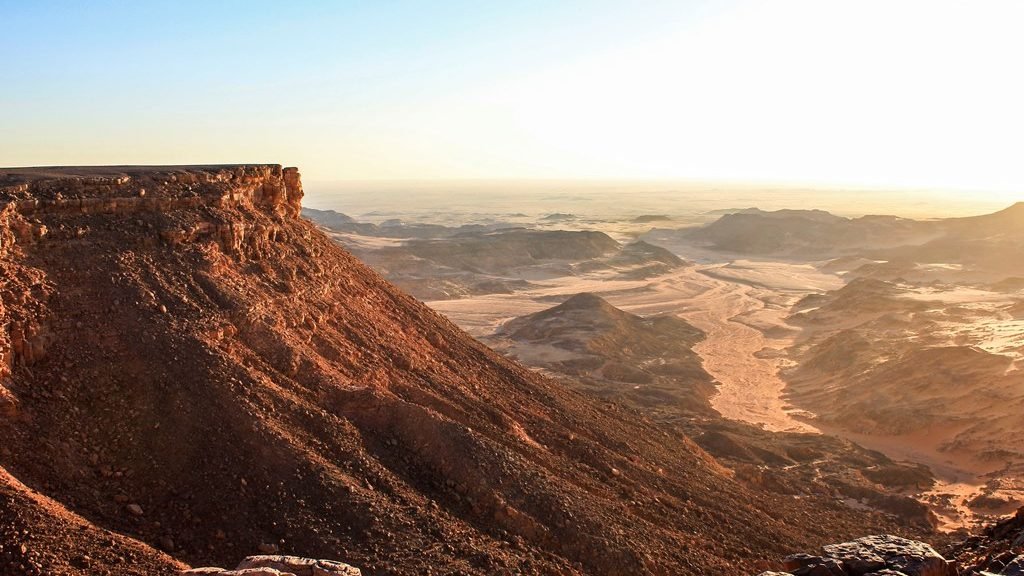
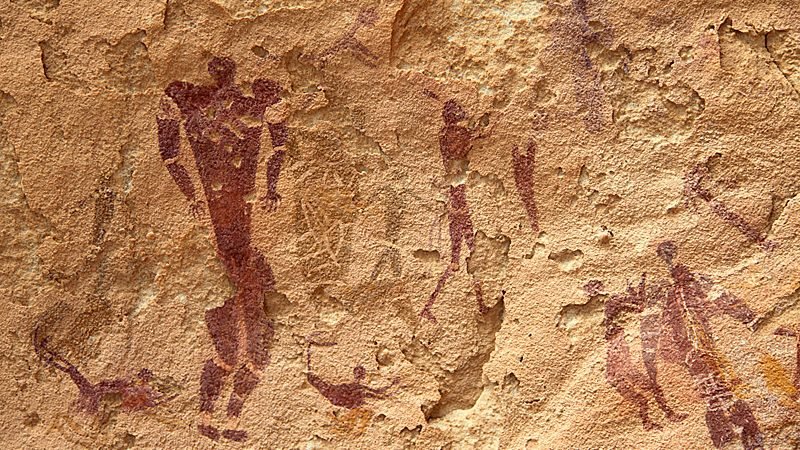
The Gilf Kebir is a sandstone massif that reaches almost 1,100 meters in altitude, in the corner of Egypt where the border meets Libya. It is two plateaus that rise abruptly in almost every direction: the surface lies about 350 meters above the plain, behind a layer of vertical rock that runs along the entire edge. In the whole area studied at Wadi Sura there is one single passage through which someone without climbing experience can get up. It does not rain. To get there you have to cross hundreds of kilometers of absolute desert, carrying your own water. And on a wall in that place there are dozens of people painted with outstretched arms and bent legs, in the exact position of someone who is swimming.
The first reaction of anyone who sees it has been the same since 1933: there was water here. That reaction is right, and it is the easy part. The hard part is everything that comes after — when it was painted, by whom, and whether those figures are really swimming. This dossier is about the distance between what was measured and what was interpreted, because at the Gilf Kebir that distance is large and almost no one mentions it.
01What it is, exactly
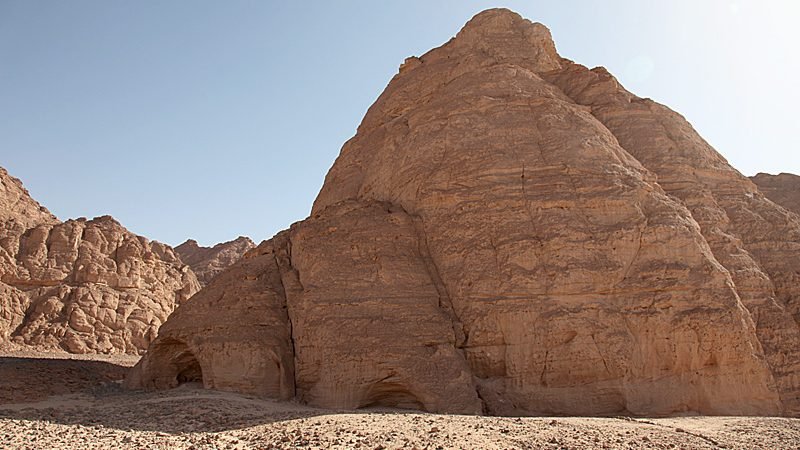
Wadi Sura is the name Almásy gave to the area at the foot of the Gilf Kebir's sandstone cliffs. It translates as something like "valley of the pictures." It is not a cave: these are shallow rock shelters, recesses at the base of the rock face — the kind of overhang you shelter under from the sun, not where you live.
Two of them matter, and they are often confused because the press treats both as "the Cave of Swimmers":
Wadi Sura I is Almásy's shelter, the one that became famous. It is the one with the swimmers, and it is the one that is ruined.
Wadi Sura II lies ten kilometers to the west and was only found in 2002. It has about eight thousand individual figures and became known as the Cave of Beasts. It is, in the words of the volume that documented it, the richest rock art site in the Libyan Desert, if not in the entire Sahara.
02October 1933
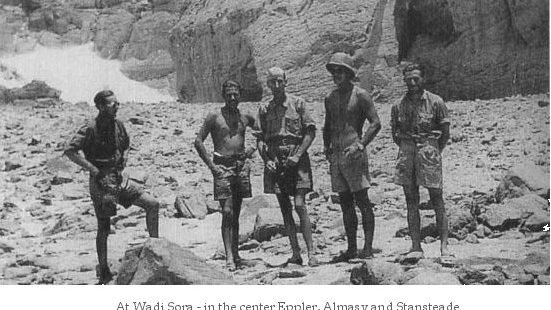
László Almásy was a Hungarian desert explorer — the same man who, decades later, would become a character in a novel and a film, in a heavily fictionalized version. In 1933 he was guiding a German expedition, the XI. DIAFE, with the ethnographer Leo Frobenius, his assistant Hans Rhotert and the graphic artist Elisabeth Charlotte Pauli. The stated goal was something else: to show them rock engravings that Patrick Clayton had located shortly before.
It was on the way that the two large painted shelters appeared. Almásy recorded the reaction, and it is from it that the site gets its name: the "surprise of seeing in the heart of the Libyan Desert images of swimmers", in the English rendering of the site's reference volume.
Two years later, in 1935, the next expedition — DIAFE XII — returned and copied the paintings. A strange creature already appeared in those copies, without a head, beside the human figures. No one understood what it was. The motif was partially destroyed, was not recognized, and went seventy years without receiving anyone's attention.
03The second cave, and the question it raised
On May 11, 2002, an Italian businessman named Massimo Foggini was traveling through the desert with his son — one of the thousands of adventure tourists the Gilf Kebir attracts every year. They found a painted shelter ten kilometers west of Almásy's.
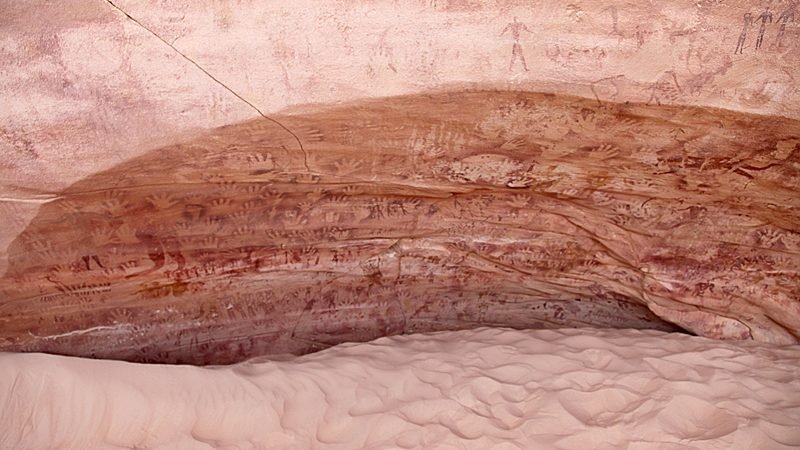
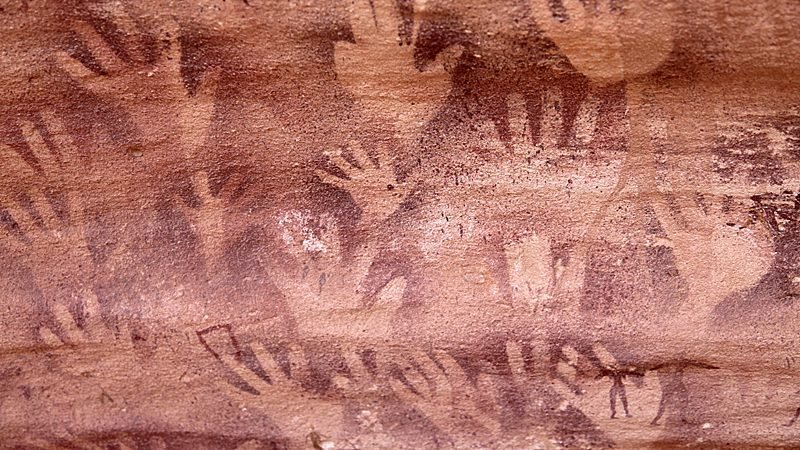
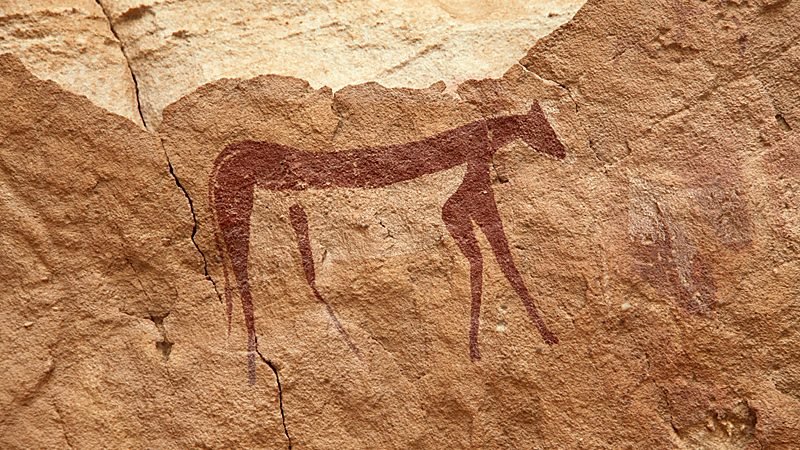
What was there reorganized the entire subject. About eight thousand figures, superimposed on a "wallpaper" of negative hands, and several dozen creatures that do not exist: animal hybrids, with a long tail raised like a lion's, almost always with only two or three legs and always headless. In several scenes, small human figures appear being swallowed — or spat out, there is no way to tell — through where the beast's head should be.
And, among them, the same swimmers as in Almásy's cave. Only now one could see something the ruined wall of Wadi Sura I did not show: they appear in a row, one behind the other, heading toward the beasts.
That is why the very volume that documents the site opens the discussion with a four-word question: are they really swimming?
04The date, and how it was obtained
Here is the point of this dossier, and it is what almost no popular text says: the paint was never dated.
The age that circulates did not come from the pigment. It came from pottery shards scattered across the region, correlated with the phase of occupation they belong to. It is a legitimate and widely used method in rock art, for the simple reason that dating mineral paint on a wall is difficult and often impossible. But it is inference by association, not measurement of the object.
The survey that supports the calculation covered the ten kilometers between the two caves and recorded 396 prehistoric sites — 74 with rock art, 123 with pottery. Of those shards, 95% belong to a single phase. In another survey, of almost 2,200 fragments, the proportion reaches 98%.
The phases of the region, as the archaeology of the Gilf Kebir defines them:
- Gilf Ac. 8500 – 6600 BC. No pottery. Recognized by elongated microliths and a characteristic blade technology. Appears at very few sites in Wadi Sura.
- Gilf Bc. 6500 – 4400 BC. The climax of the occupation. Decorated Khartoum-style pottery. It is to this phase that the art is attributed.
- Gilf Cc. 4400 – 3500 BC. Few sites, and with short occupation. Thin-walled vessels. There is almost no cattle-herder art at Wadi Sura, which helps date by exclusion.
The reasoning is sound: if 95% of everything found on the ground is from one phase, and art in that style dominates the walls, it is reasonable to link the two things. But notice how the authors write the conclusion. They say it is "highly probable" that the style connects to Gilf B. And they add, in so many words, that it "can not fully be excluded" that part of the art goes back to the earlier phase — which would push some figures up to two thousand years further back.
05The water, which was in fact measured
If the age of the painting is inference, the existence of the water is not. This is the most solid fact in the entire dossier, and it comes from a 2006 Science article signed by Rudolph Kuper and Stefan Kröpelin.
They gathered radiocarbon dates from 150 archaeological excavations in the now hyperarid Eastern Sahara — Egypt, Sudan, Libya and Chad — covering the last twelve thousand years. What emerged was a cycle with a dated beginning and end:
Humid conditions arrive abruptly in 8500 BC. The desert becomes savanna with seasonal lakes. People move in, settle, live there for millennia. And from 5300 BC onward desiccation begins — gradual, not catastrophic — and pushes everyone out.
Now overlay the two things. The Gilf B phase, that of the art, runs from 6500 to 4400 BC. It fits entirely within the humid window, and its final half coincides with the onset of the drought. The next phase already has few and short-lived sites.
The art ends when the water ends. This is not interpretation: these are two independent dating series that fit together.
06The readings, from the most sober to the most improbable
What the figures mean is another story, and here the ground becomes less firm. It is worth reading the positions knowing who defends them — and, in the case of this site, the discussion takes place within the same academic volume, which is rare and is excellent.
They are people swimming, and there was somewhere to swim
Almásy's reading, and the one that names the place. It has in its favor the most solid fact in the dossier: in the early and middle Holocene, in that savanna environment, temporary lakes could well have existed. Paleoclimatology supports the scenario.
What it does not explain is the posture. The figures appear in a line, one behind the other, advancing toward creatures that do not exist. It is a strange composition for a bathing scene.
The doubt comes from those who documented the site
After 2002, with dozens of creatures appearing alongside more swimmers, the perspective "has somewhat changed" — the words are the reference volume's. And what the Cave of Beasts made visible, the ruined wall of Almásy's did not: the swimmers appear in a row, one behind the other, in clear association with the beasts.
That is why the discussion of meaning, in that volume, opens with a four-word question: are they really swimming? The one asking is not an outside skeptic — it is the team that spent years copying figure by figure on that wall.
If the answer is no, the name of the site has been wrong since 1933. And the error is the kind that spreads on its own, because every new text inherits the old name.
They are the dead, floating in the primordial waters
The reading of Jean-Loïc Le Quellec, one of the leading authorities on Saharan rock art. For him, the swimmers and the headless beasts may be a visualization of the afterlife, comparable to the journey of the dead through the Egyptian underworld: the swimmers would be the dead floating in Nun, the primordial ocean, as in the Coffin Texts. The beasts, which sometimes bear straps and net-like structures on their bodies, would be forerunners of the demons that had to be captured with nets. And the pairs of negative hands would refer to the concept of ka, the vital essence, written in hieroglyphs precisely with two raised arms.
It is an elegant reading, and it explains the line: a procession of the dead makes more sense than a queue of swimmers. The problem is the calendar — and the first to point it out is the author himself.
The Gilf Kebir is the cradle of Egyptian civilization
The Egyptologist Miroslav Bárta follows Le Quellec's line and goes further, in a 2010 book: he claims the region as the possible origin of the mythology and symbolism of ancient Egypt. He identifies in one group of figures the precursor of the pharaonic motif of "smiting-the-enemy," and in another scene a white "sky goddess" supported by an "earth god," compared to Nut and Geb.
The response came in the site's reference volume, and it is devastating. The authors point out that he uses "Neolithic" problematically for the Sahara; that he leaves out all the other Saharan regions that could make the same claim with equal right; and that he ignores the general conviction among Egyptologists that an entire civilization can hardly be deduced from a single region.
And then comes the detail that settles the matter: the "sky goddess" is, in fact, one of the headless beasts — and one clearly marked as male.
The paragraph with which the authors close the discussion is the best in the entire bibliography on the site, and it applies well beyond it: it is understandable that an Egyptologist, bound to his comparative methods in the face of mysterious images in the middle of the desert, should succumb to the temptation to relate them to his own field of research. In this way he becomes a victim of his own discipline — and also of the alluring beasts.
07Chronology
- c. 8500 BCHumid conditions arrive abruptly in the Eastern Sahara. The desert becomes savanna with seasonal lakes, and people occupy the region.
- c. 6500 – 4400 BCGilf B phase: the climax of the occupation of Wadi Sura. It is to this window that the paintings are attributed, by correlation with the pottery.
- from 5300 BCGradual desiccation begins. The population leaves the desert over the following millennia, with part of the movement heading toward the Nile valley.
- c. 4400 – 3500 BCGilf C phase: few sites, with short occupation. Cattle-herder art, which dominates other regions, is scarce at Wadi Sura.
- October 1933László Almásy, guiding Leo Frobenius's XI. DIAFE expedition, finds two large painted shelters and names the area Wadi Sura.
- 1935The DIAFE XII expedition copies the paintings. A headless beast already appears in the copies, but it is neither understood nor given attention.
- 1952Hans Rhotert publishes the material from the expeditions. The beast motif remains unrecognized.
- May 11, 2002Massimo Foggini and his son find Wadi Sura II, the Cave of Beasts, ten kilometers to the west — with about eight thousand figures and in good condition.
- 2006Kuper and Kröpelin publish in Science the climatic chronology of the Eastern Sahara based on 150 excavations.
- 2009The interdisciplinary project on Wadi Sura begins, funded by the German research foundation, with full documentation of the art and landscape archaeology of the surroundings.
- 2013The site's reference volume comes out, 545 pages, published in Cologne — and it is there that the correlation dating, the readings and the critique of them are recorded.
08What remains open
The age of the paint. Until the pigment is dated directly, the range of 6500 to 4400 BC remains the best inference available — and the authors themselves admit that part of the art may be up to two thousand years older. A direct date would change the whole conversation, including the discussion about meaning.
What the figures are doing. Swimming, floating, dying, crossing over. The wall does not say, and the reference volume is explicit in classifying any answer as highly speculative. This is a case in which the honest answer is "we do not know," and it is less satisfying and more correct than the alternatives.
And what will be left. Almásy's cave is in a condition described as deplorable, with only a fraction of the original painted surface still in place — which, added to the high abstraction of the figures, has made interpretation difficult from the start. There is an Italian conservation project, led by Barbara Barich, working on measures for Wadi Sura I. The second cave is much better preserved, and the same tourism that revealed it is what now threatens it.
09Frequently asked questions
Where is the Cave of Swimmers located?
At Wadi Sura, at the foot of the cliffs of the Gilf Kebir plateau, in the corner of Egypt where the border meets Libya. To get there you have to cross hundreds of kilometers of desert carrying your own water.
Is the Cave of Swimmers really a cave?
No. These are shallow rock shelters, recesses at the base of the sandstone rock face. The swimmers' shelter is Wadi Sura I, found by László Almásy in 1933; Wadi Sura II, the Cave of Beasts, lies ten kilometers to the west and is the one that appears in most photos. See what it is, exactly.
How old are the Cave of Swimmers paintings?
The paint was never dated. The range of c. 6500 to 4400 BC comes from the surrounding pottery, and the authors call it “highly probable,” admitting that part of the art may be up to two thousand years older. See the date, and how it was obtained.
Are the figures really swimming?
We do not know. They appear in a row, heading toward headless creatures, and the very team that documented the site asks whether they are swimming; some read them as the dead floating in the primordial waters. See the readings.
What was the Green Sahara?
The humid period of the Eastern Sahara, dated by radiocarbon at 150 excavations: humid conditions arrive abruptly in 8500 BC, the desert becomes savanna with seasonal lakes, and desiccation begins from 5300 BC. See the water.
10Sources consulted
This dossier is original writing. The sources below were consulted to verify dates, figures and attributions; none was reproduced.
- Kuper, R. (ed.) — Wadi Sura – The Cave of Beasts. A rock art site in the Gilf Kebir (SW-Egypt). Africa Praehistorica 26. Cologne: Heinrich Barth Institut, 2013, 545 pp. The site's reference volume, read in the full PDF published by the institute. It is the source for the discoveries of 1933 and 2002, the correlation dating, the 396 sites of the survey, the Gilf A, B and C phases, the readings of Le Quellec and Bárta, the critique of them, and the state of preservation.
- Kuper, R. & Kröpelin, S. — Climate-controlled Holocene occupation in the Sahara: motor of Africa's evolution. Science 313 (5788), 2006, pp. 803–807. The source for the 150 excavations, the onset of humid conditions in 8500 BC and the beginning of desiccation in 5300 BC.
- Almásy, L. — 1933 account quoted in the Cologne volume, the source of the line about the surprise of seeing pictures of swimmers in the heart of the Libyan Desert.
- Le Quellec, J.-L., Flers, P. & Flers, P. — Du Sahara au Nil. Paris: Soleb/Fayard, 2005; and later works by the same author, from 2008 and 2009, cited in the Cologne volume as the origin of the reading of the swimmers as the dead in Nun.
- Bárta, M. — Swimmers in the Sand. On the Neolithic Origins of Ancient Egyptian Mythology and Symbolism, 2010, cited and critiqued in the Cologne volume.
- Rhotert, H. — 1952 publication of the material from the Frobenius expeditions, cited in the Cologne volume regarding the beast motif that went unrecognized at the time.