The arrows of North Sentinel
Every other dossier in this archive deals with questions we have not yet managed to answer. This one deals with the only question whose answer exists, is alive, speaks a language no one has classified — and has made it clear, for more than two centuries, that it has no intention of being interviewed.
- Where
- Andaman archipelago, India
- Coordinates
- 11°34′N 92°14′E
- Area
- 59.67 km²
- Population
- estimated between 50 and 200
- Last friendly contact
- February 1991
- Legal status
- approach prohibited
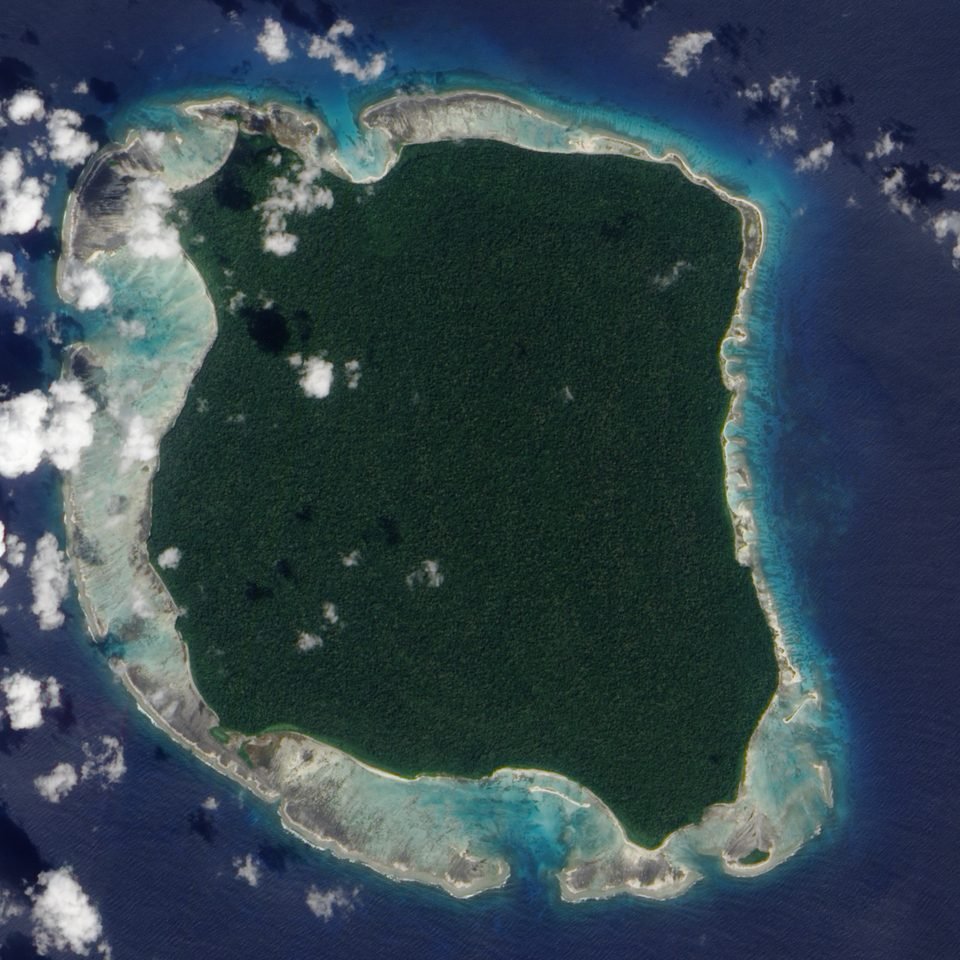
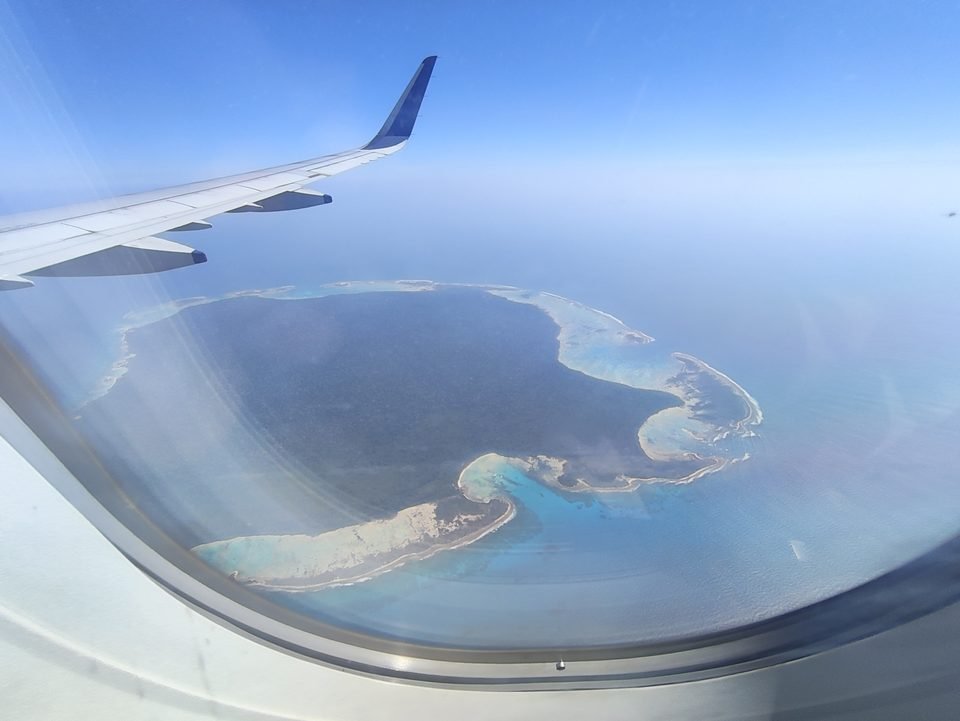
About fifty kilometers west of Port Blair, in the Bay of Bengal, there is an almost square island — seven point eight kilometers by seven — ringed by a coral reef that keeps any vessel of moderate draft from getting close. Seen from above, it is a patch of dense forest with a narrow fringe of pale sand. There is no harbor, no village clearing visible from the air, no permanent smoke. There is beach, forest and, now and then, figures who come out of the forest.
When a boat comes close enough, those figures come down to the waterline with long bows and shoot. This happened in 1867, in 1974, in 1981, in 2004, in 2006 and in 2018. It is the most consistent fact we have about that place, and practically the only one that repeats without variation.
What makes North Sentinel different from everything else in this archive is simple: here the obstacle is not erosion, nor burial, nor the lack of an instrument. It is a decision — made by living people, communicated with absolute clarity, and finally respected by a nation state after more than a century of insisting on the opposite.
01What can be seen from afar
Start with what is solid. The island covers 59.67 km², a little more than the island of Manhattan, and is sovereign territory of the Republic of India within the territory of Andaman and Nicobar. The reef that surrounds it is the first physical reason for the isolation: it breaks the approach of any hull larger than a launch, and forces anyone arriving to make the last stretch in a small boat, exposed, slowly, in full view of whoever is on the beach.
About the population, one has to be honest about method. Every number in circulation was obtained by counting from a distance, by boat or by helicopter, adding up the people visible on the shore on a given day. The Indian census of 2001 recorded 39 people; that of 2011 recorded 15 — a number the Indian press described, rightly, as a guess. A circumnavigation in 2014 counted 16. The 2016 handbook of the Anthropological Survey of India works with a range of 100 to 150. The more cautious literature speaks of something between 50 and 200.
As for technology, what is known comes from direct observation and from objects seen in use. They use bow and arrow for hunting on land and shallow-bottomed canoes for fishing in the lagoon, propelled by poles pushed against the bottom instead of paddles. Their arrowheads and adze blades are larger and heavier than those of the other Andamanese groups, and they are made of metal — salvaged from ships stranded on the reef and worked by them. In 1974 they accepted and kept aluminum pots left on the beach.
That detail about metal deserves attention, because on its own it dismantles the cliché that accompanies the subject. A people who identify iron in the hull of a wreck, extract it, rework it and adapt it to their own hunting technology are not frozen in any time. They are doing exactly what any society does with a new resource: taking in what is useful and discarding what is not.
02The inventory of contacts
The complete list of documented approaches is short enough to fit on a page, and it is the most useful record that exists on the subject — because it shows a pattern of behavior, not a succession of accidents.
In 1771, the East India Company's hydrographic survey passed offshore and noted in the logbook a multitude of lights on the beach. It is the first European mention. No one landed.
In 1867, the merchant ship Nineveh ran aground on the reef. One hundred and six survivors reached the beach and were attacked; they held out for a few days until the Royal Navy took them off. This is the founding record of the island's reputation, and it is also the first case in which the response came after an unsolicited arrival.
In January 1880, the British colonial officer Maurice Vidal Portman landed with an armed force. He found the forest empty and captured six people: an elderly couple and four children. He took them to Port Blair. The couple fell ill and died within a few weeks. The children were returned to the island with gifts.
If there is an event capable of explaining a policy of refusal kept up for five generations, it has a date, an official's name and an archived administrative report. On the 1880 landing
The next interval is long. India resumed the approaches from 1967, under the anthropologist Triloknath Pandit, of the Anthropological Survey of India, with a method of leaving gifts on the shore and pulling back. In 1974, a film crew accompanied by armed police landed to record an encounter and left on the sand coconuts, aluminum pots, a live pig, a toy car and a doll. The response was a volley of arrows; one of them struck the director in the left thigh. The Sentinelese speared and buried the pig and the doll, and kept the coconuts and the pots.
That sentence is worth rereading, because it is far more informative than it seems. It was not indiscriminate rejection. It was sorting: the plant food and the metal went in, the live pig and the doll were speared and buried. Someone there looked at that set of objects, classified them and decided item by item.
On August 2, 1981, the freighter Primrose ran aground on the reef during the monsoon. The crew saw armed people gathering on the beach and the captain sent a distress call estimating more than fifty archers and warning that he could not guarantee the crew's lives. They stood guard in shifts with flare guns and iron bars until a helicopter hired by an oil company took them off, about a week later. The rusting hull of the Primrose stayed stranded there for decades — and supplied the island with a remarkable quantity of metal.
On January 4, 1991, the routine of gifts finally produced the encounter. A team of thirteen people, led by S. Awaradi, with the doctor Arun Mullick and the anthropologist Madhumala Chattopadhyay, threw coconuts into the water. Armed men waded into the sea to collect them, and the scene repeated until the coconuts ran out. On the same day, a young man aimed his bow at Chattopadhyay — and a Sentinelese woman made him lower the weapon. On the third trip, the team got into the water beside the boat and handed over coconuts directly. There was another encounter on February 21.
03The Andaman precedent
To understand why India gave up, one has to look at the neighboring islands — because there the experiment has already been run, and the result has been tallied.
When sustained contact began, at the end of the eighteenth century, there were estimated to be something like seven thousand Andamanese spread across the archipelago. The first British settlement dates from 1789; within four years the diseases it brought had devastated the coastal populations. Then came the epidemics of measles, pneumonia and influenza. A single measles epidemic in the nineteenth century killed about half of the Andamanese population.
The figures for the Great Andamanese group tell the rest on their own: six hundred people in 1901, nineteen in 1961. Today the group exists — they number a little over fifty — but most of their languages died with the last speakers. The Jarawa numbered 380 in the 2011 census; the Onge, 101.
The mechanism is immunological and there is nothing mysterious about it. A population cut off from the mainland for millennia carries no antibodies to measles, influenza, tuberculosis, whooping cough or chickenpox. A single asymptomatic visitor is enough. And in a small community the simultaneous illness of all the adults brings down hunting, fishing, water gathering and the care of the sick all at once — so that the real mortality far exceeds the lethality of the disease itself.
It was that reasoning, and not abstract sensitivity, that ended the program. Official visits were halted in the mid-1990s — between 1994 and 1997, depending on the source —, and the policy came to be described by those carrying it out as hands-off, eyes-on. The Andaman and Nicobar Islands (Protection of Aboriginal Tribes) Regulation, of 1956, prohibits travel to the island and approaching within five nautical miles — about 9.3 kilometers. The Navy and the Coast Guard patrol the perimeter.
042004: the island rose
On December 26, 2004, the Sumatra-Andaman earthquake — one of the largest ever recorded by seismograph — unleashed the tsunami that killed more than two hundred thousand people around the Indian Ocean. The plate moved beneath the whole archipelago. Parts of the Andaman and Nicobar Islands sank between one and four meters. North Sentinel did the opposite: it was lifted.
The uplift was on the order of one to two meters, and the immediate consequence was geographic. The reef that ringed the island emerged. The lagoons where people fished disappeared along almost the entire perimeter, remaining visible only to the east. The shoreline advanced out to sea. On April 23, 2005, four months later, the European Space Agency's Proba microsatellite photographed the result with the CHRIS sensor, at eighteen meters of resolution: the island appeared literally too high in the water.
Three days after the earthquake, an Indian Coast Guard helicopter flew over the island to check whether there were survivors. The answer came in the form of an arrow, shot from the beach at the aircraft. It was the confirmation, from afar and without contact, that the people had survived and were in a condition to react.
The part that is rarely told is what comes next. With the lagoons dry, shallow-water fishing — which depended on them and on the poled canoes — stopped working as before. The island probably had to reorganize its own subsistence around a new coastline. When the crew of the Primrose reported, in 1981, having seen people building boats on the beach, the detail seemed picturesque. After 2004, it looks like something else: the capacity to rebuild the fleet.
052018: the Chau case
John Allen Chau was 26, American, a graduate in exercise science, and had been planning to evangelize the Sentinelese since high school. In 2017 he went through training with the missionary organization All Nations, in which instructors played the role of “hostile” natives. He got vaccinated, went through quarantine, studied the basics of linguistics and first aid. The preparation was real; it was the premise that was false.
In October 2018 he settled in Port Blair and paid twenty-five thousand rupees to local fishermen to take him to the vicinity of the island. He was taken late on the night of November 14 and on the 15th and 16th made approaches by kayak carrying a waterproof Bible, cards with drawings, a fish and a soccer ball as gifts. He tried to talk, sang hymns and tried out words in Xhosa. On one of his advances, a Sentinelese boy shot an arrow that pierced the Bible he was holding against his chest.
He went back to the boat, wrote in his diary that perhaps that island was Satan's last stronghold on Earth, wondered whether he was losing his mind, and decided to try again. On the last trip he told the fishermen to leave without him. On November 17, from the sea, they saw the body dragged along the beach and buried in the sand.
The Indian government opened an investigation, arrested seven people for facilitating access and, after consulting anthropologists, gave up on recovering the body. The justification was exactly the logic of this dossier: the risk of a confrontation with a rescue team, and the health risk of a landing, outweighed any benefit. The body is still there.
Chau was neither the first nor the last. In January 2006, two Indian fishermen were illegally catching crabs near the island when their boat drifted onto the beach during the night; they were killed, and the helicopter sent out located the buried bodies but pulled back under arrows. In December 2022, three fishermen disappeared and their boat was spotted at North Sentinel. In March 2025, another American citizen landed alone, left a soda can and a coconut on the sand, collected sand samples and was arrested on his return.
06The readings, from the most sober to the most improbable
The refusal is a policy, not an instinct
It is the reading the record itself supports. In 1974 the gifts were sorted: coconuts and aluminum went in, pig and doll were buried. In 1991 there was repeated acceptance of coconuts, handover by hand and the scene of the woman lowering a man's bow. In 2018, a teenager shot at a Bible and the body was buried, not abandoned.
None of this is an automatic reaction. It is a repertoire of different responses to different situations, with visible internal disagreement. The economical conclusion is that there is a collective decision there about outsiders, and that it was made — and is upheld — by people who know what they are doing.
The refusal is a memory of the nineteenth century
The hypothesis is that the policy of refusal hardened from 1880 on, when Portman took six people and returned four orphaned and possibly sick children. Some argue that the episode may have introduced an epidemic to the island, and that the lesson was incorporated into oral tradition.
It is plausible and has a documented event behind it. What is missing is verification: we have no access to Sentinelese oral memory, and the Nineveh shows that the armed response already existed in 1867, thirteen years before Portman. Colonial trauma probably reinforced a practice — but did not invent it.
Isolation is abandonment, and we should make contact carefully
There is a minority academic position, defended above all by anthropologists who work with isolated peoples in the Amazon, according to which absolute isolation is unsustainable in the long run: outside pressure only increases, contact will end up happening in a disorderly way, and it would be better for it to be planned, with a medical team present and prior vaccination.
The counterargument lies in the figures of section 03. Planned contact with a medical team was exactly what was tried with the Great Andamanese, and the group fell from six hundred people to nineteen. Contact with the Jarawa, initiated by the Jarawa themselves in 1997–98, brought measles outbreaks and tourist exposure along the road that cuts through their territory. The regional record does not favor the thesis.
They are "Stone Age humans," frozen in time
It is the frame that dominates popular coverage of the subject, and it does not survive the first fact. They work metal salvaged from wrecks. They adopted aluminum in 1974. They survived the change in the coastline after the 2004 earthquake lifted the reef and dried out the lagoons. They sort unfamiliar objects with discernment.
No human population is frozen in time. Thousands of years of history took place on North Sentinel as they did anywhere else — wars, inventions, disputes, changes of rules, deaths, births. The difference is that of that history we do not have a single line. Calling it the "Stone Age" is to mistake our ignorance for their biography.
07Chronology
- 1771An East India Company survey passes offshore and records lights on the beach. First written mention.
- 1789First British settlement in the archipelago. Within four years, diseases devastate the coastal populations of the Andamans.
- 1867The merchant ship Nineveh runs aground on the reef. One hundred and six survivors hold out against attacks until the Royal Navy takes them off.
- January 1880Maurice Vidal Portman lands with troops and captures six people. The elderly couple die in Port Blair; the four children are returned.
- 1901 · 1961The Great Andamanese group falls from six hundred people to nineteen — the demographic cost of contact, measured in official censuses.
- 1967India resumes the approaches under Triloknath Pandit, with the method of leaving gifts on the shore and pulling back.
- 1974A film crew lands; an arrow strikes the director in the thigh. The pig and the doll are speared and buried; coconuts and pots, accepted.
- August 2, 1981The freighter Primrose runs aground. The crew stands guard for about a week until it is taken off by helicopter.
- January 4, 1991First documented peaceful contact. Coconuts handed over directly; a Sentinelese woman makes a young man lower his bow. Another encounter on February 21.
- mid-1990sThe official visits program is ended. The policy becomes explicitly one of no contact.
- December 26, 2004The Sumatra-Andaman earthquake lifts the island by one to two meters, exposes the reef and dries out the lagoons. Three days later, an arrow answers the Coast Guard helicopter.
- January 2006Two fishermen die after their boat drifts onto the beach. The helicopter sent out locates the buried bodies but pulls back under arrows.
- November 17, 2018The missionary John Allen Chau is killed after landing alone. Seven intermediaries are arrested; India gives up on recovering the body.
- December 2022 · March 2025Three fishermen disappear and their boat is spotted on the island. Two years later, another American lands alone, leaves objects on the sand and is arrested on his return.
08What remains open
Almost everything. We do not know how many they are, or with what margin of error. We do not know what language they speak — it is known only that it is not intelligible to the Jarawa or to the Onge, which suggests a very ancient separation from the other Andamanese groups, but the classification remains blank. We do not know how they organize themselves, what they inherited, what they tell about 1880 or about 2004, or whether they tell anything.
Nor do we know what happened there during most of the time they have been there. The depth of human occupation in the archipelago is measured in tens of thousands of years, and none of it is recorded anywhere we can consult.
Three questions remain open, and only one of them is about them. Whether the isolation is sustainable — pressure from fishermen, tourists and missionaries has only grown since 2018, and policing a nine-kilometer perimeter on the open sea has its limits. What the 2004 uplift did to the island in the long term — an exposed reef and dried-out lagoons alter the food base of a small population, and no one can measure that without getting close. And how long we can stand not knowing — which is the question about us.
09Frequently asked questions
Where is North Sentinel Island?
In the Andaman archipelago, in the Bay of Bengal, about fifty kilometers west of Port Blair. It is Indian territory, within Andaman and Nicobar, and covers 59.67 km², almost a square of forest surrounded by reef. See what can be seen from afar.
Who lives on North Sentinel Island, and how many?
The Sentinelese, a people who refuse contact. How many they are is not known: the counts are made from a distance and swing widely — the 2011 census recorded 15, the 2016 handbook of the Anthropological Survey of India works with 100 to 150 —, and the more cautious literature speaks of something between 50 and 200. Their language has not been classified.
Why is North Sentinel Island so dangerous?
Because those who approach are usually met with arrows — so it was in 1867, 1974, 1981, 2004, 2006 and 2018. The record, however, shows a collective decision, not a reflex: in 1991 there were peaceful encounters. And the danger runs both ways, because a single visitor can bring diseases against which they have no antibodies. See the Andaman precedent.
Can you visit North Sentinel Island?
No. A 1956 regulation prohibits travel to the island and approaching within five nautical miles, about 9.3 kilometers, and the Navy and the Coast Guard patrol the perimeter. Since the mid-1990s, Indian policy has been one of no contact.
Who died on North Sentinel Island?
The best-known case is that of the American missionary John Allen Chau, killed in November 2018 after landing alone; India gave up on recovering the body. In 2006, two fishermen who drifted onto the beach were also killed. See the Chau case.
10Sources consulted
This dossier is original writing. The sources below were consulted to verify dates, numbers and attributions; none was reproduced.
- Consolidated encyclopedic entries on North Sentinel Island, the Sentinelese and the Andamanese peoples — chronology of contacts, census data and legislation.
- Andaman and Nicobar Islands (Protection of Aboriginal Tribes) Regulation, 1956 — legal basis of the ban on approach.
- European Space Agency — record from the Proba/CHRIS microsatellite on the uplift of the island after the earthquake of December 26, 2004, image of April 23, 2005.
- Survival International — institutional position on uncontacted peoples and on the demographic history of the contacted Andamanese groups.
- Public records of the expedition of January 4, 1991 — team, method and account by Madhumala Chattopadhyay and Triloknath Pandit.
- Press coverage and documentation of the Indian investigation into the death of John Allen Chau, November 2018.
- National Geographic — report on the island's isolation and on contemporary outside pressure.