The Mashco Piro people
More than a century ago, a people of the Peruvian Amazon decided to live far from us. It is not a people without history: it is a people whose recent history includes a flight. Now they appear on the river beaches, ever closer to logging roads — and each appearance says more about the forest around them than about those who come out of it.
- Where
- Madre de Dios and Ucayali, Peru; Acre, Brazil
- Rivers
- Las Piedras, Manu, Tahuamanu, Purús
- Population
- ≈ 750, according to the Peruvian government (estimate)
- Language
- a variant of Yine (Piro), Arawak family
- Legal status
- protection and no-contact regime (Law 28,736, of 2006)
- Ongoing
- case at the Inter-American Court, hearing in Sept. 2026
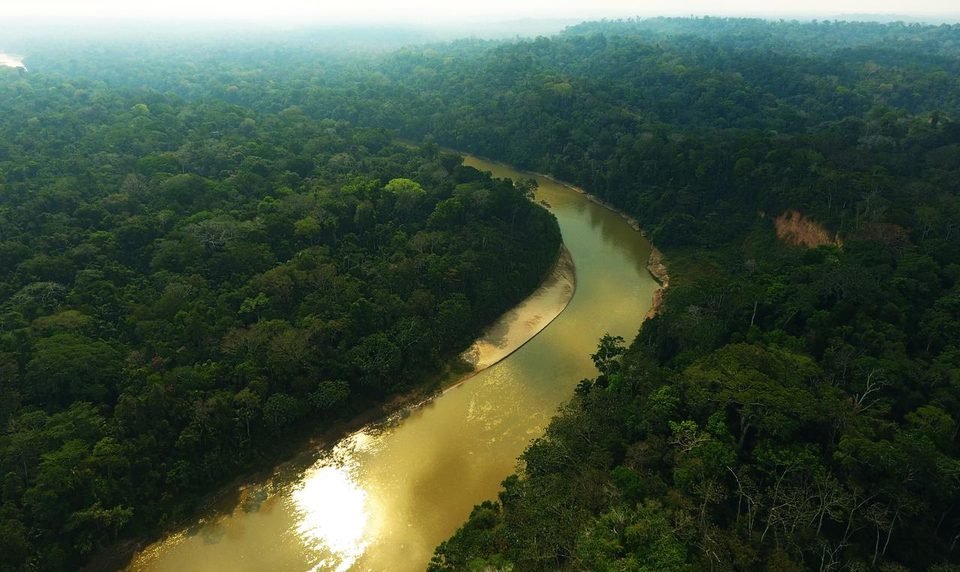
In the dry season, between May and September, the rivers of southeastern Peru drop and expose long sand beaches on their bends. It is on these that, from time to time, groups of men, women and children appear who live in no known village, appear in no census and answer to no name we have given them. They are called the Mashco Piro. Among themselves, according to those who have managed to hear them, they use another word.
This dossier does not have a question to solve in the sense the others do. There is no stone to date and no text to decipher. There is a living people that chose not to be found, and a state, a few companies, a few Indigenous organizations and a few courts arguing, at this very moment, over how much forest that choice deserves. The pages below are about that mismatch.
01Who they are, and how much we do not know
Start with the name, because it is already a problem. "Mashco" was the label applied by neighbors and outsiders, and it carries a pejorative sense — something close to "wild people" in the mouths of those who used it. Peruvian protection agents who speak Yine reported, in 2015, that the group they were talking with on the riverbank preferred to be called Nomole, a word translated as "relatives" or "brothers." We use "Mashco Piro" here because it is the name that appears in laws, maps and court cases — and it is the name readers will search for — but we note the caveat.
The language is the firmest piece of data. They speak a variant of Piro, or Yine, of the Arawak family — the same language as the Yine communities living downriver, such as Monte Salvado and Diamante. That is why the few recorded conversations took place through Yine interpreters. And it is also the first clue to the origin of the isolation: peoples who speak almost the same language did not separate millennia ago. They separated recently, and for some reason.
On the size of the people, honesty requires showing the spread. In 1976 the talk was of twenty to a hundred people. IWGIA, an international organization supporting Indigenous peoples, estimated a hundred to two hundred and fifty in 1998. Peru's Ministry of Culture works today with about seven hundred and fifty, a figure repeated by the international press since 2024 and which makes them, according to Survival International, the largest known isolated people in the world.
02Rubber, the isthmus and the flight
The isolation of the Mashco Piro has an approximate date, and it coincides with the worst chapter in Amazonian history at the end of the nineteenth century. When the rubber boom reached the upper Ucayali, in the 1880s, slavery had already been formally abolished in Peru since 1854 — and it was replaced by debt peonage, in which the Indigenous worker never finished paying what the boss said he owed. By 1891, most of the Piro of the Urubamba were in debt to a single rubber baron, Carlos Fermín Fitzcarrald.
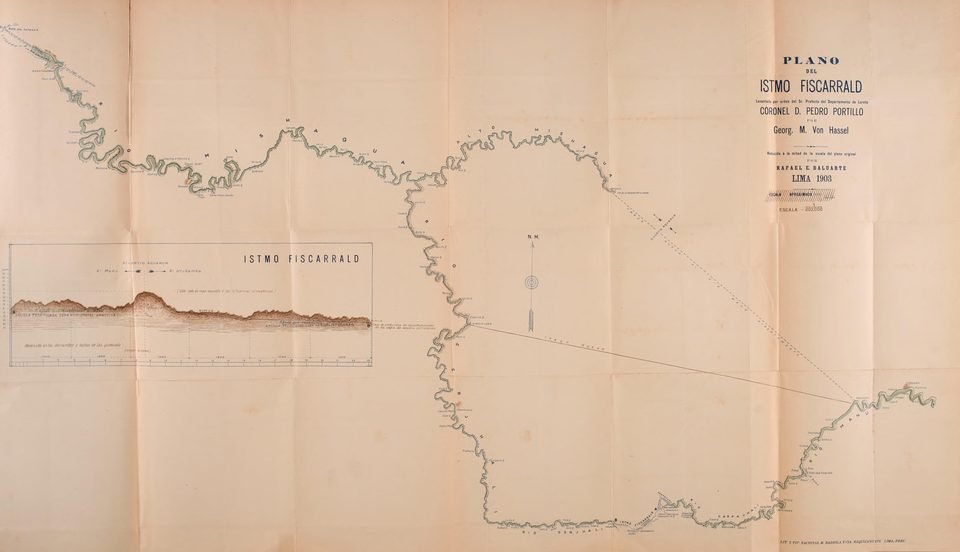
Fitzcarrald went down in history, and in the movies, for a feat of engineering: in 1894 he opened the overland passage between the Ucayali basin and that of the Madre de Dios, hauling a steamboat across an isthmus a few kilometers wide. What the movies did not tell is what came with the passage. With it, the upper Manu — Mashco Piro territory — came within reach of the rubber barons. Accounts from the period and later historiography describe the slaughter of a large part of the Mashco Piro of the upper Manu by Fitzcarrald's armed band between 1893 and 1894. Regional sources speak of hundreds dead; no figure from that time is reliable, and it is fair to say only this: it was a massacre, and it is documented.
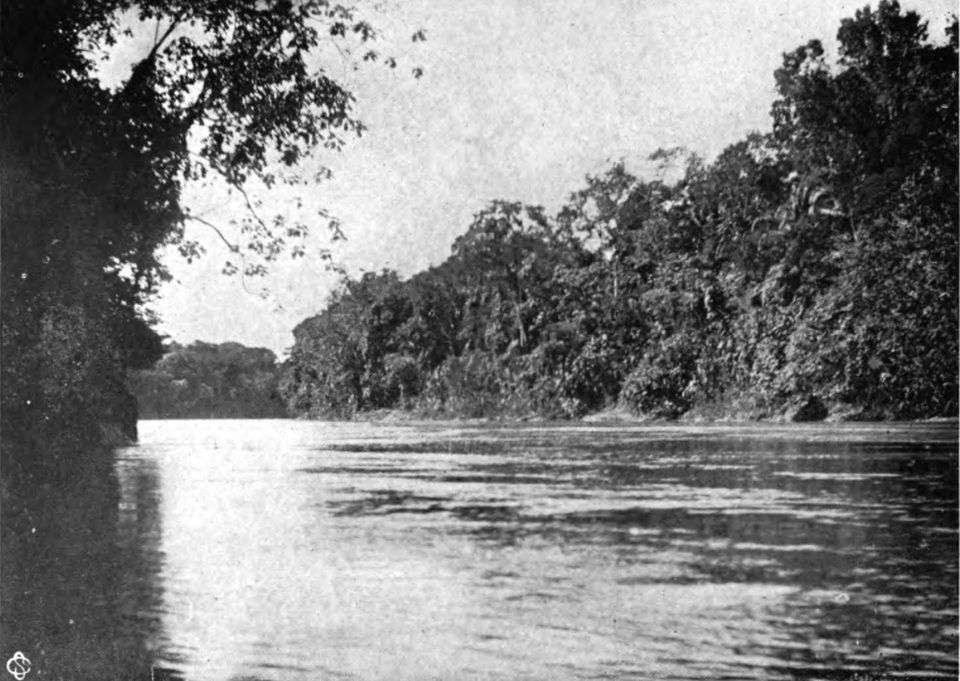
After the massacre came capture. Between 1897 and 1909, according to regional historiography, Mashco and Piro were enslaved along the Purús and the Madre de Dios by Carlos Scharff, who had been Fitzcarrald's foreman. There are records of uprisings — such as the one in 1903 on the Tahuamanu, in which rubber workers were killed and, in reprisal, Indigenous people were hunted down.
The reading anthropology makes of this period is direct, and it is the most important in this dossier: the group we now call the Mashco Piro is, very probably, descended from those who fled. People who saw what contact with the rubber camps produced and withdrew into the headwaters, where the boats could not reach. Isolation is not an original state. It is a response — and a response that worked for more than a hundred years.
03The territory on paper
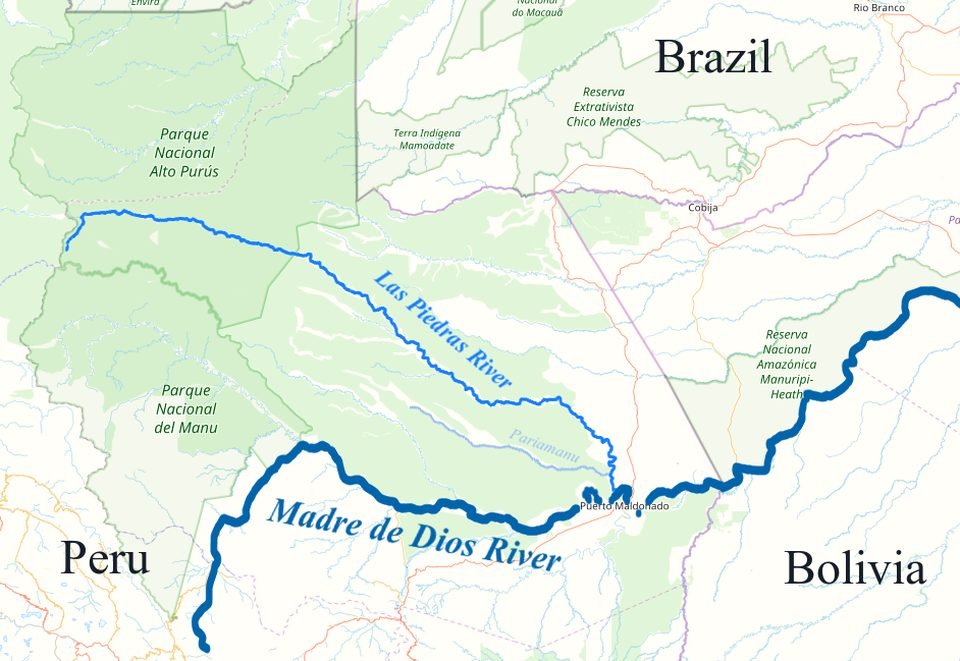
The territory of the Mashco Piro does not respect borders: it runs from the headwaters of the Madre de Dios, crosses the Las Piedras and the Tahuamanu and reaches the sources of the Acre, the Iaco, the Chandless and the Purús, already in Brazil. On paper, however, it is sliced into pieces with different names and dates.
On the Peruvian side, the largest piece is the Madre de Dios Territorial Reserve, created on April 22, 2002 by resolution of the Ministry of Agriculture, with 829,941 hectares. Farther north, on the upper Purús, there is the Mashco Piro Indigenous Reserve, of 816,057 hectares, created as a territorial reserve in 1997 and converted into an Indigenous reserve in July 2016 — it overlaps Alto Purús National Park. Manu National Park, to the south, also shelters isolated groups. The two reserve figures, almost the same, are often confused in the press; they are different areas.
The law that governs all this is Law 28,736, of May 2006, known as the PIACI Law — the Spanish acronym for Indigenous peoples in isolation and in initial contact. It enshrines the principle of no contact: the state does not seek out these peoples, and it restricts the entry of third parties into the reserves. But the law, in its original wording, allowed exceptions for resource extraction deemed a "public necessity" — and it is in that loophole that much of the conflict takes hold.
The central problem is that the 2002 reserve came out smaller than the territory. FENAMAD, the Indigenous federation of Madre de Dios, had been documenting the presence of the isolated peoples since 1999 and proposed a much larger area; according to the federation, the reserve created recognized about a third of what had been identified. In September 2016, a multisectoral state commission approved the study that would convert the territorial reserve into an Indigenous reserve — a stronger protection category — and expand it by about 240 thousand hectares. Ten years later, that still has not happened. Part of the expansion area is occupied by forestry concessions: in February 2025, a report by OjoPúblico counted fourteen of them inside it.
On the Brazilian side, the most recent step dates from January 2025: Funai, Brazil's Indigenous affairs agency, issued an order restricting use of the Mashco do Rio Chandless Indigenous Land, in Acre, with just over 538 thousand hectares in the municipalities of Santa Rosa do Purus, Manoel Urbano and Sena Madureira. The restriction bans entry without authorization and the extraction of resources until the land is demarcated.
04The appearances, 2007–2015
For most of the twentieth century the Mashco Piro were an inferred presence: trails, abandoned camps, raided gardens, a violent encounter here and there — such as the fatal attack on loggers on the Tahuamanu, in August 1998. From the end of the 2000s this changes. They begin to be seen, and with increasing frequency.
In September 2007, ecologists flying over Alto Purús filmed from a helicopter about twenty people on the bank of the Las Piedras. By 2011, the pattern was different: groups began appearing on the beaches of the upper Madre de Dios, in view of tourist boats heading down to the Manu. And 2011 was also the year tension claimed victims again. In October, a park ranger was seriously wounded by an arrow at the Pakitza control post, in the Manu. In November, Nicolás "Shaco" Flores, a Matsigenka man from the community of Diamante who for years had let the isolated people harvest from his garden and had tried to approach them, was killed by an arrow to the chest.
In December 2014, a large group — residents spoke of up to two hundred people — entered the Yine community of Monte Salvado, on the Las Piedras, when most residents were away because of local elections. They took pots, machetes, rope and food, killed domestic animals and went back into the forest. Fifty-five people who had taken shelter at the guard post were evacuated. It was, according to FENAMAD, the third time that year the group had reached the community; the federation called the episode an "act of desperation," provoked by illegal loggers and drug traffickers in the territory.
In 2015 the Ministry of Culture set up a permanent post on the upper Madre de Dios, with agents who spoke Yine. For the first time there was regular conversation, on the riverbank: some individuals came back every few days, asked for bananas and machetes, and made it clear they did not want to live in a village. That same year, in May, a young Matsigenka man from Shipetiari, Leonardo Pérez, was killed by an arrow when a group of about thirty Mashco Piro passed through the community.
052024: the year of the arrows
On June 26 and 27, 2024, more than fifty Mashco Piro appeared on a beach on the Las Piedras, opposite Monte Salvado, asking for food from the residents on the other bank. In July, Survival International released photographs and video of the encounter, taken by residents, pointing out that the beach was a few kilometers from logging concessions. The images went around the world.
What came next showed that the beach was the calm side of the story. On July 27, according to FENAMAD, a logger was wounded by an arrow at an illegal logging camp. On August 29, at the San Juan creek, in the basin of the Pariamanu River — a tributary of the Las Piedras — a group of workers opening a trail in the reserve's expansion area was attacked. Two bodies were recovered, with arrow wounds, and taken to Puerto Maldonado.
The death toll is the first point on which the versions diverge, and the divergence deserves to be shown as it is. FENAMAD and the international press spoke of two dead, one wounded and two or more missing. The regional subprefect of Madre de Dios, based on the account of the sole survivor, went as far as speaking of five dead; only two bodies were recovered and identified. The second point is what the group was doing there: the first version was that they were clearing land in a Brazil nut concession; at the site, signs of illegal logging were found. Nor was there official confirmation that the workers were employees of the logging company holding the neighboring concession.
That company is Maderera Canales Tahuamanu, one of the firms with concessions in the territory used by the Mashco Piro, which has opened about 190 kilometers of truck roads in the region, according to the international press. On August 30, a day after the attack, the FSC — the international forest-management label — suspended the company's certification for eight months, citing the location of the concession in relation to the territory of the isolated people. Survival called the suspension "welcome news – but only half of what's required"; the Ministry of Culture announced an investigation with the Public Prosecutor's Office and the police.
On October 26, at a creek near Monte Salvado, about a hundred armed Mashco Piro were sighted, and a FENAMAD protection agent was hit by an arrow in the shoulder. The Yine community of Monte Salvado was evacuated to Puerto Maldonado on Air Force flights. Adding up the year's sightings, according to a tally cited by Mongabay, more than four hundred people were seen in 2024.
062025–2026: the dispute on paper
The fight of 2025 and 2026 did not take place in the forest, but in commissions, bills and courts — and that is where the future of the Mashco Piro is being decided.
In the commission. In December 2024, the multisectoral commission that was supposed to complete the reserve's expansion met again. According to minutes obtained by OjoPúblico, the vice minister of Agrarian Development Policy and Oversight, of the Ministry of Agriculture, opposed the expansion and argued for keeping the fourteen forestry concessions in the area; the vote was postponed. The regional government of Madre de Dios and municipalities in the region also oppose it.
In Congress. On August 26, 2025, the congressman Juan Carlos Mori Celis introduced Bill 12,215, which amends the PIACI Law to require the executive to submit to Congress, every six months, an evaluation of all the reserves, with the possibility of keeping, modifying or abolishing them, and to review every two years the very classification of the peoples as isolated. AIDESEP, the country's largest Amazonian Indigenous organization, and the platform of federations that includes FENAMAD responded that the reserves would come to live under permanent review "until they are annulled." An earlier bill with a similar aim, 3,518, from 2022, was shelved after the Indigenous backlash. In December 2025, the Congressional Commission on Andean, Amazonian and Afro-Peruvian Peoples unanimously approved shelving 12,215.
In court. The case has a long timeline. In 2005 FENAMAD requested urgent measures from the Inter-American Commission on Human Rights; in 2007 they were granted, and they remain in force. In 2011 came the formal petition. In 2022, the Commission concluded, in Report 397/22, that Peru violated the rights of the Mashco Piro — collective property, self-determination, judicial guarantees, cultural rights. On November 1, 2024, it referred the case to the Inter-American Court. It is the first case about isolated peoples in Peru to reach that court. In 2025, after Peru passed Law 32,301, which expands control over nongovernmental organizations and provides for heavy fines for anyone who supports actions against the state, the Court ordered, at the request of FENAMAD and EarthRights International, that the country not punish the organizations for litigating the case.
On September 24 and 25, 2026, the Court held the public hearing of the case in Montevideo. FENAMAD and EarthRights asked the court to order the completion of the process, opened in 2014, that converts the territorial reserve into an Indigenous reserve, the intangible protection of the ancestral territory, sanitary cordons, recognition of the community monitoring system the federation has maintained for twenty-five years and the cancellation of all large-scale extractive projects "at any stage" within it. The ruling has not yet been issued.
07The readings, from the most sober to the most improbable
The appearances are a symptom of pressure on the territory
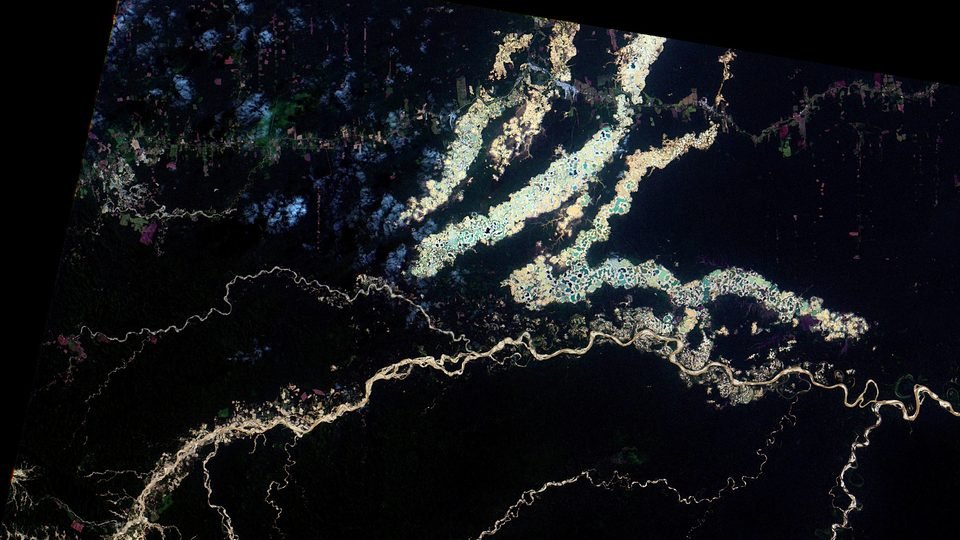
This is the reading of the Indigenous organizations, of Survival and of many anthropologists, and the record supports it: the encounters are concentrated in the Las Piedras basin, where logging roads have advanced; they come with raids on tools and food; and the 2024 peak coincides with the opening of trails in the expansion area that was never put into effect. Illegal logging, wildcat mining and drug trafficking in the region squeeze the hunting and fishing a nomadic people depends on.
The limit of this reading is that it explains the direction of the movement, but not all of it. No one has measured the game available in the territory, nor knows in detail where the groups moved before.
There are also internal reasons we do not know
Peruvian anthropologists point out that the Mashco Piro maintain with their neighbors an old relationship made of exchange and war, and that the interest in metal — machetes, pots — predates the recent escalation. Internal changes, such as the coming of age of a new generation, divisions between families or disputes with other isolated groups, may explain part of the movements.
It is plausible, and it is a healthy caveat against single-cause explanations. The problem is that it is, by definition, unverifiable: talking about the internal reasons of a people that does not talk with us is speculation.
Contact is inevitable, and should be planned
In 2015, the anthropologists Robert Walker and Kim Hill argued in the journal Science that, with peoples who are already coming out of isolation, controlled contact — with a medical team and vaccination ready — would be less lethal than disorderly contact with loggers and miners. The regular encounters of 2015 on the upper Madre de Dios lent weight to the argument.
The objection, put forward by most Indigenous organizations and by experienced field specialists in isolated peoples, is that the history of planned contact in the Amazon — in Peru and in Brazil — is a history of epidemics. And that the choice is theirs: the right to isolation includes the right to decide whether and when to leave it.
They are "uncontacted," a people from before history
It is the frame of the headlines, and section 02 dismantles it. The Mashco Piro did not stay outside history: they were run over by it. They speak almost the same language as neighbors they lived alongside, they know metal, the boat and the rubber baron, and they chose isolation after seeing what the outside world was doing. The correct name for that is voluntary isolation. "Untouched" erases precisely the part in which they were touched — and reacted.
08Chronology
- the 1880sThe rubber boom reaches the upper Ucayali. Debt peonage replaces slavery, abolished in 1854.
- 1891Most of the Piro of the Urubamba are in debt to the rubber baron Carlos Fermín Fitzcarrald.
- 1893–1894Fitzcarrald opens the overland passage to the Manu. His armed band massacres a large part of the Mashco Piro of the upper Manu.
- 1897–1909Mashco and Piro are enslaved on the Purús and the Madre de Dios under Carlos Scharff. The survivors withdraw to the headwaters.
- 1997The upper Purús territorial reserve is created; in 2016 it becomes the Mashco Piro Indigenous Reserve, of 816,057 hectares.
- April 22, 2002The Madre de Dios Territorial Reserve is created, with 829,941 hectares — smaller than the territory proposed by FENAMAD.
- May 2006Law 28,736, the PIACI Law, establishes the protection regime for peoples in isolation and initial contact.
- 2007The Inter-American Commission grants precautionary measures to the Mashco Piro. In September, about twenty people are filmed from a helicopter on the Las Piedras.
- October and November 2011A park ranger is wounded by an arrow at Pakitza, in the Manu. In November, Nicolás "Shaco" Flores is killed near Diamante.
- December 2014A large group enters Monte Salvado and takes tools and food. Fifty-five residents are evacuated.
- 2015The Ministry of Culture's permanent post on the upper Madre de Dios; first regular conversations through Yine interpreters. In May, Leonardo Pérez is killed at Shipetiari.
- September 2016A multisectoral commission approves converting the Madre de Dios reserve into an Indigenous reserve and expanding it by about 240 thousand hectares. It is not carried out.
- 2022Report 397/22 of the Inter-American Commission concludes that Peru violated the rights of the Mashco Piro.
- June 26–27, 2024More than fifty Mashco Piro appear opposite Monte Salvado asking for food. The images are released in July.
- August 29, 2024Attack in the Pariamanu basin: two workers confirmed dead, others missing. The next day the FSC suspends the certification of Maderera Canales Tahuamanu.
- October 26, 2024A protection agent is wounded by an arrow near Monte Salvado; the community is evacuated.
- November 1, 2024The Inter-American Commission refers the case to the Court — the first about isolated peoples in Peru.
- January 2025In Brazil, Funai restricts use of the Mashco do Rio Chandless Indigenous Land, in Acre, with 538 thousand hectares.
- August 26, 2025Bill 12,215 proposes periodic review by Congress of all the reserves for isolated peoples.
- December 2025Bill 12,215 is unanimously shelved in the Commission on Andean, Amazonian and Afro-Peruvian Peoples.
- September 24–25, 2026Public hearing of the Mashco Piro case at the Inter-American Court, in Montevideo. Ruling pending.
09What remains open
How many there are, with any reasonable margin of error. Whether they are one people or several related groups moving through different areas. What they tell about the rubber era, if they tell it at all. Why some groups sought conversation in 2015 and others shoot at those opening trails in 2024 — whether it is the same people changing strategy or different people with different experiences.
And three questions that depend on us, not on them. Whether the expansion approved in 2016 will leave the paper, or whether the concessions inside it will be kept. What the Inter-American Court will decide, and whether Peru will comply. And whether the law that now forbids contact will remain standing in the face of new attempts to review the reserves — two have already been shelved.
10Frequently asked questions
Who are the Mashco Piro?
An Indigenous people in voluntary isolation in southeastern Peru, with a territory that reaches Acre, in Brazil. “Mashco” is a label given by neighbors and outsiders, with a pejorative sense; in 2015, agents who speak Yine reported that the group preferred to be called Nomole, “relatives.” See who they are.
Where do the Mashco Piro live?
In the headwaters of the Madre de Dios, the Las Piedras and the Tahuamanu, in Peru, up to the sources of the Acre, the Iaco, the Chandless and the Purús, already in Brazil. On paper, the territory is sliced into reserves with different names and dates. See the territory on paper.
What language do the Mashco Piro speak?
A variant of Piro, or Yine, of the Arawak family — the same language as the Yine communities living downriver. That is why the few recorded conversations took place through Yine interpreters. See who they are.
How many Mashco Piro are there?
No one has counted. Peru's Ministry of Culture works with about seven hundred and fifty, but every estimate is extrapolated from traces and overflights; in 1976 the talk was of twenty to a hundred people, and IWGIA estimated a hundred to two hundred and fifty in 1998. See who they are.
Why do the Mashco Piro live in isolation?
Very probably because they descend from those who fled the rubber boom, after the slaughter of a large part of the Mashco Piro of the upper Manu by Fitzcarrald's band, between 1893 and 1894. Isolation is not an original state: it is a response. See rubber and the flight.
11Sources consulted
This dossier is original writing. The sources below were consulted to verify dates, figures and attributions; none was reproduced.
- Consolidated encyclopedia entries on the Mashco Piro and the Piro (Yine) — language, historical population estimates and the rubber period.
- Ministerial Resolution 0427-2002-AG (Madre de Dios Territorial Reserve); Supreme Decree 007-2016-MC (Mashco Piro Indigenous Reserve); Law 28,736, of 2006.
- Inter-American Commission on Human Rights — Report 397/22 and note referring Case 13,572 to the Inter-American Court, 2024; EarthRights International — chronology of the case.
- Mongabay (2024, 2025 and 2026), Pressenza and Servindi (September 2026) — the 2024 clashes, the FSC suspension and the Montevideo hearing.
- OjoPúblico, February 2025 — minutes of the multisectoral commission and the position of the Ministry of Agriculture on the expansion.
- Infobae, La República and Inforegión (2024) — the attacks of August and October 2024, versions of the death toll and the evacuation of Monte Salvado.
- DAR (Derecho, Ambiente y Recursos Naturales) — note of December 3, 2025 on the shelving of Bill 12,215 in committee.
- Organization of Isolated Indigenous Peoples and Survival International — Bill 12,215/2025 and the reaction of Indigenous organizations; Survival International on the sightings of 2014 and 2024.
- National Geographic, 2015 — the upper Madre de Dios post, the deaths of 2011 and 2015 and the debate over controlled contact; Walker and Hill, Science, 2015.
- Instituto Socioambiental, January 2025 — Funai's order on the Mashco do Rio Chandless Indigenous Land.