The Korowai and the houses high in the trees
Few peoples in the world have been photographed as much over the last thirty years. Almost all the photos show the same thing — a house in the crown of a tree — and that is precisely the house the Korowai least often build to live in. This dossier is about what the camera looked for there, what it commissioned, and what was left out of the frame.
- Where
- Southern Papua, Indonesia
- Coordinates
- 5°25′S 139°49′E (Yaniruma)
- Territory
- ≈ 1,300 km², between the Eilanden and Becking rivers
- Population
- about 4,000
- Regular contact
- since October 4, 1978
- Status
- contacted; some live in villages, some in the forest
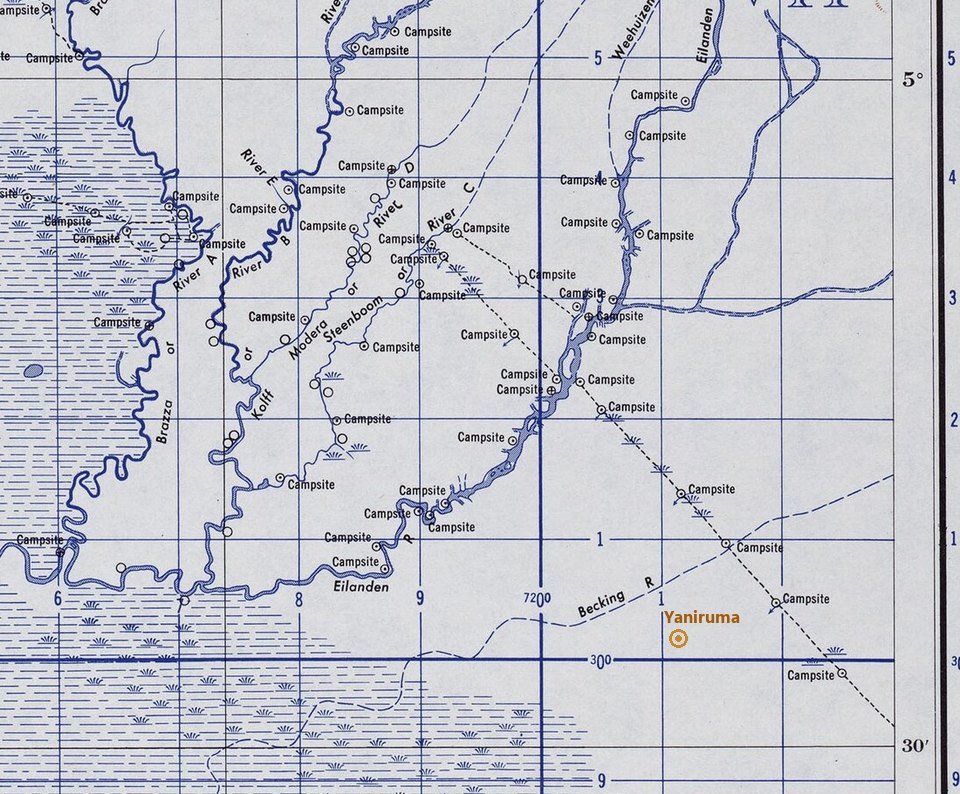
In the south of New Guinea, on the Indonesian side of the island, there is a plain of swampy forest cut by two large rivers that run down from the mountains to the Arafura Sea: the Eilanden, to the north, and the Becking, to the south. The land lies about a hundred meters above the sea, more than five meters of rain fall each year, and between the two rivers live, scattered across dozens of clan territories, the Korowai — about four thousand people who speak a language of the Awyu–Dumut family and who, until the end of the 1970s, had no regular contact with anyone from outside the region.
In 1996, an aerial photograph published by National Geographic showed a Korowai house hanging in the crown of a tree, far above the forest. Since then, the people have become known around the world as "the tree-house people" — and, almost always in the same sentence, as "the last cannibals." Dozens of film crews and a few thousand tourists came. Later came the confessions too: part of what was filmed had been built to be filmed.
Unlike North Sentinel, there is no refusal of contact here to be respected from a distance: the Korowai have known missionaries, traders, state officials and tourists for more than forty years, and many live in villages with a school and an airstrip. The mystery in this dossier is a different one, and it is about us: why the image the world kept of the Korowai is so different from the one they themselves describe.
01Between the Eilanden and the Becking
Start with the map. Korowai territory lies in the upper Eilanden basin, today divided among five regencies of two Indonesian provinces — Boven Digoel, Mappi and Asmat, in South Papua; Pegunungan Bintang and Yahukimo, in Highland Papua. It is just under 1,300 km² of low, swampy forest, with dry ground only on the gentle rises where people plant and live.
Life is organized around the clan and the clan's territory. The Korowai grow bananas and other crops in swidden gardens, extract starch from the sago palm, hunt with bows and traps, raise pigs that serve as a medium of exchange, and hold, once in the life of each clan, the great sago grub feast, which brings together neighbors from many territories. The neighbors matter: to the south are the Kombai, who speak a related language and build similar houses; to the west, the Citak, whose headhunting raids against the Korowai and Kombai only stopped, according to the missionary record, in 1966.
02First contact, and the two dates
There are two dates in the literature, and they do not contradict each other as much as it seems. The first is from March 1974: an American expedition led by the anthropologist Peter Van Arsdale, the geographer Robert Mitton and the community development worker Mark Grundhoefer met, on the 17th and 18th, thirty men on the south bank of the upper Eilanden, east of the mouth of the Kolff River, and noted down a basic word list. The expedition's own record describes the group as western Korowai or eastern Citak — the identification was left open.
The second date is the one ethnography adopts as the beginning of regular contact. After a year and a half of overflights and boat trips, the Dutch missionary Johannes Veldhuizen, of the Mission of the Reformed Churches (ZGK), came in from the southwest, from Citak land, in March 1978. The first encounter with the Korowai took place on October 4, 1978, mediated by a Citak-Kombai man named Nggop, who was related to the Molonggai and Sendekh clans.
On March 30, 1979, Veldhuizen obtained from a Kombai man, Yanggio Ambuakharun, permission to open a mission post at the mouth of the Yaniruma creek, near where the Sokom flows into the Becking. There came an airstrip, a store with iron axes, salt and fishhooks, a school in Indonesian and a health post. At first, Yaniruma was more Kombai than Korowai: the Korowai built houses there, but used them only from time to time, when they worked on the airstrip or the roads.
Contact advanced slowly, upriver. In 1985 the first properly Korowai village was opened; in 1986, Manggel; in 1988, Yafufla; in 1989, Mabül, at the mouth of the Mabül River on the Eilanden, by a government expedition linked to the 1990 national census. Some Korowai families moved to the Citak villages of Mbasman and Mu, on the southwestern edge of the territory. And the ethnographers themselves record the most serious side effect of this change: bringing together clans that did not usually live side by side, on another clan's ground, made witchcraft accusations soar in the first years of each village.
As late as 1997, van Enk and de Vries summed up the situation like this: apart from occasional mission trips, regular contact was limited to the pacified banks of the two rivers, and most Korowai clans remained uncontacted. Fifteen years later, Stasch wrote that about half the Korowai were already building houses on the ground, in permanent villages, and that many moved back and forth between village and forest. The two statements describe the same process at two moments.
03The house they live in
The most common Korowai house is called xaim and it is, in fact, a raised house: a floor of bark and poles on tree trunks cut off high up, with a ladder made from a single notched trunk. The detail that changes the conversation is the height. In Stasch's measurements, the floor of these houses sits between three and nine meters off the ground, with a median of about four and a half meters. Van Enk and de Vries, writing about the Becking region, give an average of eight to twelve meters. Both measurements come from people who lived there; the difference probably lies in the region and in what each counted as a "house."
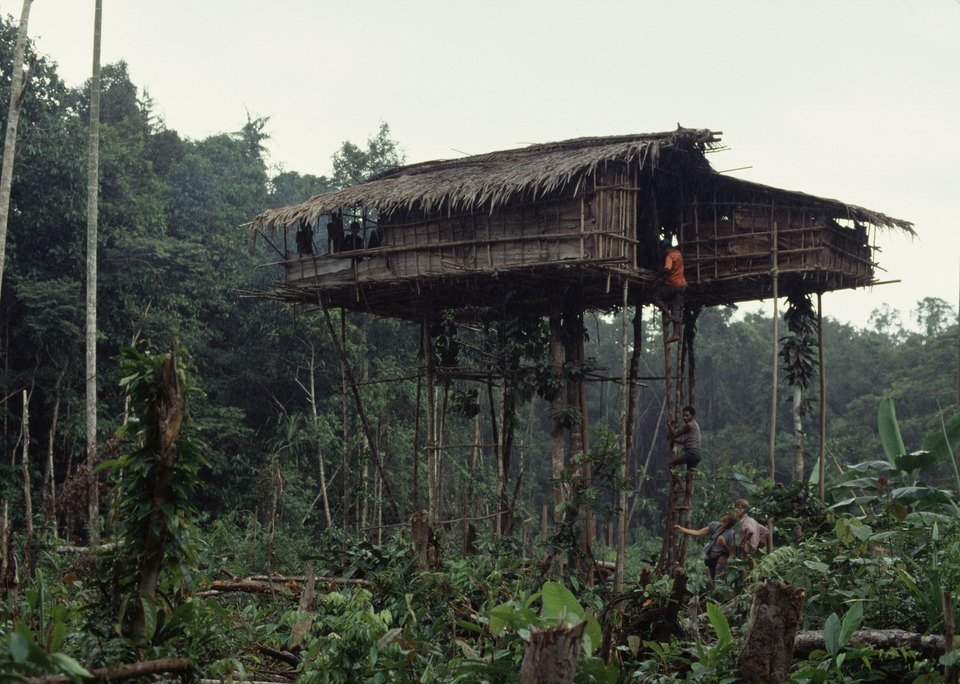
There is a second type, almost never photographed: the xaü, a house on the ground or less than a meter above it. And there is the third, the one the world knows: the lu-op, literally "climbing house," built in the crown of a living tree, between fifteen and thirty-seven meters up. Van Enk recorded examples of up to 45 meters upriver. When the Korowai tell their own lives as a sequence of houses, about seven in ten are xaim, almost all the others are xaü — and only one in fifty is a treetop house.
Why raise the house? The explanation that travels the world is military: the height would protect against enemies. It has a serious version — in 1998, the Dutch research agency publicized the study by van Enk and de Vries saying that the tall houses, with removable ladders, were a defense against Citak headhunters — and an inflated version, which circulates in encyclopedia entries and captions, with kidnappings for slavery and arson that the Korowai do not practice. Stasch, asking the residents, heard a different emphasis. What they cite most is fear of two kinds of monster — the khakhua, the witch who causes all deaths, and the laleo, the dead person who comes back and prowls the edge of the life of the living. The height is protection against what attacks at night and cannot be seen. The Korowai also simply like the open view a tall house gives; men who built treetop houses in the past said they wanted to see the world as beautiful, and to be talked about as strong.
04The house the camera commissions
The most widely seen photograph of a Korowai house was taken from a helicopter by George Steinmetz in 1995, during an expedition with Veldhuizen and van Enk to clans still without contact, and it opened the 1996 National Geographic story. It shows a treetop house — and, according to Stasch, the house was already abandoned when it was photographed, its roof and walls torn off by the wind shortly after it was finished. Two years earlier, in 1994, an American channel had aired the film Treehouse People: Cannibal Justice. The title already carried the two ideas that would stick to the people.
What came next was demand. Tourists and television crews arrived looking for the house in the photo, and the house in the photo was rare. The Korowai began building it to order. In March 2010, to take a single month recorded by Stasch, two treetop houses were put up for foreigners: one for a group of German tourists, another for a Japanese television crew. And this is not a recent discovery: as early as 1997, van Enk and de Vries noted that tour agencies were taking groups to "real and fake" tree houses along the stretch of the Becking between Yaniruma and Yafufla.
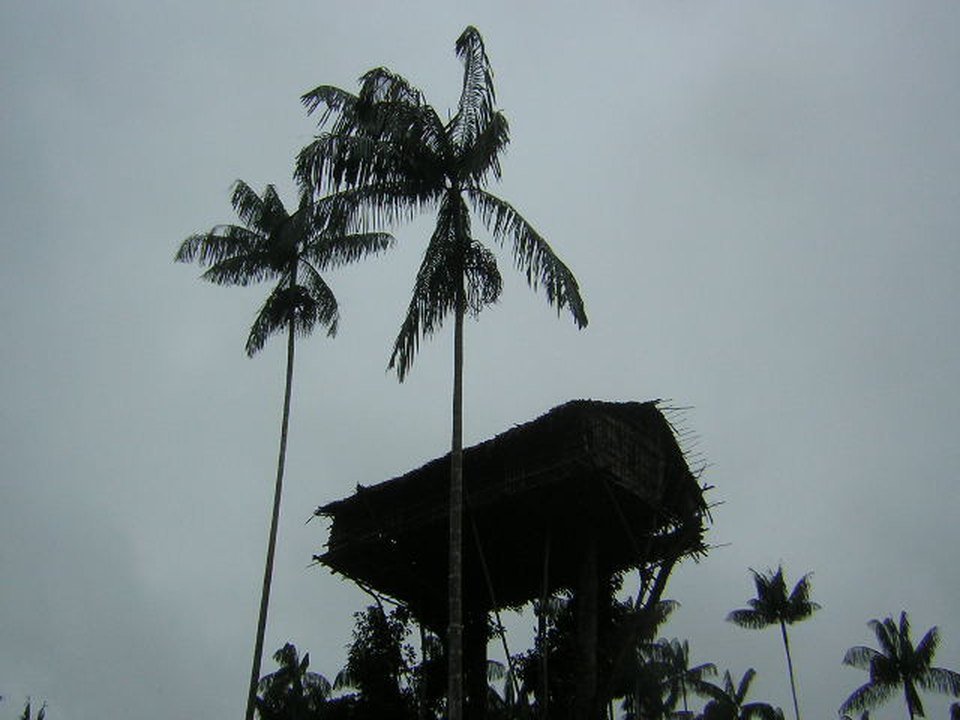
The best-documented case is the BBC's. In 2009, a crew from the series Human Planet filmed a Korowai family building and moving into a house high in a tree; the episode aired in 2011. In 2018, while recording another series, My Year with the Tribe, the presenter Will Millard heard from the Korowai themselves that those houses had been made for the foreign producers, and that they were not where they lived. In April 2018 the BBC publicly acknowledged that showing the family moving into the house as if it were a real home "is not accurate," and withdrew the series from distribution for an editorial review — which, weeks later, found another staged scene, of whale hunting, in another episode.
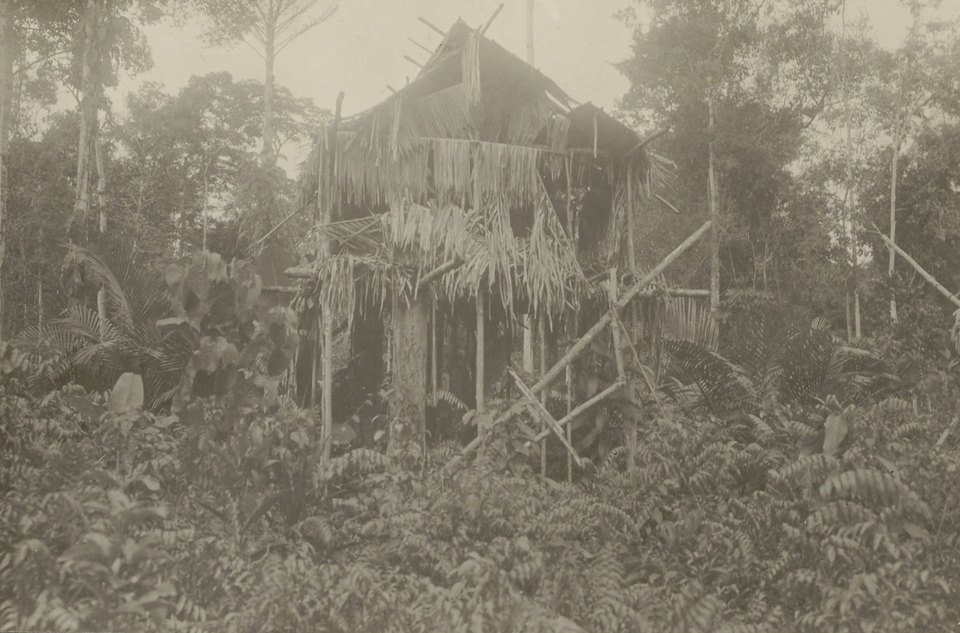
Stasch's argument, in a 2011 article devoted entirely to this, is that the photo of the treetop house says more about who photographs than about who lives there. The image precedes the house: the photographer arrives with the National Geographic photo in mind, hires the construction, and the result looks, to whoever sees it, like the transparent record of an object that existed independently of the camera. It is a rare case in which the size of the bias can be measured — one house in fifty in real life, almost all of them in the photographs.
05Khakhua: what is known about cannibalism
This is the part of the subject that sensationalism has distorted the most, and also the part where denying everything would be another distortion. The ethnographic record is consistent and comes from people who lived there. The Korowai, like other Awyu peoples, believe in the khakhua — spelled xaxua in Stasch's orthography — a man of their own people who has stopped being human through a desire to eat people. The khakhua acts in secret: he devours the victim's vital organs from within, puts false matter in their place, and the person goes on living without remembering anything, until dying of what seems to be another cause. Every death, in this logic, has a khakhua behind it.
The traditional response was execution. The man named as a khakhua — often by the dying person themselves — was tried, frequently under torture, killed, and the body was eaten and shared out among allied clans. Van Enk and de Vries stress two limits: the consumption of human flesh happened only in this context, never as punishment for another crime nor as warfare, and the Korowai did not practice the headhunting common among their neighbors. Stasch writes, in 2011, that such episodes had taken place within the memory of most adults.
Before it is a practice, the khakhua is a theory of death — and execution was the form of justice that theory demanded.
In 2001, in an article whose title is already the thesis — Giving up homicide — Stasch described how the Korowai said they had abandoned the execution of witches, partly because they already felt ambivalent about the practice, partly because of incidents with the Indonesian police. A case from the early 1990s, in Yaniruma, ended with a man arrested and mistreated by the police for killing an accused brother-in-law. The belief in the khakhua has not disappeared — what changed was the response to it.
The media preferred the present tense. In May 2006, the Australian journalist Paul Raffaele guided the crew of Channel Nine's 60 Minutes to the Korowai for a report called "The Last Cannibals," centered on a boy of about six, Wawa, presented as condemned to be killed and eaten for having been accused of witchcraft after his parents' death. Channel Seven sent its presenter to "rescue" him in front of the cameras; the crew was expelled from Indonesia for entering on a tourist visa. In 2019, a former Nine news director admitted to having tipped off the Indonesian authorities to sabotage the competitor. The boy was never harmed, and he was raised by another family. In September 2006, Raffaele published in Smithsonian magazine an account in which a guide claimed that the executions were continuing among the more remote clans.
06Village, tourism and what isolation still means
Since 1990, according to Stasch, the Korowai have received about fifty film crews and a few thousand tourists, from almost every European country, the United States, Japan and Australia. Tourism has become one of the few sources of money in the region: carrying luggage, hosting, guiding, building, performing. In his work from 2015 to 2019, Stasch describes these encounters as "dramas of otherness": both sides go there to look at the other's strangeness. The tourist wants to see people outside history; the Korowai, for their part, have their own theories about those white people who pay to take pictures — one of them, often repeated, is that the photos are sold to a "boss" out there for a lot of money.
What, then, is not isolation? No Korowai clan is "uncontacted" in the sense of North Sentinel. All of them have been, for decades, inside a network of mission, state, trade and tourism, even those who prefer to live far from the villages. What exists is chosen and variable distance: families who spend months in the forest, northern clans that keep little contact with the villages on the Becking and the Eilanden. That is a way of life, not a fossil.
And there are pressures that have nothing picturesque about them. Since the 1980s, companies have prospected for oil and alluvial gold in the area, without follow-through. In 2018, an illegal gold rush inside Korowai territory led the provincial government to announce the removal of the miners. In April 2025, the armed wing of the Papuan separatist movement, the TPNPB, said it had halted illegal mining "in Korowai" in Yahukimo — in the same month it killed more than a dozen civilian miners elsewhere in the regency.
072026: the war reached the airstrip
The most recent news about the Korowai has no tree house in it at all. On February 11, 2026, a small Smart Air plane was fired on after landing at the Danowage airstrip, known as Korowai Batu, in Kombai district, in Boven Digoel. The pilot and the copilot were killed; the thirteen passengers came out alive. The TPNPB claimed the attack; the police attributed it to an armed group from Yahukimo. Flights to the area were suspended, about forty residents fled to Senggo, and nine teachers and health workers who served the region were evacuated to Jayapura.
On July 2, 2026, an American pilot from a missionary aviation organization was killed in another district of Yahukimo, in an attack attributed to the same armed wing. From July 22 on, according to the Papuan press and human rights organizations, operations by Indonesian security forces hit the Korowai area on the Yahukimo side, with reports of three civilians killed and of tens to hundreds of people taking refuge in the forest, among them pregnant women and children, short of food and medicine. On August 22, the GIDI evangelical church reported at least twenty-six women and one child sheltering at a single spot, and three deaths among the displaced.
The contrast with the global image is hard to overstate. While videos and listicles about "the tree people" keep circulating, the Korowai area in 2026 is a zone of armed conflict between a separatist movement and a state, with a closed airstrip, a school without a teacher and families hiding in the same forest as the photographs.
08The readings, from the most sober to the most improbable
The raised house is real; the treetop house, today, is mostly made to order
This is what the two long-term ethnographies and the BBC itself support together. The ordinary house on trunks exists, is old and remains in use outside the villages. The house at the top of the crown also exists in tradition — but it was rare, little inhabited by families, and since the 1990s it has been built mainly at the request and expense of whoever arrives with a camera.
The weak point is one of scale, not direction: there is no recent systematic count of how many treetop houses were made for foreigners and how many for the builders' own use. But the 2018 admission, the 1997 record of "fake" houses and the paid commissions of 2010 all point the same way.
The height serves as defense against enemies
It has a basis and an author. The Citak took heads among the Korowai and Kombai until 1966, and fear of those raids was still strong among the residents of the Becking in the 1990s. In 1998, the publicity for the study by van Enk and de Vries attributed the tall houses, with ladders that can be pulled up, to this defense; the Korowai sometimes cite people prowling around as a reason to raise the house.
Against it weighs the later ethnography: according to Stasch, the reason the Korowai most often give for the height is invisible monsters — the khakhua and the laleo — not armed neighbors, and the popular version, with kidnappings and arson, describes practices they do not have. The two readings can coexist: one explains the probable origin of the custom, the other the meaning it has for those who live in it. The divergence is between the two ethnographers, and it is recorded here without taking a side.
Cannibalism is still practiced
The past practice, in the specific context of the execution of people accused of witchcraft, is documented. Its continuation today depends on claims by guides and on 2006 news reports that were not verified, and the Wawa episode showed how willing television was to manufacture urgency on top of it.
On the other side are the Korowai's own account to Stasch, the police presence that motivated the abandonment and the assessment by anthropologists that, at least in the clans in frequent contact, the practice has ended. Absence cannot be proven in remote clans — but there is nothing beyond rumor asserting presence either.
A people "frozen in time," with no contact with the world
It is the frame that sells the trip and the documentary, and it is contradicted by almost everything in this dossier: a mission since 1978, villages with schools since the 1980s, a census in 1990, tourism since the early 1990s, mining, money, iron axes and, now, war.
The Korowai negotiate with the camera — they build what it asks for, charge for it, argue among themselves about what the tourists want. That is not a loss of authenticity; it is history happening, as anywhere else. Calling it the "Stone Age" confuses what the visitors went looking for with the people they found.
09Chronology
- 1909–1910A Dutch expedition to the Lorentz River photographs abandoned raised houses in southern New Guinea. The image of the Papuan "tree house" is already a genre.
- 1966According to the missionary record, Citak headhunting raids against the Korowai and Kombai cease.
- March 17–18, 1974The expedition of Peter Van Arsdale, Robert Mitton and Mark Grundhoefer meets thirty men on the upper Eilanden — western Korowai or eastern Citak.
- October 4, 1978Johannes Veldhuizen, of the Dutch Reformed mission, meets Korowai for the first time, with Nggop as mediator.
- March 30, 1979Permission for the Yaniruma mission post, on the Becking. A school, a health post and an airstrip come in the following years.
- 1985–1989The first Korowai villages: Funbaum (1985), Manggel (1986), Yafufla (1988), Mabül (1989). Some families move to the Citak villages of Mbasman and Mu.
- early 1990sTourism begins; agencies take groups to "real and fake" houses on the Becking. A case of the execution of a man accused of witchcraft in Yaniruma ends with police intervention.
- 1994 · 1996The film Treehouse People: Cannibal Justice on American TV; the National Geographic story with Steinmetz's aerial photo of an already abandoned treetop house.
- 1997Van Enk and de Vries publish their grammar and ethnography of the Korowai with Oxford University Press.
- 2001Rupert Stasch publishes Giving up homicide, on the abandonment of witch executions.
- May to September 2006"The Last Cannibals" on Australia's 60 Minutes; the broadcasters' fight over the boy Wawa; Raffaele's account in Smithsonian.
- 2009 · 2011The BBC films the building of a treetop house for Human Planet; the episode airs in 2011.
- March 2010Two treetop houses built to order in a single month, for German tourists and for a Japanese TV crew.
- April 2018The BBC admits the scene of the family moving into the house was not real and withdraws Human Planet from distribution for review. The same year, illegal mining in the territory leads the provincial government to intervene.
- February 11, 2026A Smart Air plane is fired on at the Danowage airstrip (Korowai Batu); pilot and copilot are killed. Flights suspended, teachers and health workers evacuated.
- July to August 2026Reports of military operations in the Korowai area of Yahukimo, with civilians killed and families taking refuge in the forest, without independent verification.
10What remains open
We do not know how many of the treetop houses photographed since 1996 were dwellings and how many were sets. We do not know with certainty how many Korowai there are today, nor how many live in villages and how many in the forest — the "half" figure is more than a decade old. We do not know exactly where the northern border of the territory ran when the ethnographers declared it unknown, nor what happened to the northern clans in the following years.
And we do not know, at this moment, what is happening in the villages and gardens between the Eilanden and the Becking. How many people are away from home, how many have died and of what, when the school and the health post will reopen — the answers depend on access that no outsider has today.
11Frequently asked questions
Where do the Korowai live?
In southern Papua, on the Indonesian side of New Guinea, on a plain of swampy forest between the Eilanden and Becking rivers, covering about 1,300 km². Not in Papua New Guinea, the neighboring country — an error that follows the Korowai through much of the foreign press. See between the Eilanden and the Becking.
Do the Korowai really live in tree houses?
The most common house, the xaim, is raised on cut trunks, with the floor between three and nine meters off the ground. The house in the crown of a living tree, the one in the photographs, is one in fifty in the memory of the Korowai themselves, and since the 1990s it has been built mainly to order for film crews and tourists. See the house the camera commissions.
Are the Korowai tribe cannibals?
The execution of men accused of being a khakhua, the witch who causes deaths, followed by consumption of the body, is documented in recent times, and only in that context. In 2001, the Korowai said they had abandoned the practice; that it continues today is a claim by guides and news reports without independent verification. See what is known about cannibalism.
Are the Korowai still isolated?
Not in the sense of “uncontacted.” They have had regular contact since 1978, villages with a school and an airstrip since the 1980s and tourism since the early 1990s; what exists is chosen distance, with families who spend months in the forest. See village, tourism and isolation.
12Sources consulted
This dossier is original writing. The sources below were consulted to verify dates, figures and attributions; none was reproduced.
- van Enk, G. J.; de Vries, L. — The Korowai of Irian Jaya: Their Language in Its Cultural Context. Oxford University Press, 1997 — history of contact, villages, house heights, the concept of khakhua.
- Netherlands Organisation for Scientific Research (NWO) — publicity for the study by van Enk and de Vries on the tall houses and defense against headhunters, March 1998.
- van Enk, G. J. — entry "Korowai", Encyclopedia of World Cultures (supplement) — population, territory, house types.
- Stasch, R. — Giving up homicide: Korowai experience of witches and police (West Papua). Oceania, vol. 71, no. 1, 2001.
- Stasch, R. — Society of Others: Kinship and Mourning in a West Papuan Place. University of California Press, 2009.
- Stasch, R. — The Camera and the House: The Semiotics of New Guinea "Treehouses" in Global Visual Culture. Comparative Studies in Society and History, vol. 53, no. 1, 2011 — house types and heights, proportion of treetop houses, commissions and prices, history of the images.
- Stasch, R. — The poetics of village space when villages are new. American Ethnologist, 2013; Dramas of otherness: "first contact" tourism in New Guinea. HAU, 2016; Primitivist tourism and anthropological research: awkward relations. Journal of the Royal Anthropological Institute, 2019.
- Record of the expedition of Peter Van Arsdale, Robert Mitton and Mark Grundhoefer, March 1974, as summarized in encyclopedia entries.
- British press coverage and the BBC statement on Human Planet, April 2018 — HuffPost UK, The Week, Gizmodo, iMediaEthics.
- ABC (Australia), Media Watch — episodes on the Wawa case, 2006 and July 8, 2019.
- Raffaele, P. — Sleeping with Cannibals. Smithsonian, September 2006 (read as a source for what was published, not as ethnography).
- Government of Papua Province — statements on illegal mining in Korowai territory, August 2018.
- Jubi (Jayapura) — reports on the attack on the Danowage airstrip, February 2026, and on the displaced Korowai in Yahukimo, August 22, 2026; Tribrata News (Indonesian National Police) and detik.com on the same attack.
- Human Rights Monitor — account of the security operations in the Korowai area of Yahukimo, July 30, 2026, and update on internally displaced people, August 2026.