Kryptos — the text the CIA never read
Since 1990, a copper sheet cut through with letters has stood in the inner courtyard of the best-known spy agency in the world. Three of its four messages fell in less than ten years. The fourth has 97 characters; it was found by chance in an archive, sold for almost a million dollars and locked away again — and it still has not been deciphered.
- Where
- CIA headquarters, Langley, Virginia
- Dedicated
- November 3, 1990
- Artist
- Jim Sanborn, with Ed Scheidt
- Ciphertext
- 869 characters, in four sections
- Solved
- K1, K2 and K3 (1992–1999)
- Unsolved
- K4 — 97 characters
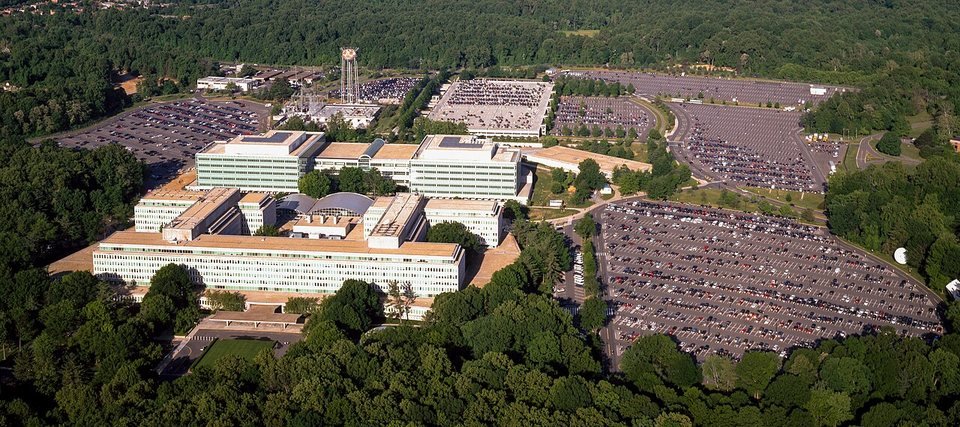
In the late 1980s, the CIA expanded its Langley headquarters, in Virginia, with a second large building, and set aside part of the budget for art on the grounds — as many American public works do. The Washington sculptor Jim Sanborn, born in 1945, won the commission in 1988, for 250 thousand dollars. He proposed a work about the house's own trade: gathering information, hiding information, revealing information.
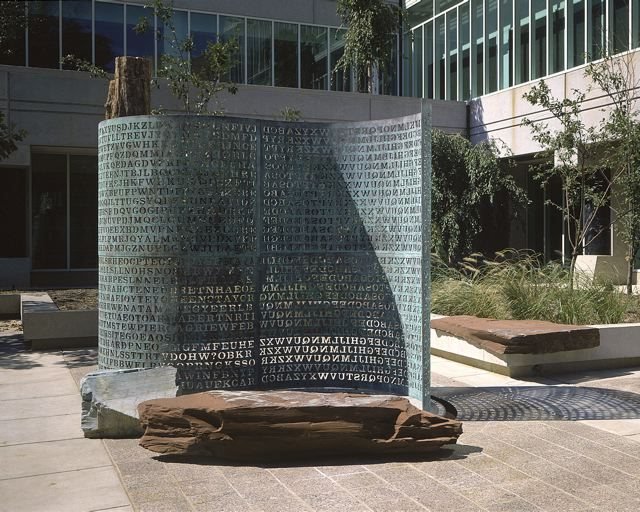
The result was finished in 1990 and dedicated on November 3, in the northwest corner of the courtyard of the New Headquarters Building, outside the cafeteria. It is called Kryptos — "hidden," in Greek. Those who work there pass it every day. Those who do not cannot get in: the courtyard lies inside one of the most heavily guarded areas in the United States. That is why this dossier is in the Sealed Archive pillar. The work is public only in the sense that its text has been photographed and circulates; the place is not.
01The sculptor and the cryptographer
Sanborn was not a cryptographer. To encrypt the text, the agency put him in touch with Edward Scheidt, who headed the CIA's Cryptographic Center and was retiring in 1989. Scheidt taught the sculptor classical cipher systems, "going back to Caesar," in his words, and Sanborn chose a few. The two agreed to compartmentalize the work: the plaintext messages were written by Sanborn, and the final encryption was also done by him. Scheidt knows the methods; it is not known whether he knows the full text of the fourth part. At the time, Scheidt rated the difficulty a nine on a scale of ten and estimated that the whole thing would fall in five to ten years.
The centerpiece is an S-shaped copper screen, reminiscent of a sheet coming out of a printer, perforated letter by letter. Around it, Sanborn placed water, plants, red and green granite, white quartz and the petrified wood log. Outside the entrance of the new building there are more elements: granite slabs with copper plates between them, on which phrases in Morse code can be read, and an engraved compass rose that points to a lodestone. No one has shown that these pieces help decipher the fourth message, but they are part of the work.
02What is engraved
The screen has two halves. The right one is a table of 26 shifted alphabets, a tool of the kind used in the Vigenère cipher, built on an alphabet that begins with the word KRYPTOS and continues with the remaining letters. It is the work's crudest clue, and it is genuine: the first two sections were encrypted with that alphabet.
The left half is the ciphertext, with no visible break between the sections. Today it is known how it divides. K1 and K2 use the Vigenère cipher with the KRYPTOS alphabet and two keywords, PALIMPSEST and ABSCISSA. K3 is a transposition: the right letters are there, out of order. K4 takes up the last lines, and this is where the method changes in nature — Sanborn and Scheidt have said, in interviews, that there was a deliberate change of methodology in the last part.
QQPRNGKSSOTWTQSJQSSEKZZWA
TJKLUDIAWINFBNYPVTTMZFPKW
GDKZXTJCDIGKUHUAUEKCAR There are 97 letters. Sanborn's four clues sit at positions 22 to 25 (FLRV), 26 to 34 (QQPRNGKSS), 64 to 69 (NYPVTT) and 70 to 74 (MZFPK). The transcription is text, reproduced here as a card, not a photograph of the work.
There are also errors, and they are part of the legend. The deciphered text has IQLUSION instead of illusion, UNDERGRUUND instead of underground and DESPARATLY instead of desperately; the keyword itself appears encrypted as PALIMPCEST in one stretch of the table. Sanborn says the misspellings are deliberate, and that much of what he does is full of intentional errors. Whether any of them is a clue to K4, no one has shown.
One error, however, was not deliberate. In April 2006, Sanborn admitted that he had left out a letter S when cutting K2. The omission changed the end of the message: the stretch read for seven years as ID BY ROWS became X LAYER TWO. He noted that, with about 1,800 letters cut by hand into the metal, a mistake could not be fixed once made.
03Three sections fall — and who got there first
The first solution was not public, which is why the story of who deciphered what has three versions that are best shown side by side.
- NSA, 1992–1993. A small team at the National Security Agency, led by Ken Miller and including Dennis McDaniels, solved K1, K2 and K3 at the end of 1992, according to later accounts. The agency only said, in March 2000, that its employees had solved the three parts. In 2013, a Freedom of Information Act request by the researcher Elonka Dunin released documents that date the complete solution to June 1993. The two dates describe the same work, at different stages.
- David Stein, CIA, 1998. An analyst at the CIA itself deciphered the three parts with pencil and paper, without a computer, and published the result in an internal intelligence-community journal. The public only learned of it in July 1999.
- Jim Gillogly, 1999. A computer scientist from Southern California solved the three parts with the help of a computer and announced it in June 1999. It was the first solution made public outside the government — his announcement is what led the CIA to reveal Stein's work.
By any criterion, the first solution belongs to the NSA, and the first public one to Gillogly. None of them made headway on K4, and Gillogly himself became one of the most cited students of the fourth part.
04What the first three say
K1 is a short, poetic sentence about the boundary between subtle shading and the absence of light, where "the nuance of iqlusion" lies. It conveys no information; it sets the tone.
K2 is the part that most fuels speculation. It speaks of something totally invisible, of information transmitted through the Earth's magnetic field and buried in an unknown location, asks whether Langley knows about it and says that only "WW" knows the exact location — the common reading: William Webster, the CIA director who dedicated the work. It ends with geographic coordinates that, read with a modern datum, fall about 50 meters southeast of the sculpture itself, on the headquarters grounds, and with the words corrected in 2006, "layer two."
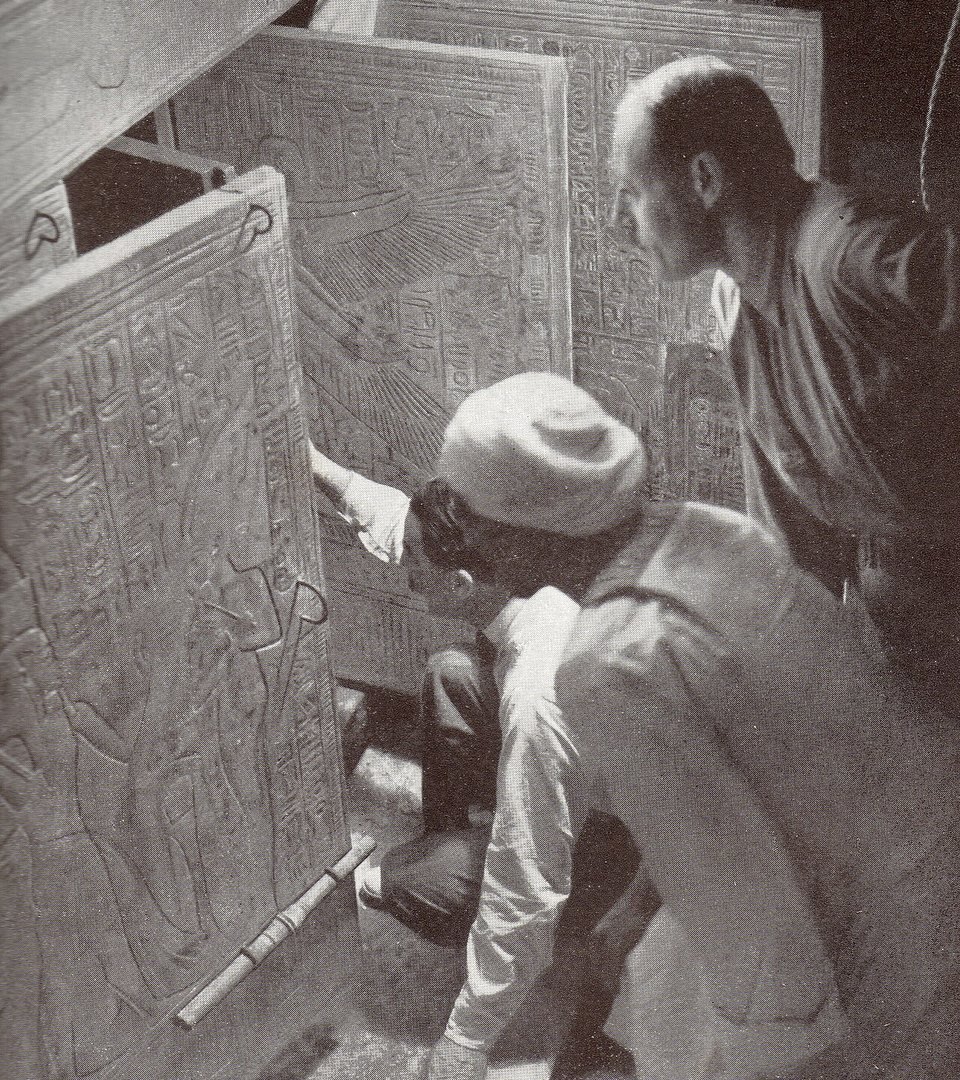
K3 is a paraphrase, with altered spelling, of Howard Carter's account of November 26, 1922, when he opened a small breach in the door of Tutankhamun's tomb, held up a candle and, asked whether he could see anything, answered yes. The choice is not arbitrary: it is archaeology's most famous scene about looking, for the first time, at what was hidden behind a wall.
05The artist's clues
Twenty years after the dedication, with no solution to K4 in sight, Sanborn began handing out pieces of the plaintext, always with the exact position. Each clue narrows the search space, and none has been enough.
- November 2010To the New York Times, on the work's 20th anniversary: letters 64 to 69, NYPVTT, decipher as BERLIN.
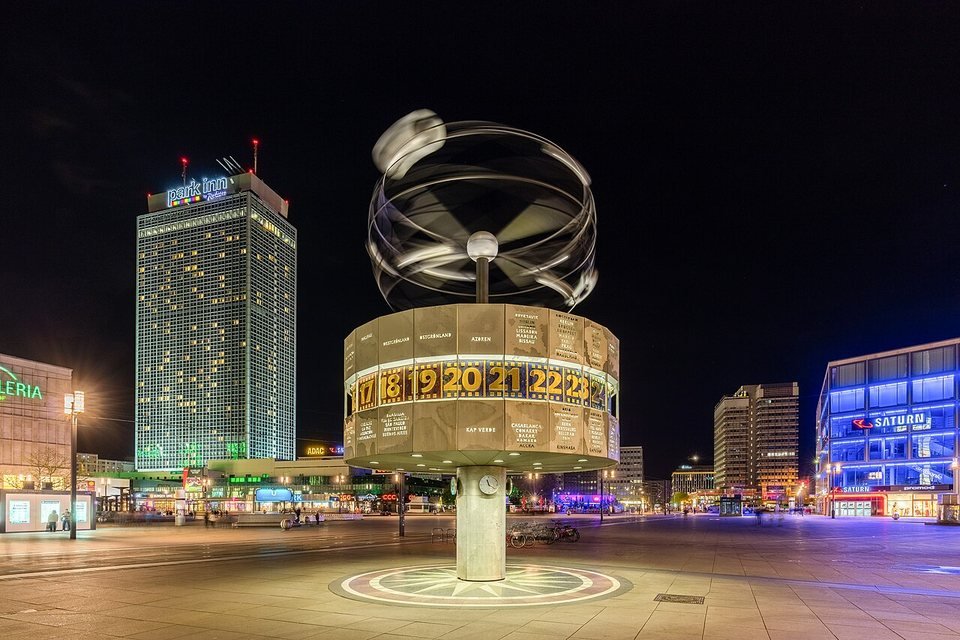
- November 2014Also to the Times: letters 70 to 74, MZFPK, are CLOCK. Together, BERLIN CLOCK. In 2025, Sanborn confirmed the reference is to the Berlin world clock.
- January 29, 2020Letters 26 to 34, QQPRNGKSS, are NORTHEAST.
- August 2020Letters 22 to 25, FLRV, are EAST. In sequence, that gives EAST NORTHEAST — a compass direction.
06Found in the archive, sold at auction
The turn that brings this dossier into the present begins in August 2025. Nearing his 80th birthday, Sanborn announced that he would put up for sale, through the American auction house RR Auction, his private archive on the work — including the K4 solution and the encryption system. In a letter, he explained that he no longer had the physical, mental or financial resources to go on being the keeper of the secret, and acknowledged that the decision would upset many people.
While the auction was being prepared, the unexpected happened. On September 3, 2025, the writer Jarett Kobek and the journalist and playwright Richard Byrne went to the Smithsonian's Archives of American Art, in Washington, where Sanborn had deposited papers from his career about two years earlier. Among them were five pages of scrambled text that the sculptor prepared in 1990 to show the CIA's history office that the message contained nothing offensive: sentences cut into strips and reassembled out of order. Using the public clues, the two reconstructed the K4 plaintext. Sanborn confirmed that it was correct. The story ran in the New York Times on October 16, 2025.
What came next is the less-known part. The Smithsonian restricted access to that material until 2075. Kobek and Byrne turned down a paid confidentiality agreement, said they do not intend to release the text and were warned by lawyers that releasing it could lead to a lawsuit. The two insist on a point this dossier considers central: they found the text, they did not break the cipher. The method — how the 97 plaintext letters became the 97 letters in the copper — remains unknown to them.
The auction closed on November 20, 2025. The estimate was 300 thousand to 500 thousand dollars; the lot sold for 962,500 dollars, to an anonymous buyer. It included the handwritten K4 plaintext, the encryption systems, alternative versions from 1988, the scrambled pages shown to the CIA and an afternoon with the artist to explain everything. Sanborn said he hoped the buyer would keep the fourth part secret.
On June 12, 2026, the buyer came forward: Paradigm, a cryptocurrency and technology investment firm. It announced that it has not read the answer and does not intend to. According to the company itself, Sanborn typed the plaintext into a new computer, which computed from it a one-way cryptographic fingerprint (a SHA-256 hash) and turned it, with a key held in a Google cloud service, into a verification tag; the text never left the device, which was then wiped. Anyone can submit a guess, at a cost of one dollar each, and the system says only whether it matches. The company also launched ten practice challenges, with prizes totaling 10 thousand dollars, and says it intends to release a K5 in the future — a fifth message of 97 characters that Sanborn says is linked to K4.
07The readings, from the most sober to the most improbable
K4 uses a different, layered method that no one has reconstructed
This is what both creators say and what the facts confirm: the techniques that opened K1 to K3 do not open K4, and the 24 clue letters rule out simple variations of Vigenère and transposition. Scheidt has spoken of a "masking" technique applied before the cipher, to hide the pattern of the text. What is not known is the recipe.
The K4 text talks about Berlin, the Wall and a direction
The known words — EAST NORTHEAST, BERLIN CLOCK — the confirmation that the clock is the one at Alexanderplatz, in the former East Berlin, and the date — the Wall fell a year before the dedication — lead many students of the work to read there a text about the end of the Cold War. It is a reading of the content, not of the cipher, and it remains incomplete without the other 73 letters.
The key lies in the work's other elements
The K2 coordinates, the compass rose, the lodestone and the Morse phrases at the entrance suggest to many amateurs that the solution requires being physically at Langley. There is no demonstration that any of these pieces enters into the encryption method.
The 2025 find "solved" Kryptos
It was the headline in many outlets, and the discoverers themselves reject it. They recovered the plaintext from scrambled drafts; they did not retrace the path from the copper to the text. For cryptography, the problem the work poses still stands.
A secret message from the CIA itself, planted in the sculpture
The text is Sanborn's, not the agency's. The CIA did not receive the solution: what the sculptor showed in 1990 were the scrambled pages, made precisely to prove the message was not offensive without revealing it in full.
08Chronology
- 1988The CIA commissions the work from Jim Sanborn, for 250 thousand dollars. Ed Scheidt, of the Cryptographic Center, teaches him the cipher systems.
- 1989Scheidt retires as head of the Cryptographic Center. In November, the Berlin Wall falls.
- November 3, 1990Kryptos is dedicated in the courtyard of the New Headquarters Building, in Langley.
- late 1992 – June 1993An NSA team solves K1, K2 and K3, without disclosing it.
- 1998David Stein, a CIA analyst, solves the three parts with pencil and paper and publishes in an internal journal.
- June 1999Jim Gillogly publicly announces the solution of K1 to K3, done by computer.
- July 1999The CIA reveals Stein's solution.
- March 2000The NSA says its employees had already solved the three parts.
- April 2006Sanborn reveals the letter left out of K2: the ending becomes X LAYER TWO.
- November 2010First K4 clue: BERLIN.
- 2013NSA documents released at the request of Elonka Dunin date the solution to June 1993.
- November 2014Second clue: CLOCK.
- January 29, 2020Third clue: NORTHEAST.
- August 2020Fourth clue: EAST.
- August 2025Sanborn announces the auction of the archive and of the K4 solution.
- September 3, 2025Jarett Kobek and Richard Byrne find, at the Smithsonian's Archives of American Art, the scrambled pages that lead to the plaintext.
- October 16, 2025The New York Times publishes the find; the auction opens the same day. The Smithsonian restricts the material until 2075.
- November 20, 2025The archive is sold for 962,500 dollars to an anonymous buyer.
- June 12, 2026Paradigm comes forward as the buyer, launches a checker that does not reveal the answer and announces it will release K5.
09What remains open
The K4 method. It is the question the work asked in 1990 and that no archival find has answered. A real solution will need to show the path, not just the destination — and now there is a checker to confirm the destination.
The plaintext, publicly. It is in a digital vault, in an archive restricted until 2075 and in the memory of a few people. Whether or when it will be published depends on decisions by those who bought it and those who found it — not on cryptography.
K5. Sanborn says there is a fifth message, also of 97 characters, linked to K4 and scattered across other works of his. Nothing of it had been shown as of October 2026.
The errors. Which misspellings are deliberate, and whether any of them carries information, only the artist knows. To date, none has been shown to be a clue.
10Frequently asked questions
What is Kryptos?
A sculpture by Jim Sanborn dedicated on November 3, 1990 in the courtyard of the CIA's New Headquarters Building, in Langley, Virginia. The centerpiece is a copper screen with 869 encrypted characters, divided into four sections, K1 to K4. See the sculptor and the cryptographer.
Has Kryptos been solved?
Three parts have: K1, K2 and K3 were solved by the NSA in 1992–1993, by David Stein, of the CIA, in 1998, and publicly by Jim Gillogly in 1999. K4 has not: in 2025 its plaintext was found in an archive, but the method remains unknown, and no public cryptographic solution had been confirmed as of October 2026. See found in the archive, sold at auction.
What is known about K4?
It has 97 characters and uses a different, layered method from the other parts. Sanborn handed out 24 letters as clues, between 2010 and 2020: EAST NORTHEAST and BERLIN CLOCK — and the clock, he confirmed in 2025, is the Berlin world clock. See the artist's clues.
What do the deciphered messages say?
K1 is a poetic sentence about the boundary between shading and the absence of light. K2 speaks of information buried in an unknown location and ends with coordinates near the sculpture itself. K3 paraphrases Howard Carter opening Tutankhamun's tomb. See what the first three say.
11Sources consulted
This dossier is original writing. The sources below were consulted to verify dates, figures and attributions; none was reproduced.
- Consolidated encyclopedia entries on Kryptos, Jim Sanborn and Edward Scheidt — commission, components, methods of K1 to K3, solutions, clues and the 2006 correction.
- National Security Agency (NSA) — documents on the solution of K1 to K3, released in 2013 at the request of Elonka Dunin.
- The New York Times — reports on the clues BERLIN (November 2010), CLOCK (November 2014) and NORTHEAST (January 2020), and on the find at the Smithsonian (October 16, 2025).
- Smithsonian Magazine — reports on the 2020 clues and on the auction announcement, 2025.
- RR Auction — catalog of the Decoding History auction (October 16 to November 20, 2025); note on the result; note "Kryptos K4: Discovered, Not Solved".
- Puzzculture — The Kryptos Solution is Auctioned Off… But the Mystery is Far From Over!, December 16, 2025.
- Robinson, D.; Huang, M. — Project Kryptos, Paradigm, June 12, 2026, and the pages on the checker and on the history of the work on the same site.
- Carter, H.; Mace, A. C. — The Tomb of Tut.ankh.Amen, vol. 1, 1923 — the account paraphrased in K3.